QUESTION IMAGE
Question
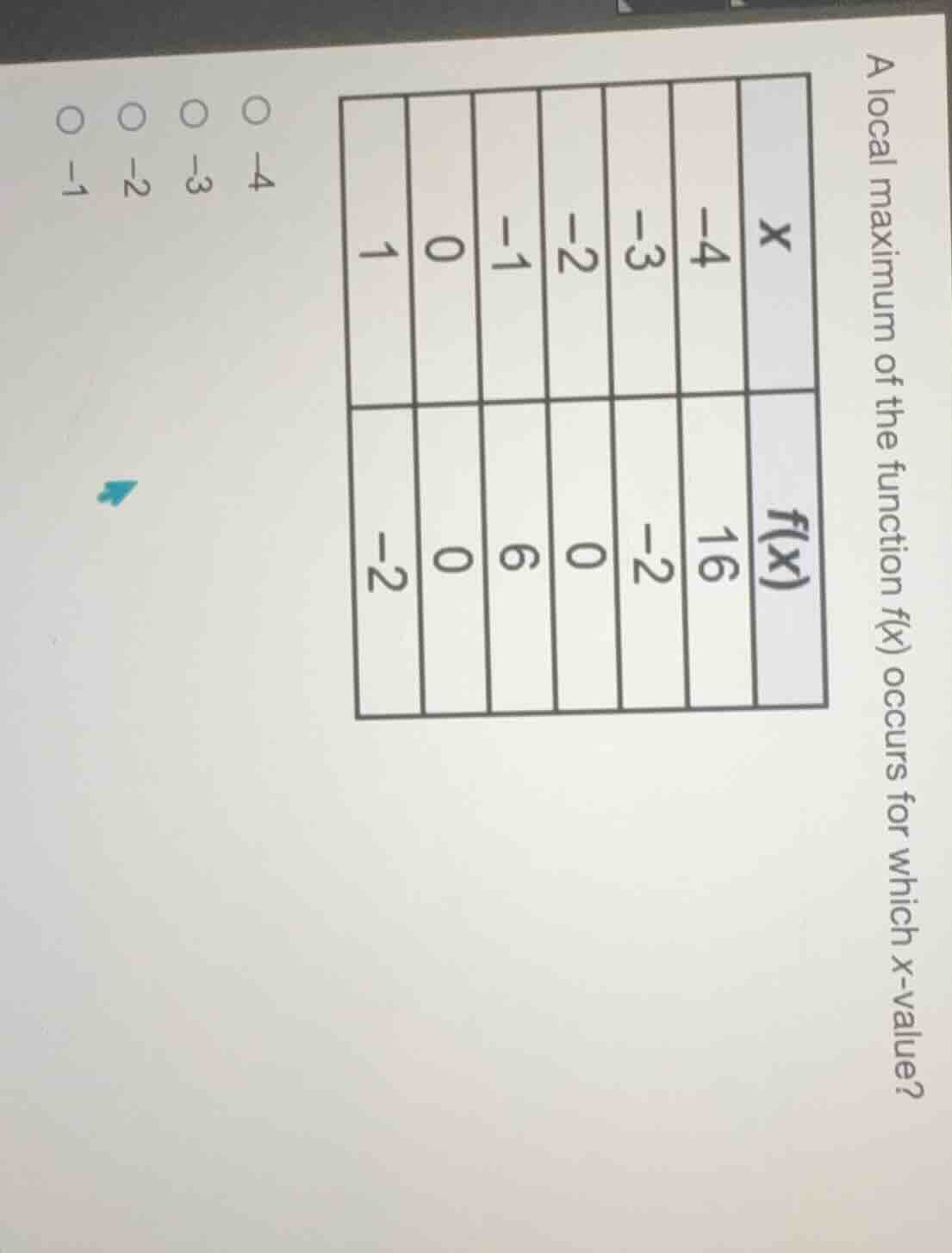
a local maximum of the function f(x) occurs for which x - value?
| x | - 4 | - 3 | - 2 | - 1 | 0 | 1 |
| f(x) | 16 | - 2 | 0 | 6 | 0 | - 2 |
options: - 4, - 3, - 2, - 1
Step1: Recall local maximum definition
A local maximum at \( x = a \) means \( f(a) \) is greater than \( f(x) \) for \( x \) near \( a \).
Step2: Analyze each x-value
- For \( x = -4 \): \( f(-4) = 16 \). Check neighbors (but no left neighbor, right neighbor \( x = -3 \), \( f(-3) = -2 \). \( 16 > -2 \), but check other points.
- For \( x = -3 \): \( f(-3) = -2 \), less than \( f(-4) \) and \( f(-1) = 6 \).
- For \( x = -2 \): \( f(-2) = 0 \), less than \( f(-1) = 6 \).
- For \( x = -1 \): \( f(-1) = 6 \). Left neighbor \( x = -2 \), \( f(-2) = 0 \); right neighbor \( x = 0 \), \( f(0) = 0 \). \( 6 > 0 \) (both sides). But compare with \( x = -4 \), \( f(-4)=16 > 6 \).
- For \( x = 0 \): \( f(0) = 0 \), less than \( f(-1) \) and \( f(1) = -2 \).
- For \( x = 1 \): \( f(1) = -2 \), less than neighbors.
Wait, re - evaluate \( x=-4 \): Left side has no value, right side \( x = - 3 \), \( f(-3)=-2 \). Now check if there's a higher value. \( f(-4) = 16 \), which is higher than all other \( f(x) \) values (16 > 6, 16 > 0, 16 > - 2). But wait, local maximum is a peak in its neighborhood. For \( x=-4 \), the neighborhood (right side) has \( f(-3)=-2 \), so \( f(-4) \) is a local maximum? Wait, no, maybe I made a mistake. Wait, the function values: \( x=-4 \), \( f(x)=16 \); \( x = - 3 \), \( f(x)=-2 \); \( x=-2 \), \( f(x)=0 \); \( x=-1 \), \( f(x)=6 \); \( x = 0 \), \( f(x)=0 \); \( x = 1 \), \( f(x)=-2 \).
Wait, actually, when \( x=-4 \), the function value is 16, and the next point \( x=-3 \) has \( f(x)=-2 \). Now, for \( x=-1 \), \( f(x)=6 \), with left \( x=-2 \) (0) and right \( x = 0 \) (0), so it's a local maximum, but \( f(-4)=16 \) is higher. Wait, maybe the table is misread? Wait the table:
| x | -4 | -3 | -2 | -1 | 0 | 1 |
|---|
Now, for \( x=-4 \), since there's no left neighbor, we check the right neighbor (\( x=-3 \), \( f=-2 \)). \( 16 > -2 \). For \( x=-1 \), left (\( x=-2 \), \( f = 0 \)) and right (\( x = 0 \), \( f = 0 \)), so \( f(-1)=6 \) is a local maximum, but \( f(-4)=16 \) is higher. Wait, but maybe the question has a typo? No, wait, the options are - 4, - 3, - 2, - 1. Wait, the initial analysis: \( f(-4)=16 \), which is the highest value. But let's check the definition again. A local maximum is a point where \( f(c)\geq f(x) \) for \( x \) in an open interval around \( c \). For \( x=-4 \), the open interval around it (since it's the left - most point) would be \( (-5,-3) \) (hypothetical), and in the domain given, the right neighbor is \( x=-3 \). Since \( f(-4)=16 > f(-3)=-2 \), and there's no left neighbor, in the context of the given table (where the domain is \( x=-4,-3,-2,-1,0,1 \)), \( x = - 4 \) has \( f(x)=16 \), which is greater than its only neighbor (right) \( x=-3 \) with \( f(x)=-2 \). And when we compare with \( x=-1 \), \( f(-1)=6 < 16 \). So the local maximum occurs at \( x=-4 \).

Snap & solve any problem in the app
Get step-by-step solutions on Sovi AI
Photo-based solutions with guided steps
Explore more problems and detailed explanations
\(-4\)