QUESTION IMAGE
Question
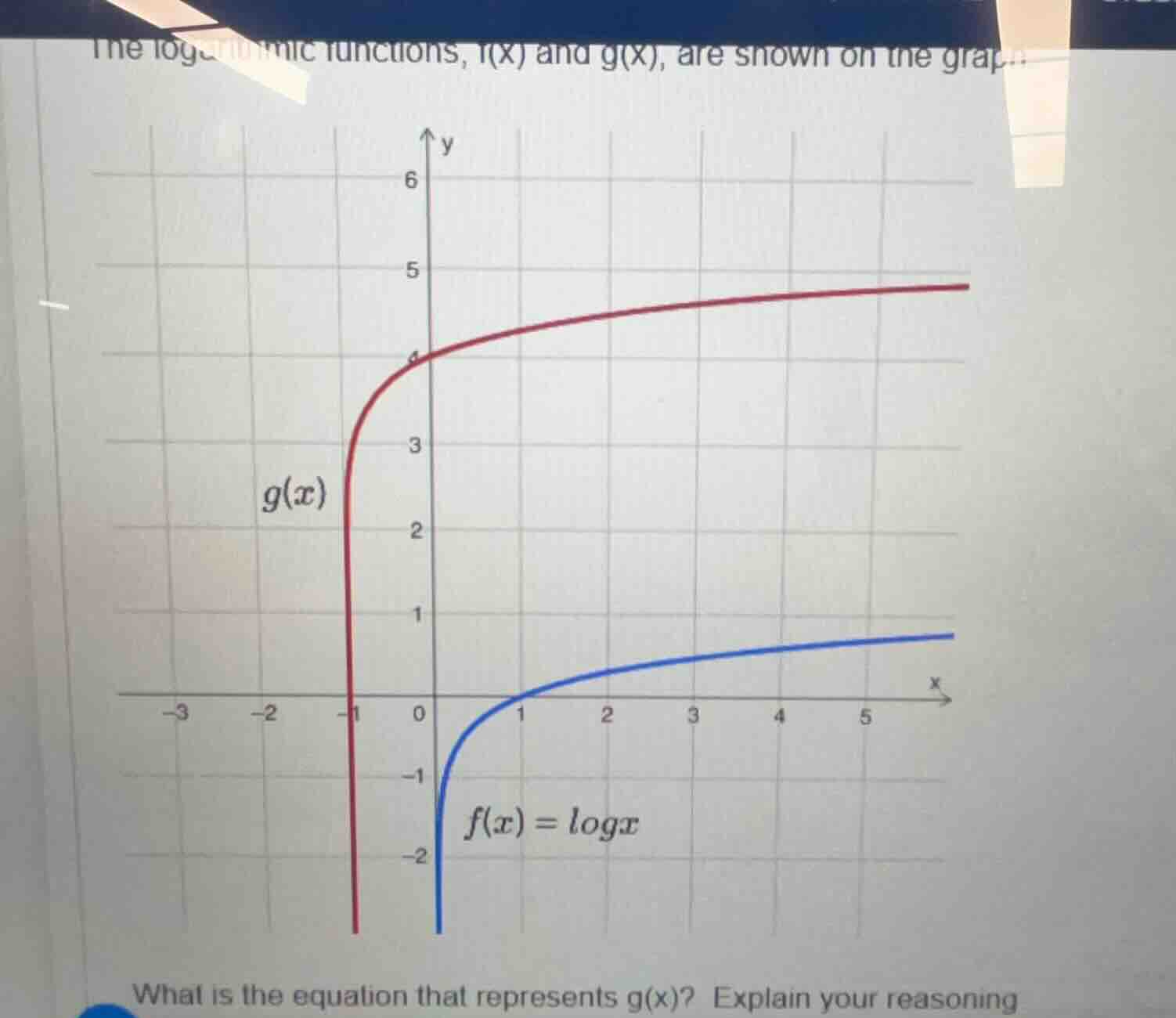
the logarithmic functions, f(x) and g(x), are shown on the graph.
what is the equation that represents g(x)? explain your reasoning
Step1: Identify parent function
The parent function is $f(x) = \log x$, which passes through $(1, 0)$.
Step2: Analyze vertical shift of $g(x)$
The graph of $g(x)$ passes through $(0, 4)$. For the parent function, when we shift it vertically up by 4 units, we get $y = \log x + 4$, but we also check horizontal shift. Wait, no—notice $g(x)$ at $x=1$ has $g(1)=4$, while $f(1)=0$. So the vertical shift is 4. Also, check the domain: $f(x)$ has domain $x>0$, $g(x)$ has domain $x>0$ as well? No, wait no—wait $g(x)$ is shifted vertically up, and also, wait no: when $x=1$, $g(1)=4$, $f(1)=0$, so $g(1) = f(1) + 4$. For any $x$, $g(x) = \log x + 4$? Wait no, wait at $x$ approaching 0 from right, $f(x)$ approaches $-\infty$, $g(x)$ approaches $+\infty$? No, wait no—wait $g(x)$ is a vertical shift up by 4? No, wait no, actually, $g(x) = \log x + 4$ would approach $-\infty$ as $x\to0^+$, but $g(x)$ approaches $+\infty$? Wait no, no, wait the graph of $g(x)$ is $f(x)$ shifted up by 4, but also, wait no—wait $f(x) = \log x$, so $g(x) = \log x + 4$ is equivalent to $g(x) = \log(10^4 x) = \log(10000x)$, but no, the vertical shift is simpler. Wait, let's take the point $(1,4)$: $f(1)=0$, so $g(1)=0+4=4$. The shape is identical, just shifted vertically up by 4 units.
Step3: Confirm the transformation
A vertical shift up by $k$ units transforms $f(x)$ to $f(x)+k$. Here $k=4$, so $g(x) = \log x + 4$. We can also write this as $g(x) = \log(10^4 x) = \log(10000x)$, but the vertical shift form is more direct from the graph.

Snap & solve any problem in the app
Get step-by-step solutions on Sovi AI
Photo-based solutions with guided steps
Explore more problems and detailed explanations
$g(x) = \log x + 4$ (or equivalent form $g(x) = \log(10000x)$)
Reasoning: The graph of $g(x)$ is the graph of $f(x)=\log x$ shifted vertically upward by 4 units. This is confirmed by the fact that every $y$-value of $g(x)$ is 4 greater than the corresponding $y$-value of $f(x)$ (e.g., $f(1)=0$ and $g(1)=4$), and the overall shape of the logarithmic curve is preserved, indicating only a vertical translation.