QUESTION IMAGE
Question
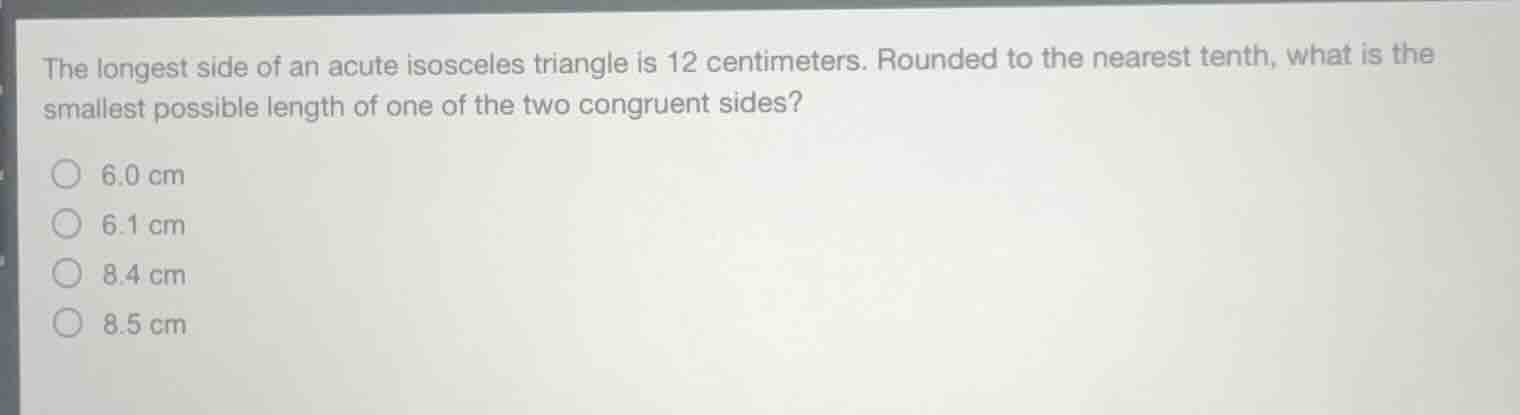
the longest side of an acute isosceles triangle is 12 centimeters. rounded to the nearest tenth, what is the smallest possible length of one of the two congruent sides?
6.0 cm
6.1 cm
8.4 cm
8.5 cm
Step1: Recall triangle inequality and acute triangle conditions
For an isosceles triangle with congruent sides \(a\) and base \(b = 12\) (since it's the longest side), the triangle inequality gives \(2a>b\), so \(2a > 12\) or \(a>6\). For it to be acute, the square of the longest side must be less than the sum of the squares of the other two sides. So \(b^{2}<2a^{2}\), substituting \(b = 12\), we get \(12^{2}<2a^{2}\), i.e., \(144 < 2a^{2}\), then \(a^{2}>72\), so \(a>\sqrt{72}\approx8.485\). But we need the smallest possible \(a\) (rounded to nearest tenth) that satisfies both. Wait, wait, maybe I mixed up. Wait, in an acute isosceles triangle, if the base is the longest side, then the vertex angle is acute. The condition for acute: \(b^{2}<2a^{2}\). But also, if the equal sides were the longest, but here the longest side is 12, so it's the base. So we have \(2a>12\) (triangle inequality) and \(12^{2}
Step2: Evaluate the options
- Option 6.0: \(6.0\) is less than \(\sqrt{72}\), so invalid (not acute).
- Option 6.1: Also less than \(\sqrt{72}\), invalid.
- Option 8.4: \(8.4^{2}=70.56\), \(2\times8.4^{2}=141.12\), and \(12^{2}=144\). But \(144>141.12\), so \(12^{2}>2\times8.4^{2}\), which would make the triangle obtuse (since if \(c^{2}>a^{2}+b^{2}\), it's obtuse). So 8.4 is invalid.
- Option 8.5: \(8.5^{2}=72.25\), \(2\times8.5^{2}=144.5\). \(12^{2}=144\), and \(144<144.5\), so it satisfies the acute condition. Also, \(2\times8.5 = 17>12\), so triangle inequality holds. And it's the smallest among the options that satisfies the acute condition (since 8.4 is too small as shown).

Snap & solve any problem in the app
Get step-by-step solutions on Sovi AI
Photo-based solutions with guided steps
Explore more problems and detailed explanations
D. 8.5 cm