QUESTION IMAGE
Question
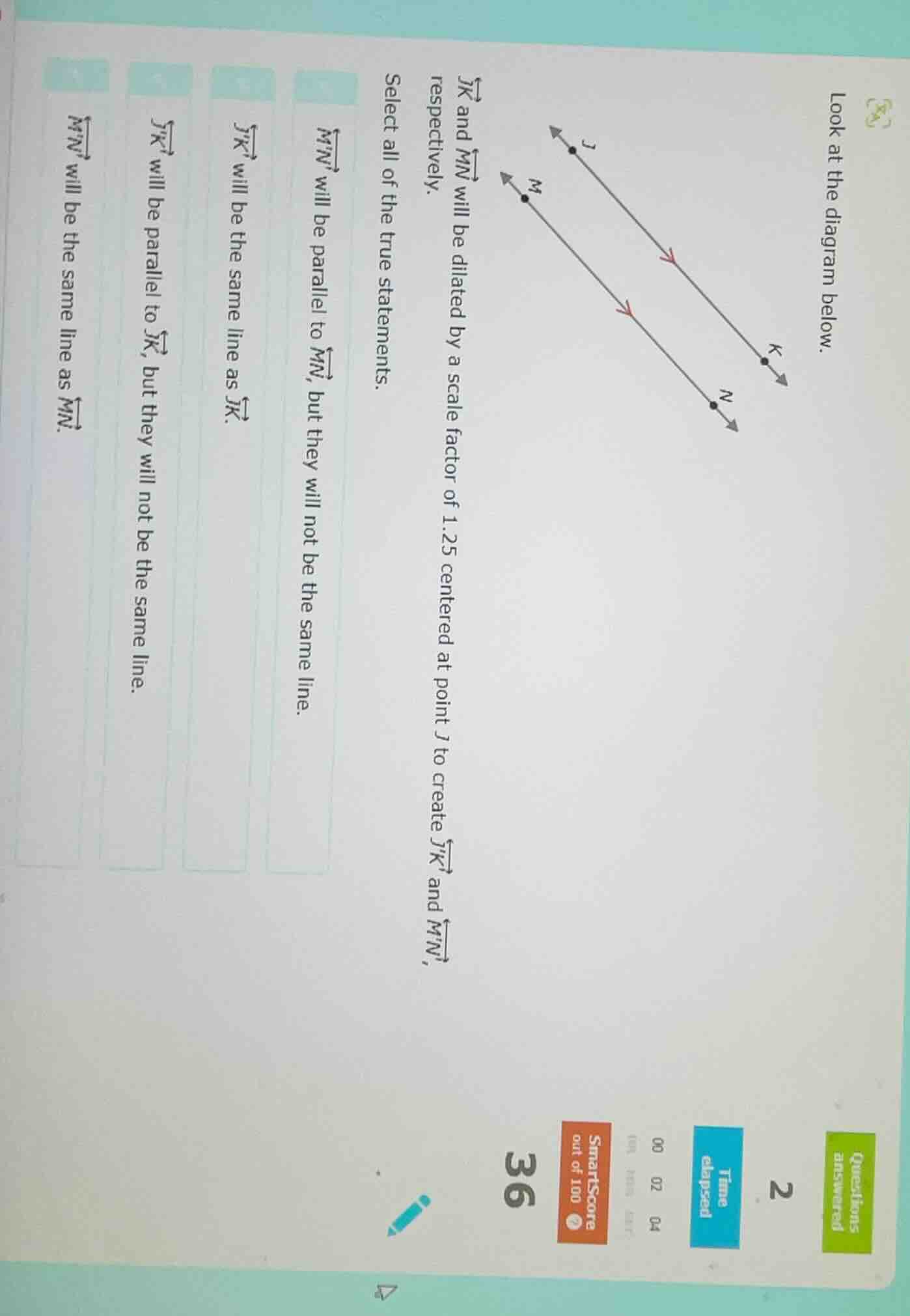
look at the diagram below.\\(overrightarrow{jk}\\) and \\(overrightarrow{mw}\\) will be dilated by a scale factor of 1.25 centered at point \\(j\\) to create \\(overrightarrow{jk}\\) and \\(overrightarrow{mw}\\), respectively.\\(\\)select all of the true statements.\\(\\)\\(overrightarrow{mw}\\) will be parallel to \\(overrightarrow{mw}\\), but they will not be the same line.\\(\\)\\(overrightarrow{jk}\\) will be the same line as \\(overrightarrow{jk}\\).\\(\\)\\(overrightarrow{jk}\\) will be parallel to \\(overrightarrow{jk}\\), but they will not be the same line.\\(\\)\\(overrightarrow{mw}\\) will be the same line as \\(overrightarrow{mw}\\).
- Recall the property of dilation: A dilation preserves the parallelism of lines. So, if we dilate \(\overleftrightarrow{JK}\) and \(\overleftrightarrow{MW}\) centered at \(J\), the image of \(\overleftrightarrow{JK}\) (which is \(\overleftrightarrow{J'K'}\)) should be the same line as \(\overleftrightarrow{JK}\) because the center of dilation is on \(\overleftrightarrow{JK}\), so dilating a line with a center on the line leaves the line unchanged (same line).
- For \(\overleftrightarrow{MW}\) and its image \(\overleftrightarrow{M'W'}\): Since dilation preserves parallelism, \(\overleftrightarrow{M'W'}\) will be parallel to \(\overleftrightarrow{MW}\), but since the center of dilation is \(J\) (not on \(\overleftrightarrow{MW}\) initially, looking at the diagram), the image \(\overleftrightarrow{M'W'}\) will not be the same line as \(\overleftrightarrow{MW}\), but parallel. Wait, no, wait: Wait, the original lines \(\overleftrightarrow{JK}\) and \(\overleftrightarrow{MW}\) are parallel (from the diagram, they are two parallel lines). When we dilate \(\overleftrightarrow{JK}\) centered at \(J\), the image \(\overleftrightarrow{J'K'}\) is the same line as \(\overleftrightarrow{JK}\) (because the center is on the line, so dilation doesn't change the line, just the points on it). For \(\overleftrightarrow{MW}\), dilating it centered at \(J\) (a point not on \(\overleftrightarrow{MW}\)) will produce a line \(\overleftrightarrow{M'W'}\) that is parallel to \(\overleftrightarrow{MW}\) (since dilation preserves parallelism) but not the same line (because the center is not on \(\overleftrightarrow{MW}\)). Wait, but the options: Let's re - examine the options:
Option 1: \(\overleftrightarrow{M'W'}\) will be parallel to \(\overleftrightarrow{MW}\), but they will not be the same line. This is correct because dilation preserves parallelism, and since the center \(J\) is not on \(\overleftrightarrow{MW}\), the image line is parallel but distinct.
Option 2: \(\overleftrightarrow{J'K'}\) will be the same line as \(\overleftrightarrow{JK}\). This is correct because the center of dilation \(J\) lies on \(\overleftrightarrow{JK}\), so dilating a line with a center on the line results in the same line.
Option 3: \(\overleftrightarrow{J'K'}\) will be parallel to \(\overleftrightarrow{JK}\), but they will not be the same line. This is incorrect because, as the center is on \(\overleftrightarrow{JK}\), the image line is the same as the original.
Option 4: \(\overleftrightarrow{M'W'}\) will be the same line as \(\overleftrightarrow{MW}\). This is incorrect because the center \(J\) is not on \(\overleftrightarrow{MW}\), so the dilated line is parallel but not the same.
Wait, maybe I misread the options. Let's list the options again:
- \(\overleftrightarrow{M'W'}\) will be parallel to \(\overleftrightarrow{MW}\), but they will not be the same line. (Correct, because dilation preserves parallelism, and center not on \(MW\) so different line but parallel)
- \(\overleftrightarrow{J'K'}\) will be the same line as \(\overleftrightarrow{JK}\). (Correct, because center \(J\) is on \(JK\), so dilating \(JK\) centered at \(J\) gives the same line)
- \(\overleftrightarrow{J'K'}\) will be parallel to \(\overleftrightarrow{JK}\), but they will not be the same line. (Incorrect, since center is on \(JK\), it's the same line)
- \(\overleftrightarrow{M'W'}\) will be the same line as \(\overleftrightarrow{MW}\). (Incorrect, as center not on \(MW\), so parallel but different line)
So the true statements are: \(\overleftrightarrow{J'K'}\) will be the same line a…

Snap & solve any problem in the app
Get step-by-step solutions on Sovi AI
Photo-based solutions with guided steps
Explore more problems and detailed explanations
- \(\overleftrightarrow{J'K'}\) will be the same line as \(\overleftrightarrow{JK}\)
- \(\overleftrightarrow{M'W'}\) will be parallel to \(\overleftrightarrow{MW}\), but they will not be the same line