QUESTION IMAGE
Question
look at this diagram:
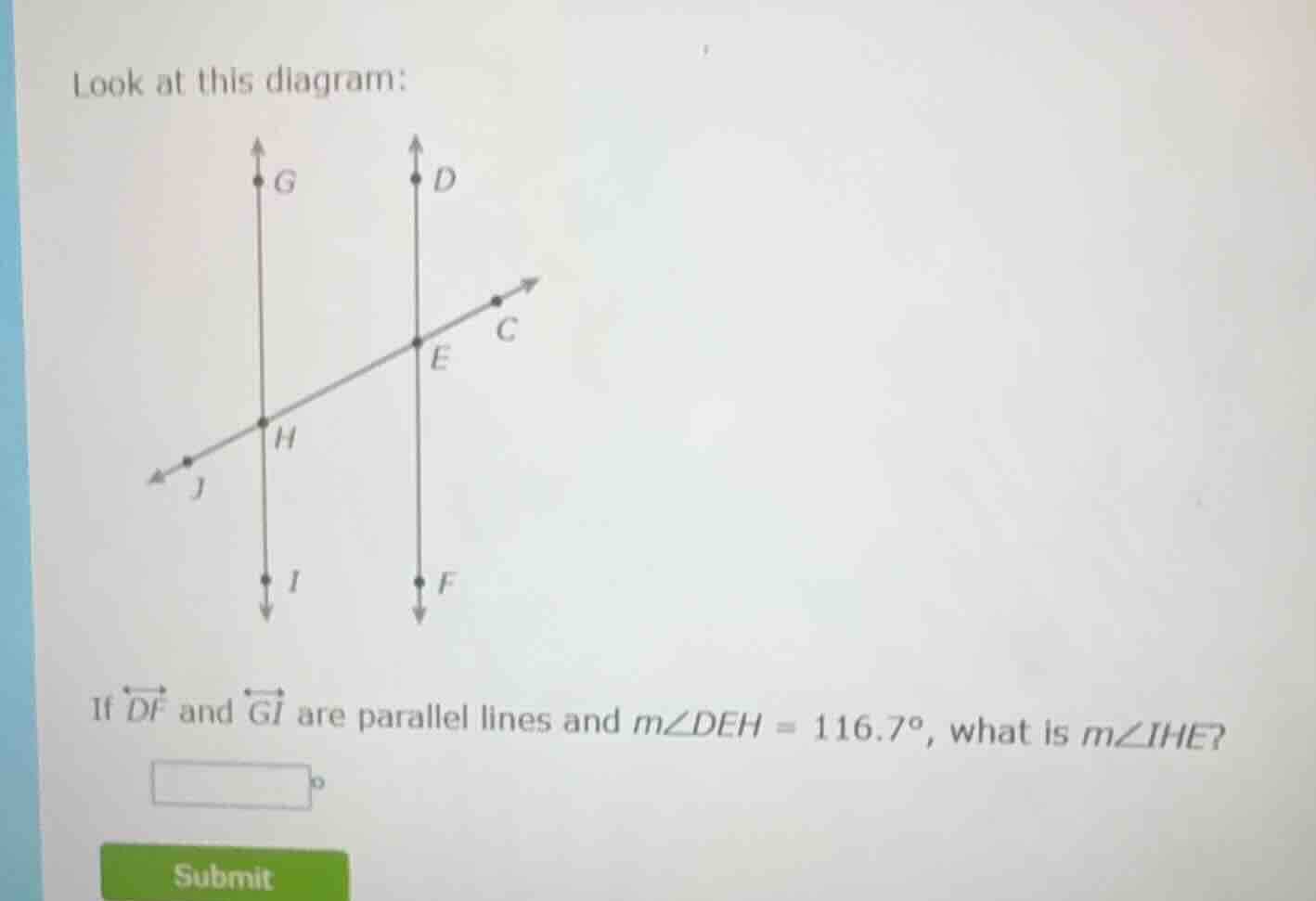
diagram of parallel lines df and gi, and transversal jc intersecting them at e and h, with points g, i on gi; d, f on df; j, h, e, c on jc
if \\( \overleftrightarrow{df} \\) and \\( \overleftrightarrow{gi} \\) are parallel lines and \\( m\angle deh = 116.7^\circ \\), what is \\( m\angle ihe \\)?
blank box\\( ^\circ \\)
submit
Step1: Identify consecutive interior angles
$\overleftrightarrow{DF} \parallel \overleftrightarrow{GI}$, transversal $\overleftrightarrow{JC}$ creates consecutive interior angles $\angle DEH$ and $\angle IHE$. These angles are supplementary.
Step2: Calculate $\angle IHE$
Use supplementary angle sum: $m\angle IHE = 180^\circ - m\angle DEH$
Substitute value: $m\angle IHE = 180^\circ - 116.7^\circ$

Snap & solve any problem in the app
Get step-by-step solutions on Sovi AI
Photo-based solutions with guided steps
Explore more problems and detailed explanations
$63.3^\circ$