QUESTION IMAGE
Question
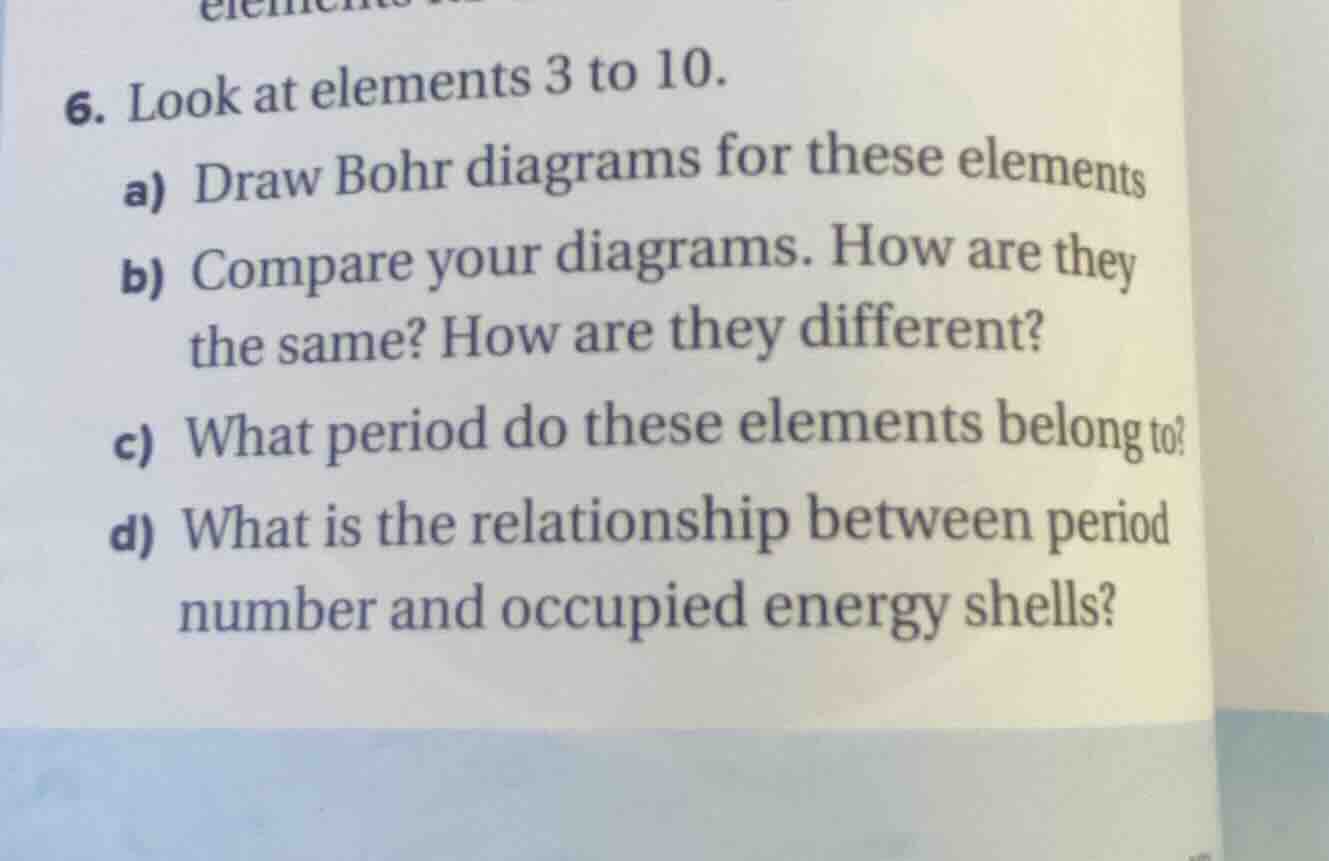
- look at elements 3 to 10.
a) draw bohr diagrams for these elements
b) compare your diagrams. how are they
the same? how are they different?
c) what period do these elements belong to?
d) what is the relationship between period
number and occupied energy shells?
Part (a) Drawing Bohr Diagrams
Elements 3 (Lithium, \( \text{Li} \)) to 10 (Neon, \( \text{Ne} \)) have the following Bohr diagrams:
- Lithium (Li, Atomic Number = 3):
- Nucleus: 3 protons (+), 4 neutrons (neutral).
- Energy shells:
- 1st shell (\( n=1 \)): Holds 2 electrons (max for \( n=1 \)).
- 2nd shell (\( n=2 \)): Holds 1 electron.
- Beryllium (Be, Atomic Number = 4):
- Nucleus: 4 protons, 5 neutrons.
- 1st shell: 2 electrons.
- 2nd shell: 2 electrons.
- Boron (B, Atomic Number = 5):
- Nucleus: 5 protons, 6 neutrons.
- 1st shell: 2 electrons.
- 2nd shell: 3 electrons.
- Carbon (C, Atomic Number = 6):
- Nucleus: 6 protons, 6 neutrons.
- 1st shell: 2 electrons.
- 2nd shell: 4 electrons.
- Nitrogen (N, Atomic Number = 7):
- Nucleus: 7 protons, 7 neutrons.
- 1st shell: 2 electrons.
- 2nd shell: 5 electrons.
- Oxygen (O, Atomic Number = 8):
- Nucleus: 8 protons, 8 neutrons.
- 1st shell: 2 electrons.
- 2nd shell: 6 electrons.
- Fluorine (F, Atomic Number = 9):
- Nucleus: 9 protons, 10 neutrons.
- 1st shell: 2 electrons.
- 2nd shell: 7 electrons.
- Neon (Ne, Atomic Number = 10):
- Nucleus: 10 protons, 10 neutrons.
- 1st shell: 2 electrons.
- 2nd shell: 8 electrons (full outer shell).
Part (b) Comparing the Diagrams
- Similarities:
- All have 2 electrons in the 1st (innermost) energy shell (since \( n=1 \) holds a maximum of 2 electrons).
- All have electrons in the 2nd energy shell (outer shell) as well.
- The nucleus contains protons and neutrons, and electrons orbit in shells.
- Differences:
- Number of protons/neutrons in the nucleus (increases from 3 to 10 protons).
- Number of electrons in the 2nd shell (increases from 1 to 8: Li=1, Be=2, B=3, C=4, N=5, O=6, F=7, Ne=8).
- Neon (Ne) has a full 2nd shell (8 electrons), making it stable (noble gas), while others have partially filled outer shells.
Part (c) Period of the Elements
Elements in the periodic table are arranged in periods (horizontal rows) based on the number of occupied energy shells (electron shells).
- Elements 3–10 (Li to Ne) all have electrons in 2 energy shells:
- 1st shell (filled with 2 electrons).
- 2nd shell (with 1–8 electrons).
Thus, they belong to Period 2 (since the number of occupied shells = period number).
Part (d) Relationship Between Period Number and Occupied Energy Shells
The period number of an element in the periodic table is equal to the number of occupied energy shells (electron shells) it has.
- For Period 2 elements (Li–Ne), there are 2 occupied shells:
- 1st shell (inner shell, filled with 2 electrons).
- 2nd shell (outer shell, with 1–8 electrons).
In general, for any element, the period number = number of occupied electron shells. For example:
- Period 1 elements (H, He) have 1 occupied shell.
- Period 3 elements (Na–Ar) have 3 occupied shells.
Final Answers (Summarized)
a) [Bohr diagrams as described above]
b) Same: 2 electrons in 1st shell; Different: Varying outer-shell electrons, nuclear particles.
c) \(\boldsymbol{\text{Period 2}}\)
d) Period number = number of occupied energy shells.

Snap & solve any problem in the app
Get step-by-step solutions on Sovi AI
Photo-based solutions with guided steps
Explore more problems and detailed explanations
Part (a) Drawing Bohr Diagrams
Elements 3 (Lithium, \( \text{Li} \)) to 10 (Neon, \( \text{Ne} \)) have the following Bohr diagrams:
- Lithium (Li, Atomic Number = 3):
- Nucleus: 3 protons (+), 4 neutrons (neutral).
- Energy shells:
- 1st shell (\( n=1 \)): Holds 2 electrons (max for \( n=1 \)).
- 2nd shell (\( n=2 \)): Holds 1 electron.
- Beryllium (Be, Atomic Number = 4):
- Nucleus: 4 protons, 5 neutrons.
- 1st shell: 2 electrons.
- 2nd shell: 2 electrons.
- Boron (B, Atomic Number = 5):
- Nucleus: 5 protons, 6 neutrons.
- 1st shell: 2 electrons.
- 2nd shell: 3 electrons.
- Carbon (C, Atomic Number = 6):
- Nucleus: 6 protons, 6 neutrons.
- 1st shell: 2 electrons.
- 2nd shell: 4 electrons.
- Nitrogen (N, Atomic Number = 7):
- Nucleus: 7 protons, 7 neutrons.
- 1st shell: 2 electrons.
- 2nd shell: 5 electrons.
- Oxygen (O, Atomic Number = 8):
- Nucleus: 8 protons, 8 neutrons.
- 1st shell: 2 electrons.
- 2nd shell: 6 electrons.
- Fluorine (F, Atomic Number = 9):
- Nucleus: 9 protons, 10 neutrons.
- 1st shell: 2 electrons.
- 2nd shell: 7 electrons.
- Neon (Ne, Atomic Number = 10):
- Nucleus: 10 protons, 10 neutrons.
- 1st shell: 2 electrons.
- 2nd shell: 8 electrons (full outer shell).
Part (b) Comparing the Diagrams
- Similarities:
- All have 2 electrons in the 1st (innermost) energy shell (since \( n=1 \) holds a maximum of 2 electrons).
- All have electrons in the 2nd energy shell (outer shell) as well.
- The nucleus contains protons and neutrons, and electrons orbit in shells.
- Differences:
- Number of protons/neutrons in the nucleus (increases from 3 to 10 protons).
- Number of electrons in the 2nd shell (increases from 1 to 8: Li=1, Be=2, B=3, C=4, N=5, O=6, F=7, Ne=8).
- Neon (Ne) has a full 2nd shell (8 electrons), making it stable (noble gas), while others have partially filled outer shells.
Part (c) Period of the Elements
Elements in the periodic table are arranged in periods (horizontal rows) based on the number of occupied energy shells (electron shells).
- Elements 3–10 (Li to Ne) all have electrons in 2 energy shells:
- 1st shell (filled with 2 electrons).
- 2nd shell (with 1–8 electrons).
Thus, they belong to Period 2 (since the number of occupied shells = period number).
Part (d) Relationship Between Period Number and Occupied Energy Shells
The period number of an element in the periodic table is equal to the number of occupied energy shells (electron shells) it has.
- For Period 2 elements (Li–Ne), there are 2 occupied shells:
- 1st shell (inner shell, filled with 2 electrons).
- 2nd shell (outer shell, with 1–8 electrons).
In general, for any element, the period number = number of occupied electron shells. For example:
- Period 1 elements (H, He) have 1 occupied shell.
- Period 3 elements (Na–Ar) have 3 occupied shells.
Final Answers (Summarized)
a) [Bohr diagrams as described above]
b) Same: 2 electrons in 1st shell; Different: Varying outer-shell electrons, nuclear particles.
c) \(\boldsymbol{\text{Period 2}}\)
d) Period number = number of occupied energy shells.