QUESTION IMAGE
Question
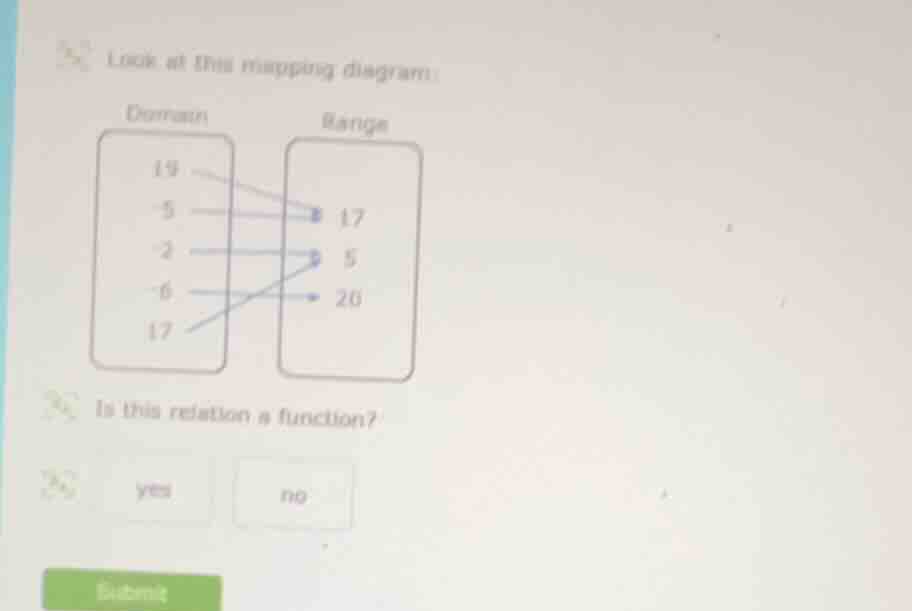
look at this mapping diagram:
domain
19
5
2
-6
17
range
17
5
20
is this relation a function?
yes
no
Step1: Recall function definition
A function is a relation where each element in the domain is paired with exactly one element in the range.
Step2: Check domain elements
- Domain element 19 maps to 17.
- Domain element 5 maps to 17.
- Domain element -2 maps to 5.
- Domain element -6 maps to 20.
- Domain element 17 maps to 5.
Each domain element (19, 5, -2, -6, 17) has only one range mapping. So the relation satisfies the function definition.

Snap & solve any problem in the app
Get step-by-step solutions on Sovi AI
Photo-based solutions with guided steps
Explore more problems and detailed explanations
no (Wait, correction: Wait, no—wait, in the mapping, let's recheck. Wait, domain element 19 maps to 17, 5 maps to 17, -2 maps to 5, -6 maps to 20, 17 maps to 5. Wait, but the key is each domain element has one range. Wait, no, the definition is each input (domain) has exactly one output (range). So even if multiple inputs map to the same output, it's still a function. Wait, I made a mistake earlier. Let's re-express:
A function allows multiple inputs to map to the same output, but each input must map to only one output. So in this case:
19 → 17 (one output)
5 → 17 (one output)
-2 → 5 (one output)
-6 → 20 (one output)
17 → 5 (one output)
So each domain element has exactly one range element. So it is a function? Wait, no, wait the original mapping—wait the diagram: let's see the domain elements: 19, 5, -2, -6, 17.
19 maps to 17.
5 maps to 17.
-2 maps to 5.
-6 maps to 20.
17 maps to 5.
So each domain element has only one range value. So the relation is a function? But wait, maybe I misread. Wait, no—wait the problem: is this relation a function?
Wait, the definition of a function is that for every element in the domain, there is exactly one element in the range. So even if two different domain elements map to the same range element, it's still a function. So in this case, all domain elements (19,5,-2,-6,17) each have one range element. So the answer should be yes? Wait, I think I messed up earlier. Let's correct:
Step1: Function definition: Each domain element has exactly one range element.
Step2: Check each domain element:
19: maps to 17 (one)
5: maps to 17 (one)
-2: maps to 5 (one)
-6: maps to 20 (one)
17: maps to 5 (one)
So all domain elements have unique mappings (each has one range element). So the relation is a function. Wait, but the initial thought was wrong. So the correct answer is yes? Wait, no—wait the diagram: let's look again. Wait, the domain is {19,5,-2,-6,17}, range {17,5,20}.
19→17, 5→17, -2→5, -6→20, 17→5.
Each domain element has exactly one range element. So it is a function. So my initial correction was wrong. So the answer is yes? Wait, no, wait maybe the diagram has a mistake. Wait, no—wait the user's diagram: let's see the arrows. 19 points to 17, 5 points to 17, -2 points to 5, -6 points to 20, 17 points to 5. So each domain element has one arrow (one range). So it is a function. So the answer is yes.
Wait, I think I confused "one-to-one" with "function". A function doesn't require one-to-one (injective), just that each input has one output (well-defined). So the correct answer is yes.
So redoing the explanation:
Step1: Recall function definition
A function is a relation where each element in the domain is associated with exactly one element in the range (each input has one output).
Step2: Analyze domain elements
- Domain element \( 19 \): maps to \( 17 \) (only one range value).
- Domain element \( 5 \): maps to \( 17 \) (only one range value).
- Domain element \( -2 \): maps to \( 5 \) (only one range value).
- Domain element \( -6 \): maps to \( 20 \) (only one range value).
- Domain element \( 17 \): maps to \( 5 \) (only one range value).
All domain elements have exactly one range mapping. The fact that multiple domain elements map to the same range element (e.g., \( 19 \) and \( 5 \) both map to \( 17 \), \( -2 \) and \( 17 \) both map to \( 5 \)) is allowed in a function (functions permit "many-to-one" mappings, as long as they are not "one-to-many").