QUESTION IMAGE
Question
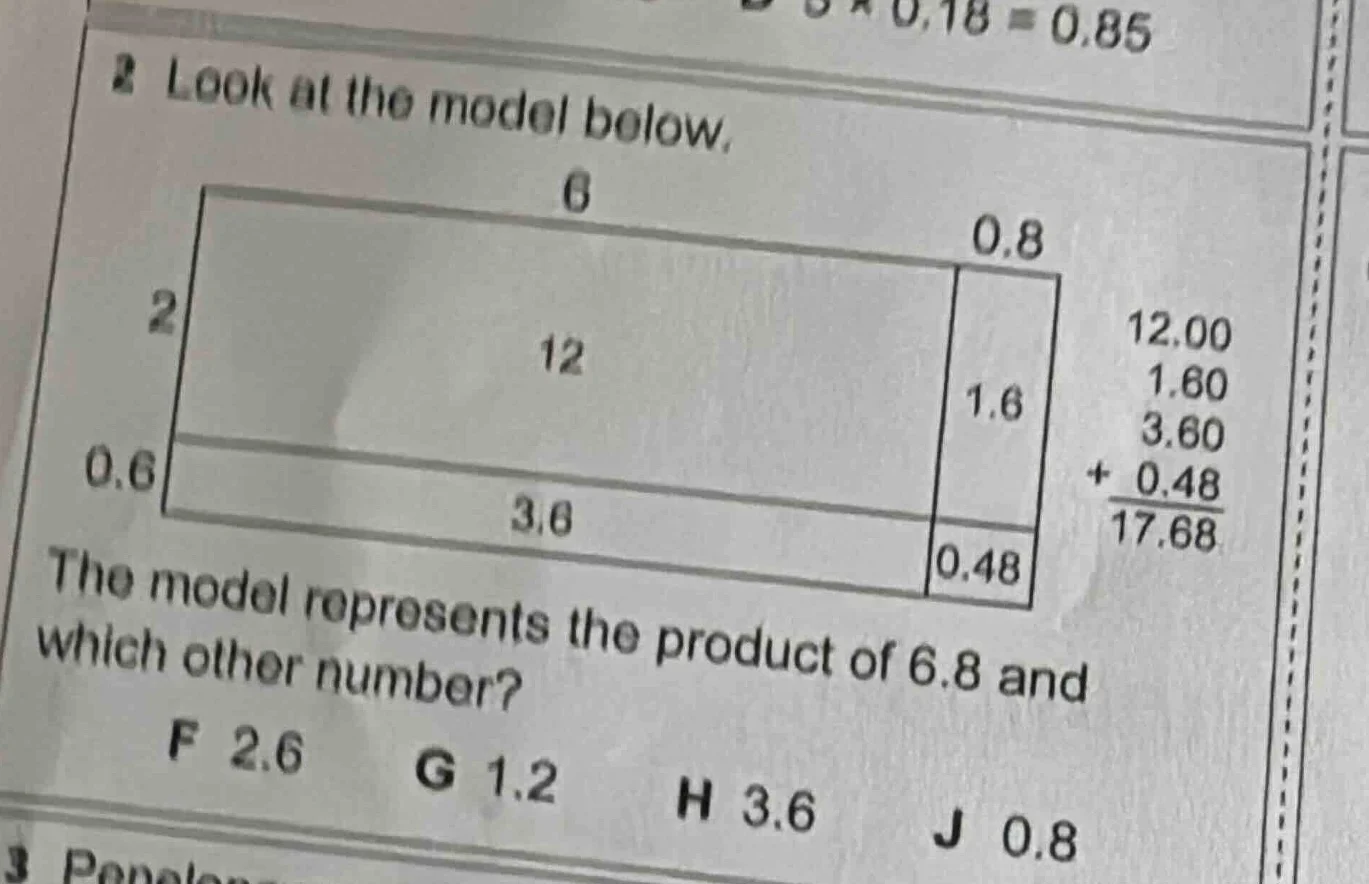
2 look at the model below.
the model represents the product of 6.8 and which other number?
f 2.6 g 1.2 h 3.6 j 0.8
Step1: Analyze the area model
The area model is used to represent the multiplication of two numbers by breaking them into parts. Here, one number is \(6.8\) (since \(6 + 0.8 = 6.8\)). The other number is broken into \(2\) and \(0.6\) (since \(2+0.6 = 2.6\)? Wait, no, let's check the products. Wait, the parts of the rectangle: the height is \(2\) and \(0.6\), so total height is \(2 + 0.6=2.6\)? Wait, no, let's check the products. The first large rectangle: length \(6\), height \(2\), area \(12\). Then length \(0.8\), height \(2\), area \(1.6\). Then length \(6\), height \(0.6\), area \(3.6\). Then length \(0.8\), height \(0.6\), area \(0.48\). So the height is \(2 + 0.6 = 2.6\), and the length is \(6 + 0.8 = 6.8\). So the product is \(6.8\times2.6\), which matches the sum \(12 + 1.6+3.6 + 0.48 = 17.68\), and \(6.8\times2.6 = 17.68\) (let's calculate: \(6\times2.6 = 15.6\), \(0.8\times2.6 = 2.08\), \(15.6+2.08 = 17.68\)). Wait, but the options are F 2.6, G 1.2, H 3.6, J 0.8. Wait, the height is \(2 + 0.6 = 2.6\), so the other number is \(2.6\), which is option F.
Wait, let's recheck. The model has length as \(6 + 0.8 = 6.8\), and height as \(2 + 0.6 = 2.6\). So the multiplication is \(6.8\times2.6\), so the other number is \(2.6\), which is option F.
Step2: Verify with multiplication
Let's calculate \(6.8\times2.6\). Using the distributive property: \(6.8\times(2 + 0.6)=6.8\times2 + 6.8\times0.6 = 13.6+4.08 = 17.68\), which matches the sum \(12 + 1.6+3.6 + 0.48 = 17.68\) (since \(12\) is \(6\times2\), \(1.6\) is \(0.8\times2\), \(3.6\) is \(6\times0.6\), \(0.48\) is \(0.8\times0.6\); so \(6\times2 + 0.8\times2 + 6\times0.6 + 0.8\times0.6=(6 + 0.8)\times(2 + 0.6)=6.8\times2.6\)).

Snap & solve any problem in the app
Get step-by-step solutions on Sovi AI
Photo-based solutions with guided steps
Explore more problems and detailed explanations
F. 2.6