QUESTION IMAGE
Question
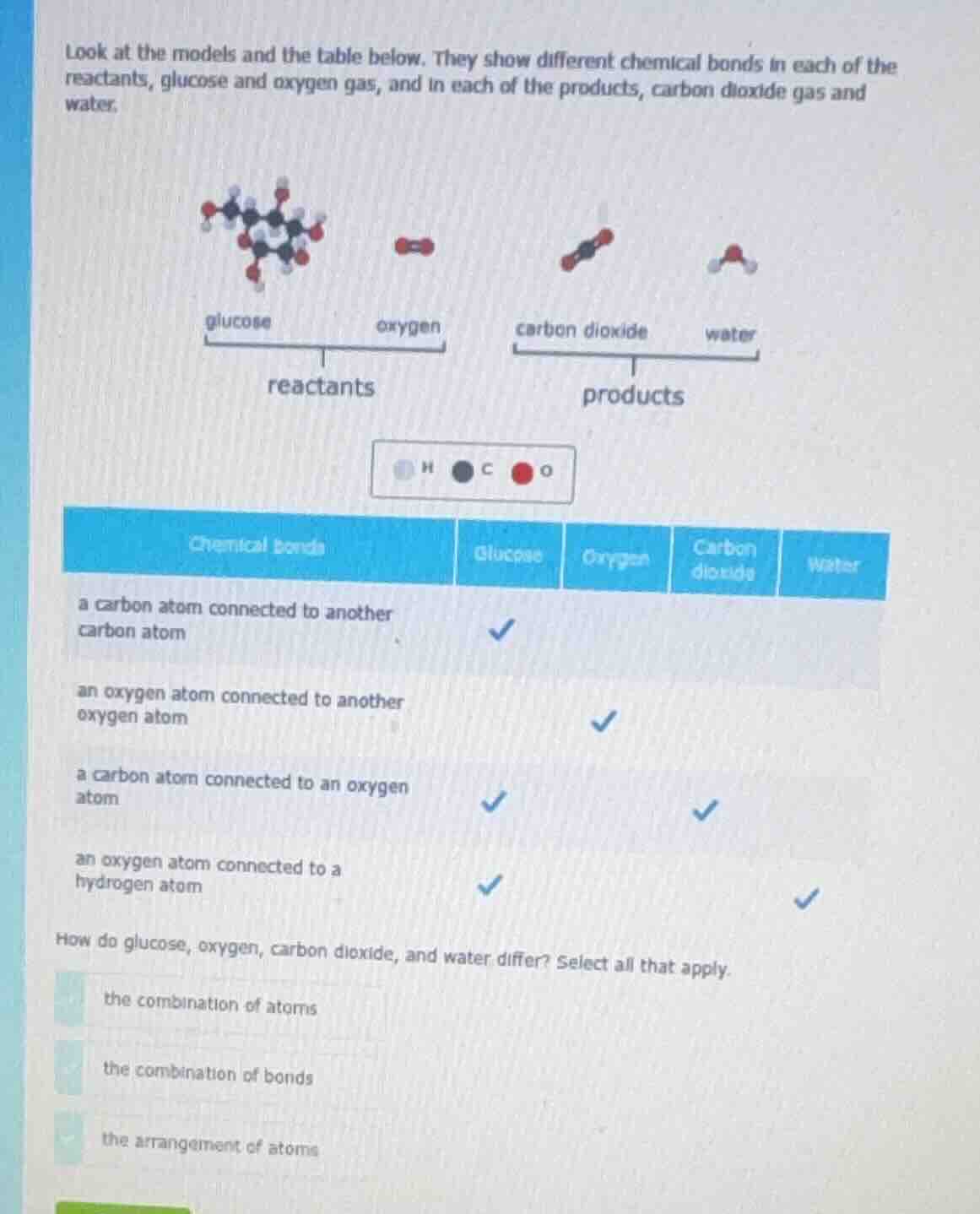
look at the models and the table below. they show different chemical bonds in each of the reactants, glucose and oxygen gas, and in each of the products, carbon dioxide gas and water.
models of glucose, oxygen, carbon dioxide, water with labels reactants and products, and a legend for h, c, o
table with columns chemical bonds, glucose, oxygen, carbon dioxide, water and rows:
- a carbon atom connected to another carbon atom (glucose: ✔️)
- an oxygen atom connected to another oxygen atom (oxygen: ✔️)
- a carbon atom connected to an oxygen atom (glucose: ✔️, carbon dioxide: ✔️)
- an oxygen atom connected to a hydrogen atom (glucose: ✔️, water: ✔️)
how do glucose, oxygen, carbon dioxide, and water differ? select all that apply.
- the combination of atoms
- the combination of bonds
- the arrangement of atoms
Brief Explanations
- Combination of atoms: Glucose has C, H, O; oxygen only has O; carbon dioxide has C, O; water has H, O. Each has a unique set of combined atoms.
- Combination of bonds: The table shows each substance has a distinct set of bond types (e.g., glucose has C-C, C-O, O-H bonds; oxygen only has O-O bonds).
- Arrangement of atoms: The molecular models show different spatial arrangements: glucose is a large, branched molecule; oxygen is a diatomic molecule; carbon dioxide is a linear diatomic-like structure; water is a bent small molecule. All have unique atom arrangements.

Snap & solve any problem in the app
Get step-by-step solutions on Sovi AI
Photo-based solutions with guided steps
Explore more problems and detailed explanations
- the combination of atoms
- the combination of bonds
- the arrangement of atoms