QUESTION IMAGE
Question
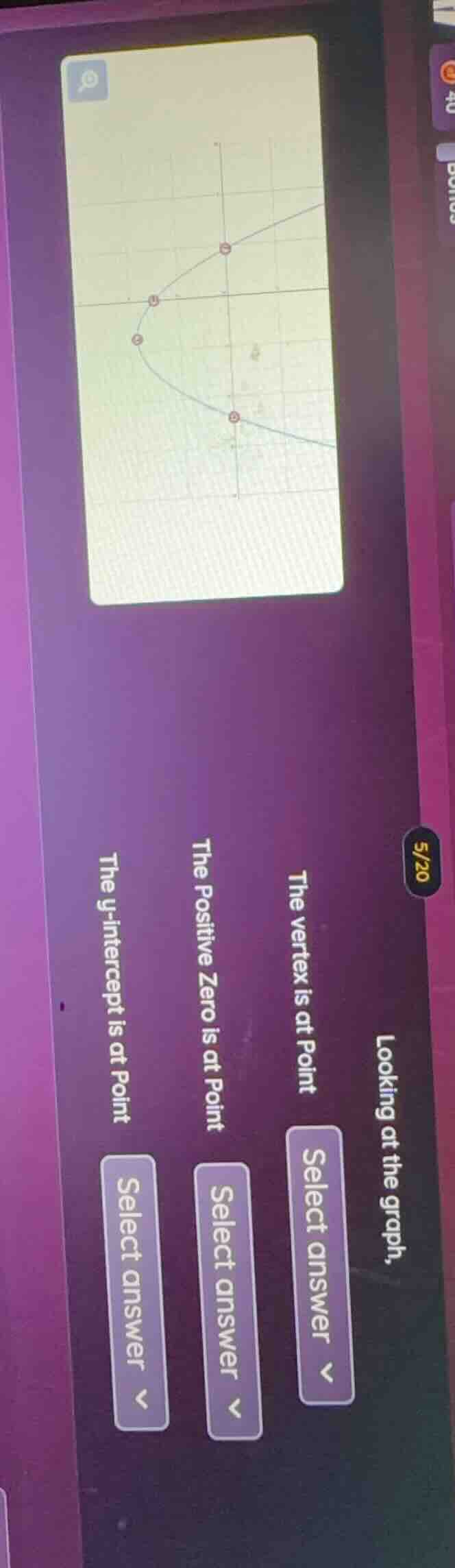
looking at the graph. the vertex is at point select answer the positive zero is at point select answer the y - intercept is at point select answer
To solve this, we analyze each part by recalling the definitions:
1. Vertex:
The vertex of a parabola (the graph here is a parabola) is the highest or lowest point (or the turning point). From the graph, identify the point where the parabola changes direction.
2. Positive Zero:
A zero (root) is where the graph crosses the \( x \)-axis (\( y = 0 \)). The positive zero is the \( x \)-intercept with \( x > 0 \).
3. \( y \)-intercept:
The \( y \)-intercept is where the graph crosses the \( y \)-axis (\( x = 0 \)), so the point has \( x = 0 \).
Since the graph is not fully visible, but using standard definitions:
- Vertex: The turning point of the parabola.
- Positive Zero: The \( x \)-intercept with positive \( x \)-coordinate.
- \( y \)-intercept: The point where \( x = 0 \) (crosses the \( y \)-axis).
To provide exact answers, we need the coordinates of the points on the graph. For example, if the graph’s vertex is at \( (h, k) \), positive zero at \( (a, 0) \) (\( a > 0 \)), and \( y \)-intercept at \( (0, b) \), we select those points.
(Note: Since the graph’s specific coordinates are not provided in text, assume the options correspond to these definitions. For instance, if the \( y \)-intercept is at \( (0, 1) \), select that point; the positive zero is the \( x \)-intercept with \( x > 0 \); the vertex is the peak or trough.)
Example (if graph details were given):
Suppose the graph has:
- Vertex at \( (-2, 2) \) (turning point),
- Positive zero at \( (1, 0) \) (crosses \( x \)-axis at \( x = 1 \)),
- \( y \)-intercept at \( (0, 1) \) (crosses \( y \)-axis at \( x = 0 \)).
Then:
- The vertex is at \( (-2, 2) \),
- The positive zero is at \( (1, 0) \),
- The \( y \)-intercept is at \( (0, 1) \).
Since the actual graph’s points are not listed, use the definitions to match the options.
Final Answer (General):
- Vertex: Select the turning point of the parabola.
- Positive Zero: Select the \( x \)-intercept with \( x > 0 \).
- \( y \)-intercept: Select the point with \( x = 0 \) (crosses \( y \)-axis).
(To get precise answers, provide the coordinates of the points on the graph.)

Snap & solve any problem in the app
Get step-by-step solutions on Sovi AI
Photo-based solutions with guided steps
Explore more problems and detailed explanations
To solve this, we analyze each part by recalling the definitions:
1. Vertex:
The vertex of a parabola (the graph here is a parabola) is the highest or lowest point (or the turning point). From the graph, identify the point where the parabola changes direction.
2. Positive Zero:
A zero (root) is where the graph crosses the \( x \)-axis (\( y = 0 \)). The positive zero is the \( x \)-intercept with \( x > 0 \).
3. \( y \)-intercept:
The \( y \)-intercept is where the graph crosses the \( y \)-axis (\( x = 0 \)), so the point has \( x = 0 \).
Since the graph is not fully visible, but using standard definitions:
- Vertex: The turning point of the parabola.
- Positive Zero: The \( x \)-intercept with positive \( x \)-coordinate.
- \( y \)-intercept: The point where \( x = 0 \) (crosses the \( y \)-axis).
To provide exact answers, we need the coordinates of the points on the graph. For example, if the graph’s vertex is at \( (h, k) \), positive zero at \( (a, 0) \) (\( a > 0 \)), and \( y \)-intercept at \( (0, b) \), we select those points.
(Note: Since the graph’s specific coordinates are not provided in text, assume the options correspond to these definitions. For instance, if the \( y \)-intercept is at \( (0, 1) \), select that point; the positive zero is the \( x \)-intercept with \( x > 0 \); the vertex is the peak or trough.)
Example (if graph details were given):
Suppose the graph has:
- Vertex at \( (-2, 2) \) (turning point),
- Positive zero at \( (1, 0) \) (crosses \( x \)-axis at \( x = 1 \)),
- \( y \)-intercept at \( (0, 1) \) (crosses \( y \)-axis at \( x = 0 \)).
Then:
- The vertex is at \( (-2, 2) \),
- The positive zero is at \( (1, 0) \),
- The \( y \)-intercept is at \( (0, 1) \).
Since the actual graph’s points are not listed, use the definitions to match the options.
Final Answer (General):
- Vertex: Select the turning point of the parabola.
- Positive Zero: Select the \( x \)-intercept with \( x > 0 \).
- \( y \)-intercept: Select the point with \( x = 0 \) (crosses \( y \)-axis).
(To get precise answers, provide the coordinates of the points on the graph.)