QUESTION IMAGE
Question
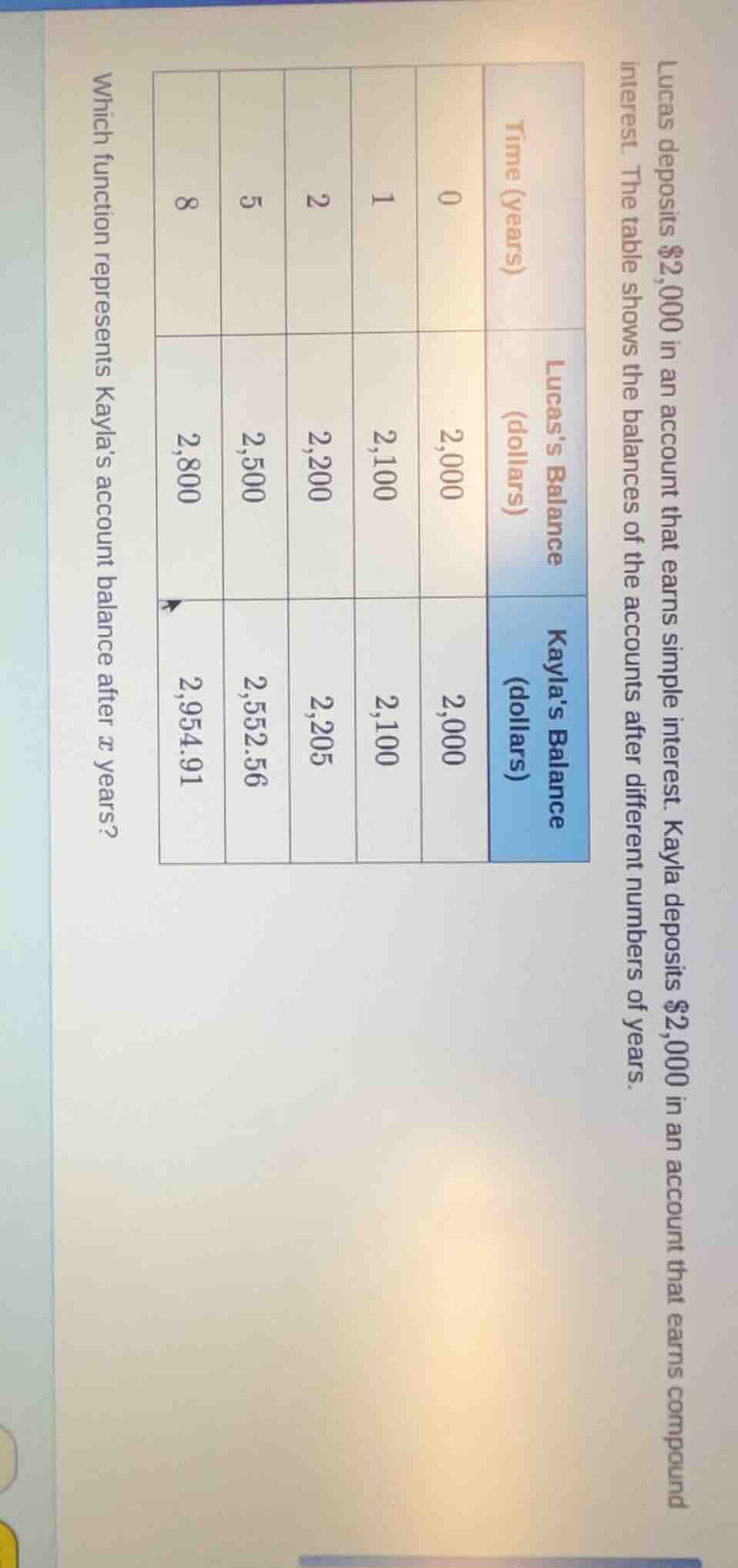
lucas deposits $2,000 in an account that earns simple interest. kayla deposits $2,000 in an account that earns compound interest. the table shows the balances of the accounts after different numbers of years.
| time (years) | lucass balance (dollars) | kaylas balance (dollars) | ---- | ---- | ---- | 0 | 2,000 | 2,000 | 1 | 2,100 | 2,100 | 2 | 2,200 | 2,205 | 5 | 2,500 | 2,552.56 | 8 | 2,800 | 2,954.91 | which function represents kaylas account balance after $x$ years? |
Step1: Identify compound interest formula
The compound interest formula is $A = P(1 + r)^x$, where $P$ is principal, $r$ is annual interest rate, $x$ is time in years, $A$ is the balance.
Step2: Use year 1 data to find $r$
Substitute $P=2000$, $x=1$, $A=2100$:
$2100 = 2000(1 + r)^1$
$\frac{2100}{2000} = 1 + r$
$1.05 = 1 + r$
$r = 0.05$
Step3: Verify rate with year 2 data
Substitute $P=2000$, $x=2$, $r=0.05$:
$A = 2000(1 + 0.05)^2 = 2000(1.1025) = 2205$, which matches the table.
Step4: Finalize the function
Substitute $P=2000$ and $r=0.05$ into the formula:
$A = 2000(1.05)^x$

Snap & solve any problem in the app
Get step-by-step solutions on Sovi AI
Photo-based solutions with guided steps
Explore more problems and detailed explanations
$A(x) = 2000(1.05)^x$ (where $A(x)$ is Kayla's balance after $x$ years)