QUESTION IMAGE
Question
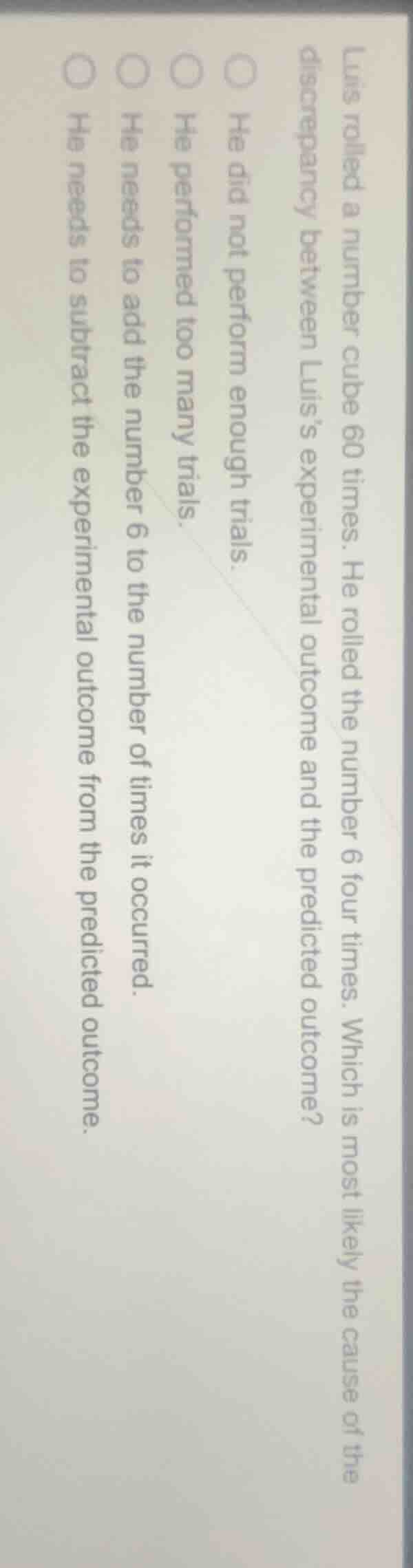
luis rolled a number cube 60 times. he rolled the number 6 four times. which is most likely the cause of the discrepancy between luis’s experimental outcome and the predicted outcome?
he did not perform enough trials.
he performed too many trials.
he needs to add the number 6 to the number of times it occurred.
he needs to subtract the experimental outcome from the predicted outcome.
A standard number cube has 6 equally likely outcomes. The predicted number of times a 6 should appear in 60 rolls is $\frac{1}{6} \times 60 = 10$. Luis only got 4 sixes. In probability, small discrepancies between experimental and predicted outcomes are common when the number of trials is not large enough; as the number of trials increases, experimental results tend to approach theoretical predictions. The other options are incorrect: 60 trials are not too many, adjusting the count by adding 6 is not a valid fix, and subtracting experimental from predicted is just calculating the difference, not the cause of the discrepancy.

Snap & solve any problem in the app
Get step-by-step solutions on Sovi AI
Photo-based solutions with guided steps
Explore more problems and detailed explanations
A. He did not perform enough trials.