QUESTION IMAGE
Question
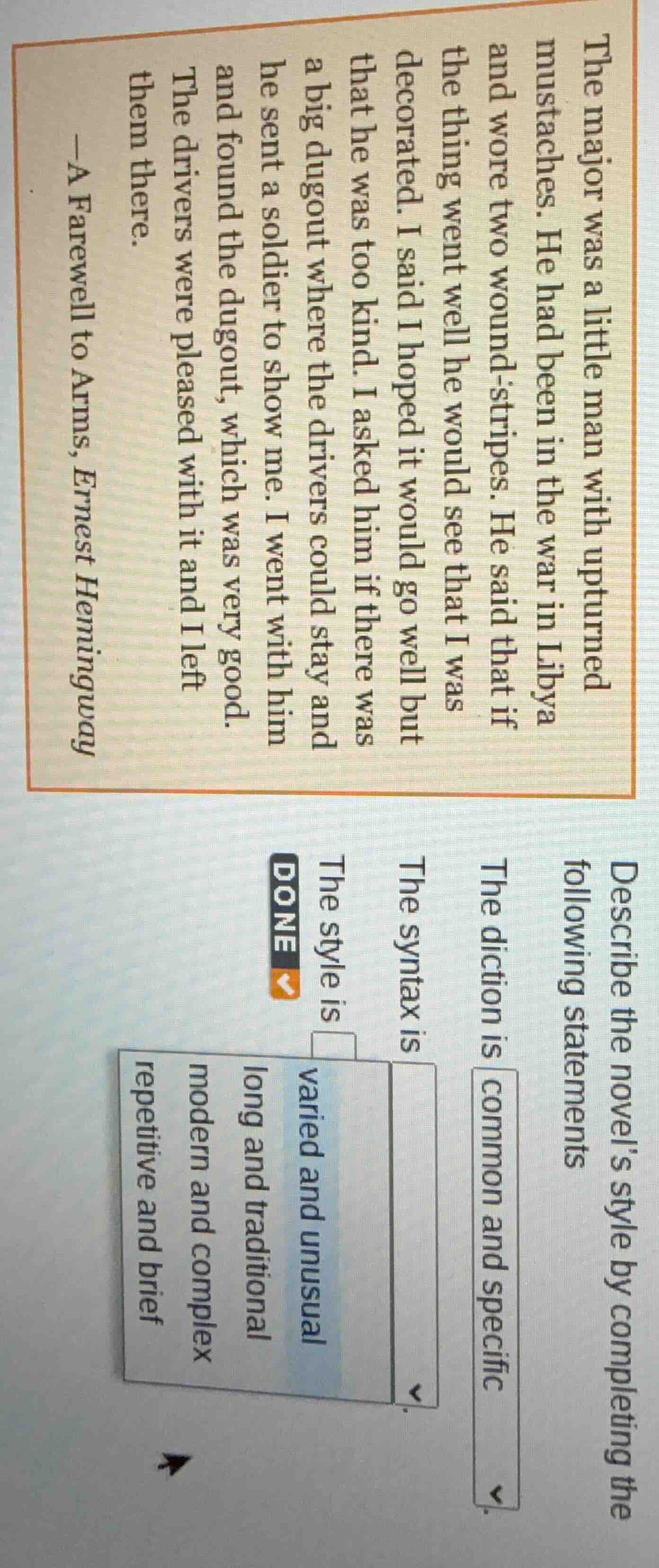
the major was a little man with upturned mustaches. he had been in the war in libya and wore two wound-stripes. he said that if the thing went well he would see that i was decorated. i said i hoped it would go well but that he was too kind. i asked him if there was a big dugout where the drivers could stay and he sent a soldier to show me. i went with him and found the dugout, which was very good. the drivers were pleased with it and i left them there.
—a farewell to arms, ernest hemingway
describe the novel’s style by completing the following statements
the diction is
the syntax is
the style is
options for diction: common and specific
options for syntax: (dropdown not fully visible, but part of multiple - choice setup)
options for style: varied and unusual, long and traditional, modern and complex, repetitive and brief
- Diction: The passage uses simple, everyday language (e.g., "little man," "dugout") that is common, paired with specific details (e.g., "upturned mustaches," "two wound-stripes") that ground the scene.
- Syntax: The sentences are short, simple, and follow a straightforward subject-verb structure, with repeated sentence frames (e.g., "He had...", "He said...") that create a repetitive, brief rhythm.
- Style: This sparse, direct, unadorned prose is characteristic of Hemingway's modernist style, which uses understatement and simple structure to convey complex emotional and thematic weight of war experiences.

Snap & solve any problem in the app
Get step-by-step solutions on Sovi AI
Photo-based solutions with guided steps
Explore more problems and detailed explanations
The diction is common and specific
The syntax is repetitive and brief
The style is modern and complex