QUESTION IMAGE
Question
the manorial system
common people
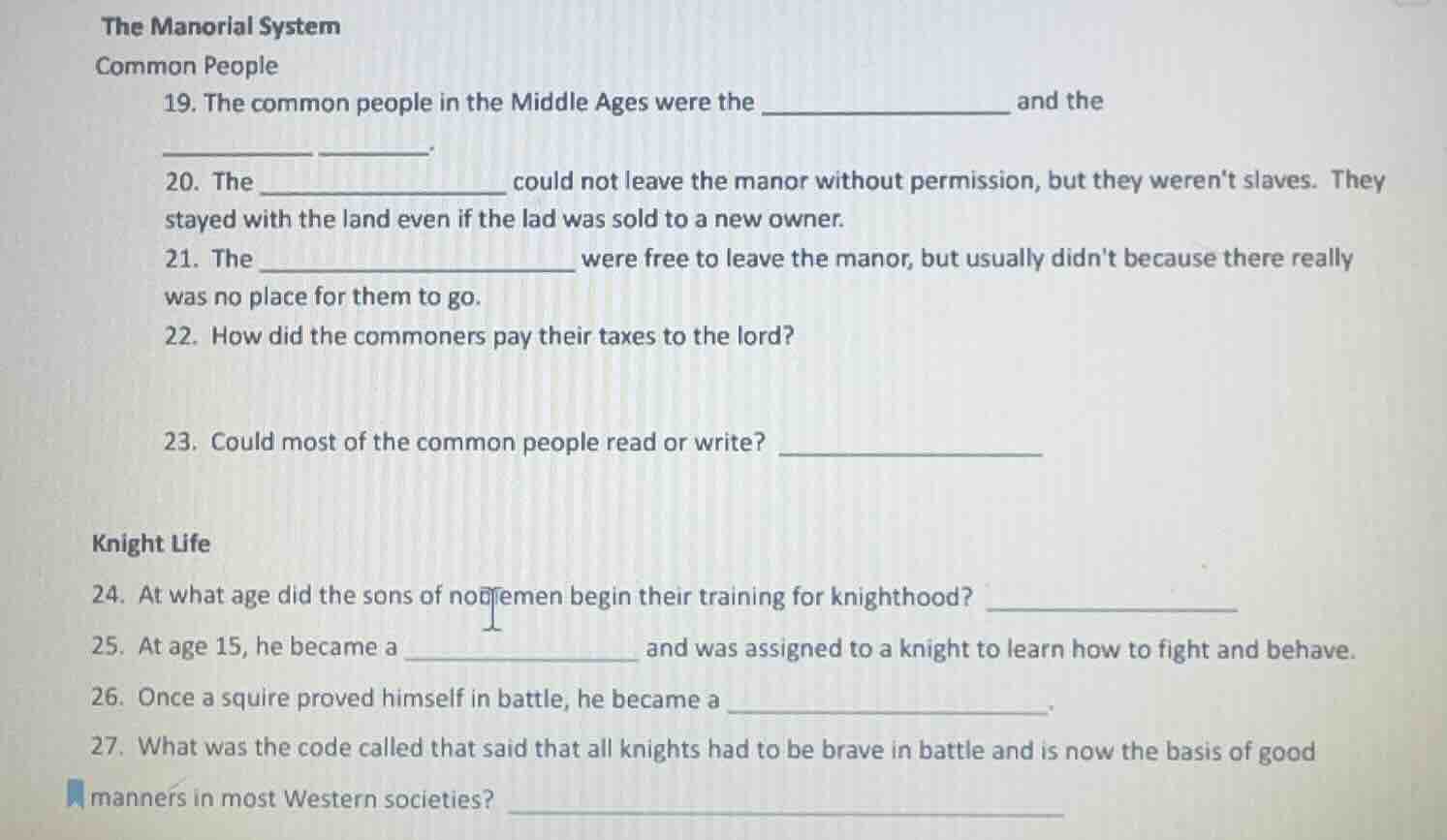
- the common people in the middle ages were the ______________ and the
_______ ____.
- the ______________ could not leave the manor without permission, but they werent slaves. they
stayed with the land even if the lad was sold to a new owner.
- the _________________ were free to leave the manor, but usually didnt because there really
was no place for them to go.
- how did the commoners pay their taxes to the lord?
- could most of the common people read or write? ______________
knight life
- at what age did the sons of noblemen begin their training for knighthood? ______________
- at age 15, he became a ______________ and was assigned to a knight to learn how to fight and behave.
- once a squire proved himself in battle, he became a _________________.
- what was the code called that said that all knights had to be brave in battle and is now the basis of good
manners in most western societies? ___________________________
Brief Explanations
These questions relate to medieval European social structures and knightly traditions, key topics in medieval history.
- The two main groups of common people in the manorial system were the unfree serfs and free peasants.
- Serfs were tied to the manor land, unable to leave without permission, and transferred with the land when sold.
- Free peasants had legal freedom to leave but often lacked alternative options.
- Commoners paid taxes through labor on the lord's land (labor services), a portion of their agricultural produce, and sometimes small monetary payments.
- Most common people lacked access to education, so they could not read or write.
- Sons of nobles typically started training for knighthood at age 7.
- At 15, a young trainee became a squire, serving a knight directly to learn combat and etiquette.
- A squire who proved their worth in battle would be knighted, becoming a full knight.
- The code of chivalry governed knightly behavior, emphasizing bravery and forming the basis of modern Western polite manners.

Snap & solve any problem in the app
Get step-by-step solutions on Sovi AI
Photo-based solutions with guided steps
Explore more problems and detailed explanations
- serfs; free peasants
- serfs
- free peasants
- They paid taxes through labor on the lord's private land, by giving a share of their farm produce, and occasionally with small amounts of money.
- No, most could not read or write.
- 7
- squire
- knight
- The Code of Chivalry