QUESTION IMAGE
Question
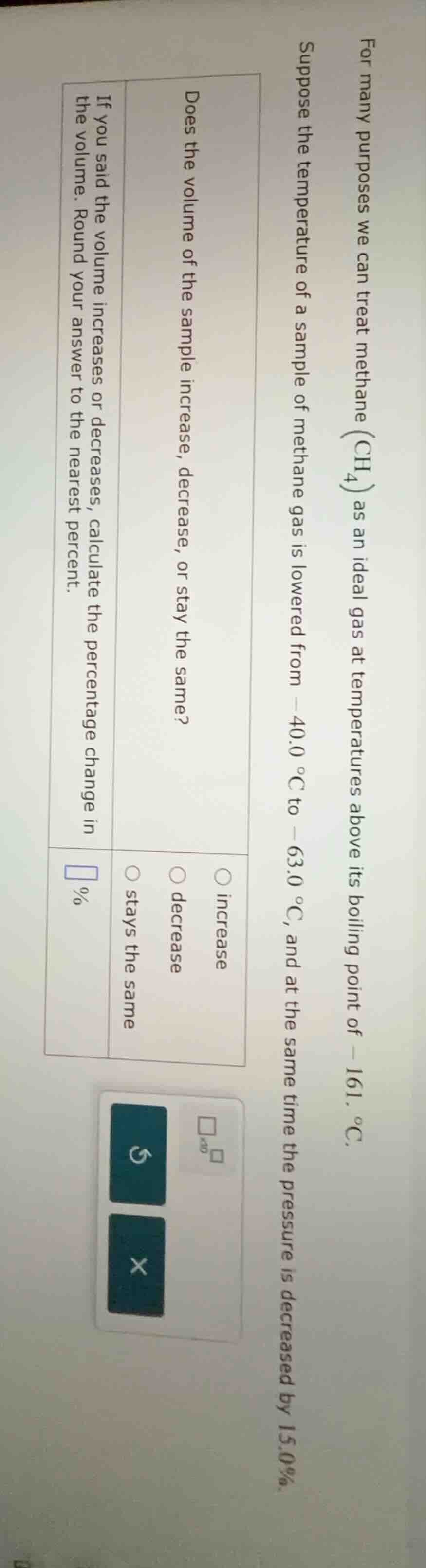
for many purposes we can treat methane (\\(\ce{ch4}\\)) as an ideal gas at temperatures above its boiling point of \\(-161. \\, ^\circ\text{c}.\\) suppose the temperature of a sample of methane gas is lowered from \\(-40.0 \\, ^\circ\text{c}\\) to \\(-63.0 \\, ^\circ\text{c}\\), and at the same time the pressure is decreased by \\(15.0\\%.\\) does the volume of the sample increase, decrease, or stay the same? \\(\circ\\) increase \\(\circ\\) decrease \\(\circ\\) stays the same if you said the volume increases or decreases, calculate the percentage change in the volume. round your answer to the nearest percent. \\(\square\\%\\)
Step1: Convert temperatures to Kelvin
The initial temperature \( T_1 = -40.0^\circ \text{C} + 273.15 = 233.15 \text{ K} \)
The final temperature \( T_2 = -63.0^\circ \text{C} + 273.15 = 210.15 \text{ K} \)
Step2: Analyze pressure change
The pressure is decreased by 15.0%, so the final pressure \( P_2 = P_1 - 0.15P_1 = 0.85P_1 \)
Step3: Apply ideal gas law (\( \frac{P_1V_1}{T_1} = \frac{P_2V_2}{T_2} \))
Rearrange to find \( \frac{V_2}{V_1} = \frac{P_1T_2}{P_2T_1} \)
Substitute \( P_2 = 0.85P_1 \), \( T_1 = 233.15 \text{ K} \), \( T_2 = 210.15 \text{ K} \)
\( \frac{V_2}{V_1} = \frac{P_1 \times 210.15}{0.85P_1 \times 233.15} = \frac{210.15}{0.85 \times 233.15} \)
Calculate denominator: \( 0.85 \times 233.15 \approx 198.1775 \)
\( \frac{V_2}{V_1} \approx \frac{210.15}{198.1775} \approx 1.0604 \) Wait, no, wait: Wait, temperature is decreasing (from 233.15 K to 210.15 K) and pressure is decreasing (to 0.85 P1). Wait, let's recalculate:
Wait, \( \frac{V_2}{V_1} = \frac{P_1 T_2}{P_2 T_1} = \frac{T_2}{0.85 T_1} \) (since \( P_2 = 0.85 P_1 \), so \( P_1/P_2 = 1/0.85 \))
So \( \frac{V_2}{V_1} = \frac{210.15}{0.85 \times 233.15} \)
Calculate 0.85 * 233.15 = 198.1775
210.15 / 198.1775 ≈ 1.0604? Wait, that can't be. Wait, no: Wait, temperature is lower (T2 < T1) and pressure is lower (P2 < P1). Let's check the formula again.
Ideal gas law: \( PV = nRT \), so for constant n, \( \frac{P_1V_1}{T_1} = \frac{P_2V_2}{T_2} \)
So \( V_2 = V_1 \times \frac{P_1 T_2}{P_2 T_1} \)
So \( \frac{V_2}{V_1} = \frac{P_1 T_2}{P_2 T_1} \)
Given \( P_2 = 0.85 P_1 \), so \( \frac{P_1}{P_2} = \frac{1}{0.85} \)
Thus, \( \frac{V_2}{V_1} = \frac{T_2}{0.85 T_1} \)
T2 = 210.15 K, T1 = 233.15 K
So \( \frac{V_2}{V_1} = \frac{210.15}{0.85 \times 233.15} \)
Calculate 0.85 * 233.15 = 198.1775
210.15 / 198.1775 ≈ 1.0604? Wait, that would mean volume increases? But temperature is decreasing. Wait, maybe I made a mistake. Wait, no: Wait, pressure is decreasing (so volume tends to increase) and temperature is decreasing (so volume tends to decrease). Let's compute the ratio:
\( \frac{V_2}{V_1} = \frac{P_1 T_2}{P_2 T_1} = \frac{1 \times 210.15}{0.85 \times 233.15} \approx \frac{210.15}{198.1775} \approx 1.0604 \). Wait, that's about 1.06, so volume increases? But temperature is lower. Wait, maybe my temperature conversion is wrong?
Wait, -40.0°C to Kelvin: -40 + 273.15 = 233.15 K. Correct. -63.0°C: -63 + 273.15 = 210.15 K. Correct.
Pressure: P2 = 0.85 P1. So P1/P2 = 1/0.85 ≈ 1.1765.
T2/T1 = 210.15 / 233.15 ≈ 0.899.
So (P1/P2)(T2/T1) ≈ 1.1765 0.899 ≈ 1.057. So V2/V1 ≈ 1.057, so volume increases by about 5.7%? Wait, but temperature is decreasing. How is that possible? Because the pressure decrease has a larger effect than the temperature decrease. Let's check:
If pressure decreases (so volume should increase) and temperature decreases (volume should decrease). The net effect: pressure decrease factor is 1/0.85 ≈ 1.176, temperature decrease factor is 210/233 ≈ 0.899. Multiply them: 1.176 * 0.899 ≈ 1.057. So yes, volume increases.
Wait, but the question says "the temperature of a sample of methane gas is lowered from -40.0°C to -63.0°C, and at the same time the pressure is decreased by 15.0%." So temperature decreases (so volume should decrease) and pressure decreases (volume should increase). Which effect is larger?
Calculating the ratio:
\( \frac{V_2}{V_1} = \frac{P_1 T_2}{P_2 T_1} = \frac{T_2}{0.85 T_1} \) (since P2 = 0.85 P1)
So \( \frac{V_2}{V_1} = \frac{210.15}{0.85 \times 233.15} \approx \frac{210.15}{198.1775} \approx 1.0604 \)
So the volume i…

Snap & solve any problem in the app
Get step-by-step solutions on Sovi AI
Photo-based solutions with guided steps
Explore more problems and detailed explanations
The volume increases. The percentage change is approximately 6% (rounded to the nearest percent).
For the first part, the answer is "increase". For the second part, the percentage change is approximately 6%.