QUESTION IMAGE
Question
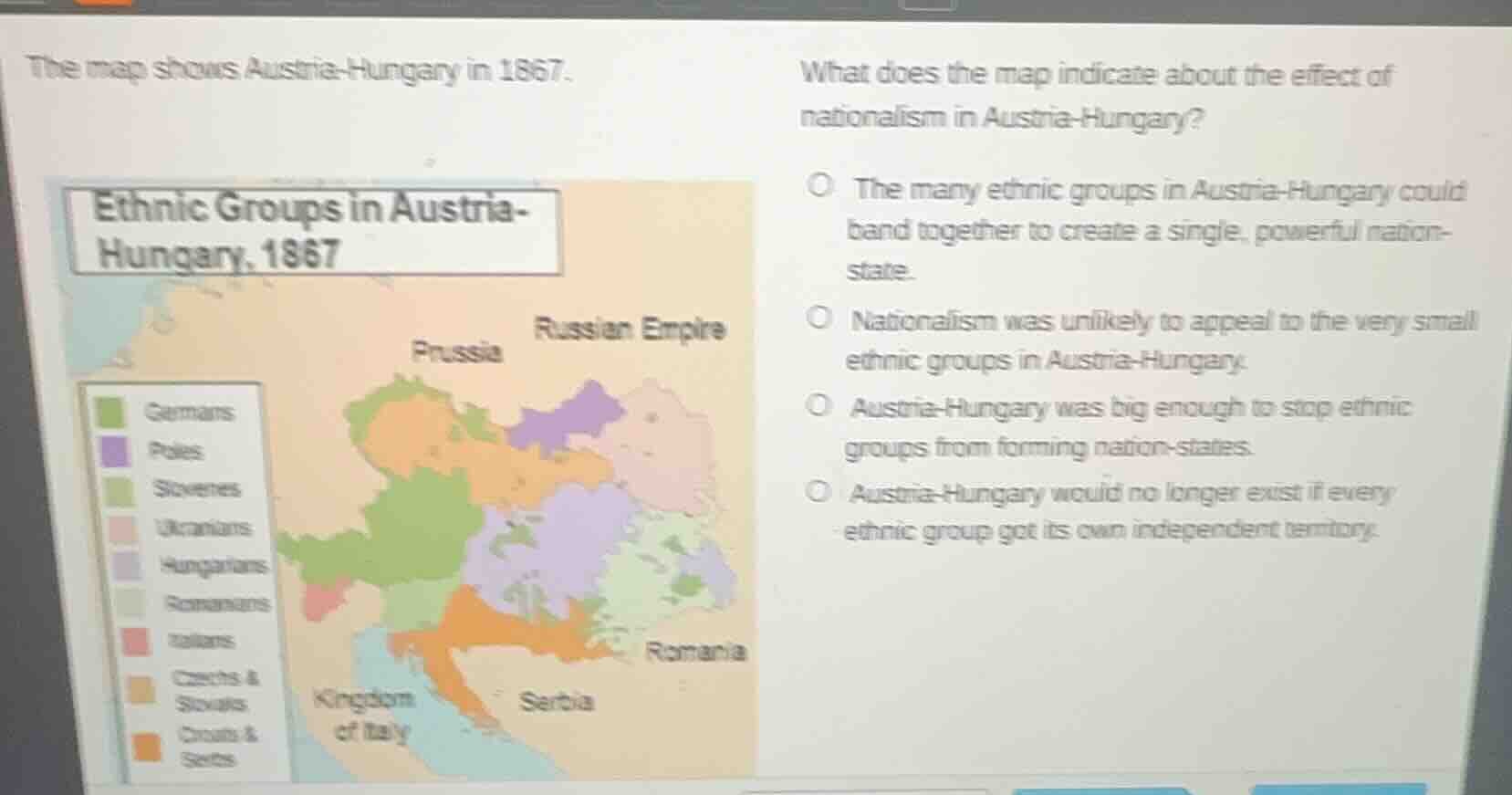
the map shows austria-hungary in 1867. what does the map indicate about the effect of nationalism in austria-hungary? the many ethnic groups in austria-hungary could band together to create a single, powerful nation-state. nationalism was unlikely to appeal to the very small ethnic groups in austria-hungary. austria-hungary was big enough to stop ethnic groups from forming nation-states. austria-hungary would no longer exist if every ethnic group got its own independent territory. map: ethnic groups in austria-hungary, 1867, showing various ethnic groups with legend: germans, poles, slovenes, ukrainians, hungarians, romanians, italians, czechs & slovaks, croats & serbs, and neighboring regions like prussia, russian empire, kingdom of italy, serbia
The map shows Austria-Hungary as a multi-ethnic empire with distinct, geographically dispersed ethnic groups (e.g., Germans, Poles, Hungarians). Nationalism emphasizes self-determination for ethnic groups to form nation-states. If each group in Austria-Hungary gained independent territory, the empire’s unified structure would dissolve, making it cease to exist. Other options are incorrect: ethnic groups were fragmented (not unified for a single nation-state), small groups could still embrace nationalism, and the empire’s size did not prevent eventual nationalist-driven dissolution.

Snap & solve any problem in the app
Get step-by-step solutions on Sovi AI
Photo-based solutions with guided steps
Explore more problems and detailed explanations
D. Austria-Hungary would no longer exist if every ethnic group got its own independent territory.