QUESTION IMAGE
Question
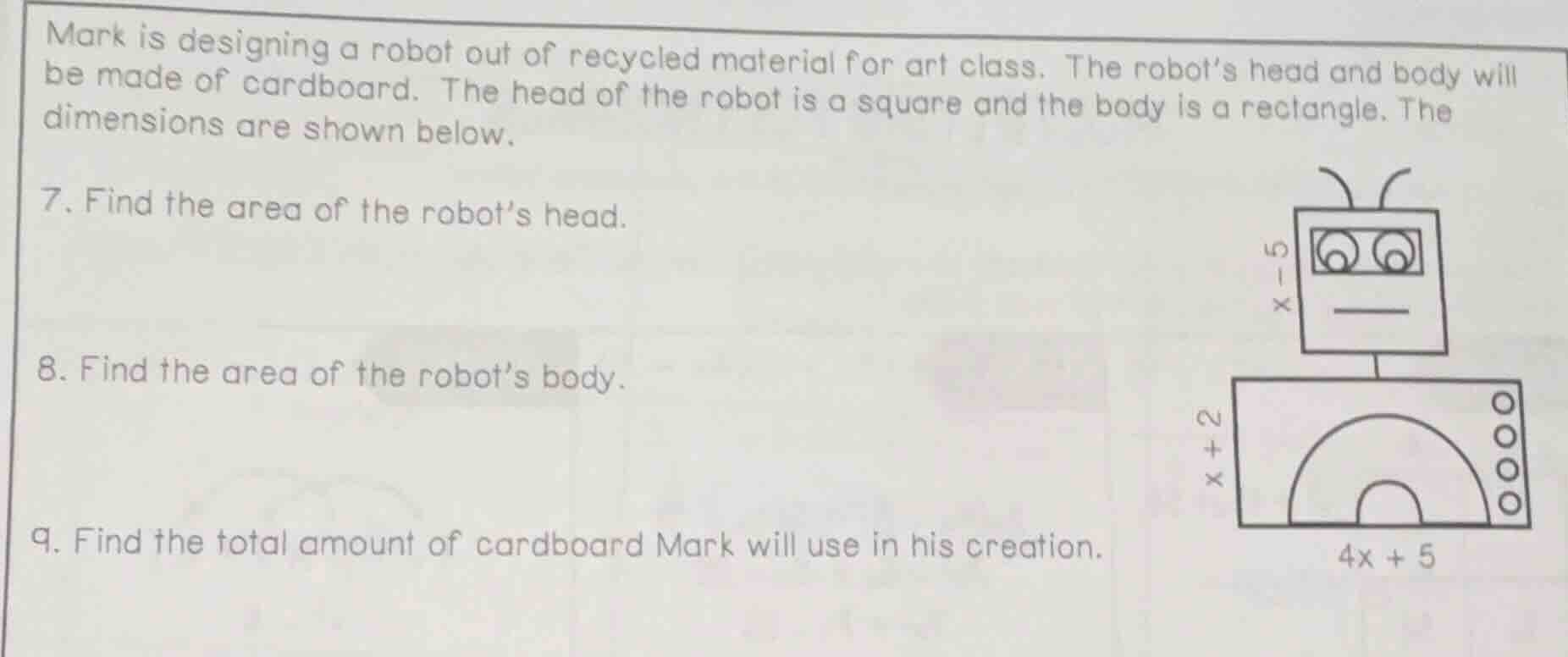
mark is designing a robot out of recycled material for art class. the robot’s head and body will be made of cardboard. the head of the robot is a square and the body is a rectangle. the dimensions are shown below.
- find the area of the robot’s head.
- find the area of the robot’s body.
- find the total amount of cardboard mark will use in his creation.
Question 7:
Step1: Identify the shape and formula
The robot's head is a square. The formula for the area of a square is \( A = s \times s \), where \( s \) is the side length. From the diagram, the side length of the square (head) is \( x - 5 \)? Wait, no, looking at the diagram, the head's side is \( x - 5 \)? Wait, the diagram shows the head with side \( x - 5 \)? Wait, no, the vertical side of the head is labeled \( x - 5 \), and since it's a square, both length and width are \( x - 5 \). Wait, no, maybe I misread. Wait, the head is a square, so area is side squared. Wait, the diagram: the head is a square with side \( x - 5 \)? Wait, no, the vertical dimension of the head is \( x - 5 \), so since it's a square, length and width are both \( x - 5 \). So area of square is \( (x - 5)^2 \). Wait, no, maybe the side is \( x - 5 \)? Wait, let's check again. The problem says the head is a square. So area of square is side × side. So if the side is \( x - 5 \), then area is \( (x - 5)(x - 5) \).
Wait, maybe I made a mistake. Wait, the diagram: the head is a square, and the vertical side is \( x - 5 \), so the side length is \( x - 5 \). So area of square is \( s^2 \), where \( s = x - 5 \). So:
Step1: Recall area of square formula
Area of square \( A = s^2 \), where \( s \) is the side length.
Step2: Substitute the side length
Here, \( s = x - 5 \), so \( A = (x - 5)^2 \).
Expanding \( (x - 5)^2 \):
\( (x - 5)^2 = x^2 - 10x + 25 \)
Wait, but maybe the side is \( x - 5 \)? Wait, maybe the diagram has the head's side as \( x - 5 \). So the area of the head is \( (x - 5)^2 = x^2 - 10x + 25 \).
Wait, but maybe I misread the diagram. Wait, the user's diagram: the head is a square with vertical side \( x - 5 \), so yes, side length \( x - 5 \). So area is \( (x - 5)^2 \).
Step1: Identify the shape and formula
The robot’s body is a rectangle. The formula for the area of a rectangle is \( A = l \times w \), where \( l \) is the length and \( w \) is the width. From the diagram, the length of the body is \( 4x + 5 \) and the width is \( x + 2 \).
Step2: Substitute the length and width into the formula
\( A = (4x + 5)(x + 2) \)
Step3: Expand the product
Using the distributive property (FOIL method):
\( (4x + 5)(x + 2) = 4x \times x + 4x \times 2 + 5 \times x + 5 \times 2 \)
\( = 4x^2 + 8x + 5x + 10 \)
\( = 4x^2 + 13x + 10 \)
Step1: Recall the areas of head and body
From Question 7, the area of the head is \( (x - 5)^2 = x^2 - 10x + 25 \).
From Question 8, the area of the body is \( 4x^2 + 13x + 10 \).
Step2: Add the two areas to find the total area
Total area \( = \) Area of head \( + \) Area of body
\( = (x^2 - 10x + 25) + (4x^2 + 13x + 10) \)
Step3: Combine like terms
Combine \( x^2 \) terms: \( x^2 + 4x^2 = 5x^2 \)
Combine \( x \) terms: \( -10x + 13x = 3x \)
Combine constant terms: \( 25 + 10 = 35 \)
So total area \( = 5x^2 + 3x + 35 \)
Wait, but let's check the expansion of the head's area again. Wait, maybe I made a mistake in the head's side length. Wait, the diagram: the head is a square, and the vertical side is \( x - 5 \), but maybe the side is \( x - 5 \)? Wait, but if \( x - 5 \) is the side, then area is \( (x - 5)^2 \). But let's verify with the body. Wait, the body is a rectangle with length \( 4x + 5 \) and width \( x + 2 \), so area is \( (4x + 5)(x + 2) = 4x^2 + 8x + 5x + 10 = 4x^2 + 13x + 10 \), which is correct.
Then total area: \( (x^2 - 10x + 25) + (4x^2 + 13x + 10) = 5x^2 + 3x + 35 \).

Snap & solve any problem in the app
Get step-by-step solutions on Sovi AI
Photo-based solutions with guided steps
Explore more problems and detailed explanations
The area of the robot’s head is \( x^2 - 10x + 25 \) (or \( (x - 5)^2 \)).