QUESTION IMAGE
Question
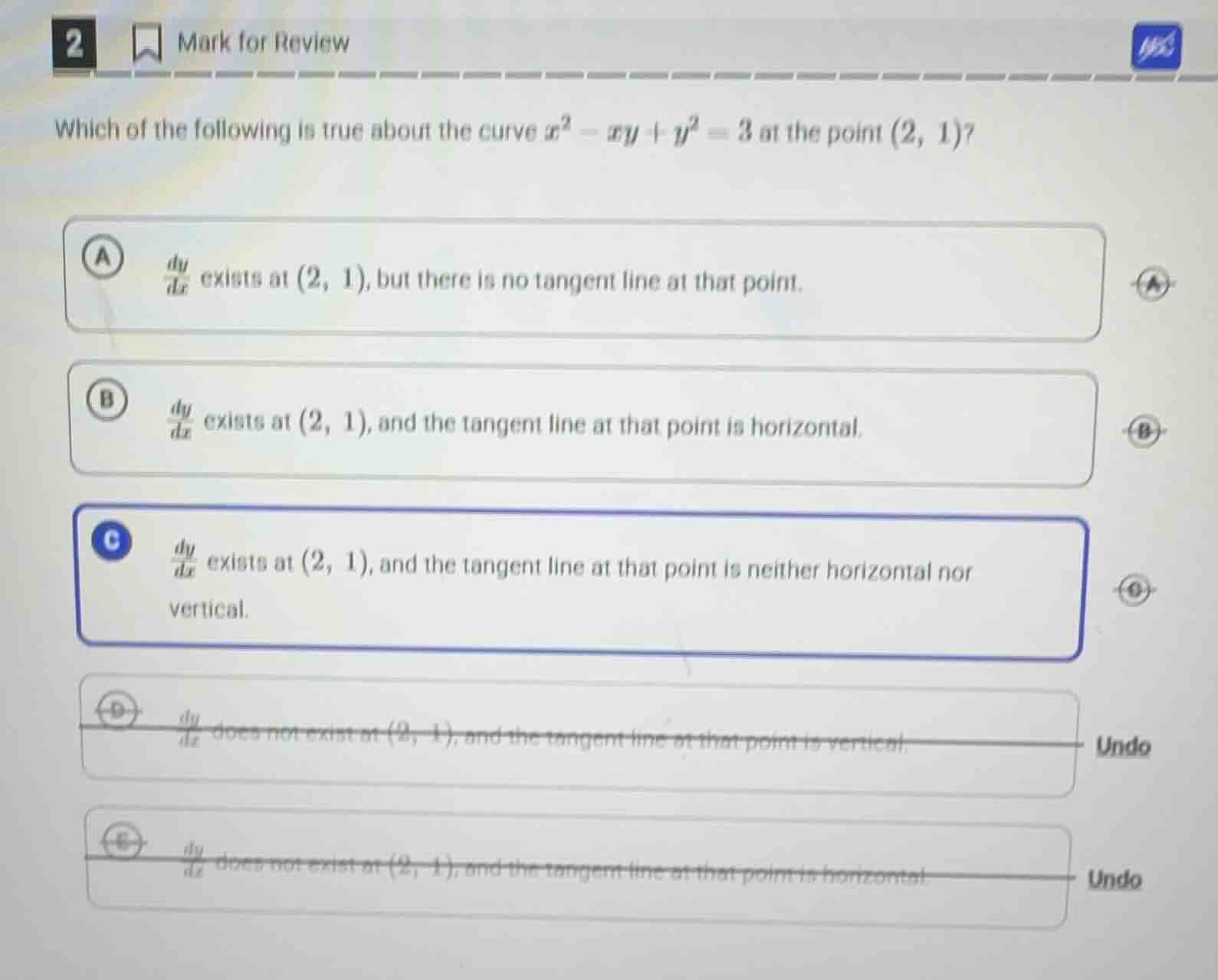
2 mark for review which of the following is true about the curve $x^2 - xy + y^2 = 3$ at the point $(2, 1)$? a $\frac{dy}{dx}$ exists at $(2, 1)$, but there is no tangent line at that point. b $\frac{dy}{dx}$ exists at $(2, 1)$, and the tangent line at that point is horizontal. c $\frac{dy}{dx}$ exists at $(2, 1)$, and the tangent line at that point is neither horizontal nor vertical. d $\frac{dy}{dx}$ does not exist at $(2, 1)$, and the tangent line at that point is vertical. e $\frac{dy}{dx}$ does not exist at $(2, 1)$, and the tangent line at that point is horizontal.
Step1: Implicit Differentiation
Differentiate \(x^2 - xy + y^2 = 3\) with respect to \(x\).
Using product rule for \(-xy\): \(\frac{d}{dx}(-xy)=-y - x\frac{dy}{dx}\), \(\frac{d}{dx}(x^2)=2x\), \(\frac{d}{dx}(y^2)=2y\frac{dy}{dx}\), \(\frac{d}{dx}(3)=0\).
So, \(2x - y - x\frac{dy}{dx}+2y\frac{dy}{dx}=0\).
Step2: Solve for \(\frac{dy}{dx}\)
Rearrange terms: \(-x\frac{dy}{dx}+2y\frac{dy}{dx}=y - 2x\)
Factor \(\frac{dy}{dx}\): \(\frac{dy}{dx}(-x + 2y)=y - 2x\)
Thus, \(\frac{dy}{dx}=\frac{y - 2x}{-x + 2y}=\frac{2x - y}{x - 2y}\).
Step3: Evaluate \(\frac{dy}{dx}\) at \((2,1)\)
Substitute \(x = 2\), \(y = 1\) into \(\frac{dy}{dx}\): \(\frac{2(2)-1}{2 - 2(1)}=\frac{4 - 1}{2 - 2}=\frac{3}{0}\)? Wait, no, wait: Wait, \(\frac{2x - y}{x - 2y}\) at \((2,1)\): numerator \(2*2 - 1 = 3\), denominator \(2 - 2*1 = 0\)? Wait, no, I made a mistake in step 2. Wait, original differentiation: \(2x - y - x\frac{dy}{dx}+2y\frac{dy}{dx}=0\) → \((2y - x)\frac{dy}{dx}=y - 2x\) → \(\frac{dy}{dx}=\frac{y - 2x}{2y - x}\). Ah, that's the error. So correct \(\frac{dy}{dx}=\frac{y - 2x}{2y - x}\).
Now substitute \(x = 2\), \(y = 1\): \(\frac{1 - 4}{2 - 2}=\frac{-3}{0}\)? No, wait, no: \(2y - x\) when \(x=2,y=1\) is \(2*1 - 2 = 0\)? Wait, no, \(2y - x = 2(1)-2 = 0\), \(y - 2x = 1 - 4 = -3\). Wait, that can't be. Wait, let's redo differentiation:
\(\frac{d}{dx}(x^2 - xy + y^2)=\frac{d}{dx}(3)\)
\(2x - (y + x\frac{dy}{dx}) + 2y\frac{dy}{dx}=0\)
\(2x - y - x\frac{dy}{dx}+2y\frac{dy}{dx}=0\)
\(2x - y + \frac{dy}{dx}(2y - x)=0\)
\(\frac{dy}{dx}(2y - x)=y - 2x\)
\(\frac{dy}{dx}=\frac{y - 2x}{2y - x}\). Now at \((2,1)\): \(y - 2x = 1 - 4 = -3\), \(2y - x = 2 - 2 = 0\). Wait, that would mean \(\frac{dy}{dx}\) is undefined? But that contradicts. Wait, no, maybe I messed up the sign. Wait, \(2x - y - x\frac{dy}{dx}+2y\frac{dy}{dx}=0\) → \( - x\frac{dy}{dx}+2y\frac{dy}{dx}=y - 2x\) → \(\frac{dy}{dx}(2y - x)=y - 2x\) → \(\frac{dy}{dx}=\frac{y - 2x}{2y - x}\). So at \((2,1)\), denominator is \(0\), numerator is \(-3\). So \(\frac{dy}{dx}\) is undefined? But that's not matching. Wait, maybe the original curve: check if \((2,1)\) is on the curve: \(2^2 - 2*1 + 1^2 = 4 - 2 + 1 = 3\), yes. Wait, maybe my differentiation is wrong. Let's try again.
Differentiate term by term:
- \(\frac{d}{dx}(x^2) = 2x\)
- \(\frac{d}{dx}(-xy) = -y - x\frac{dy}{dx}\) (product rule: derivative of x is 1, times y, plus x times derivative of y)
- \(\frac{d}{dx}(y^2) = 2y\frac{dy}{dx}\) (chain rule)
- \(\frac{d}{dx}(3) = 0\)
So combining: \(2x - y - x\frac{dy}{dx}+2y\frac{dy}{dx}=0\)
Now, collect \(\frac{dy}{dx}\) terms: \(\frac{dy}{dx}(2y - x) = y - 2x\)
Thus, \(\frac{dy}{dx}=\frac{y - 2x}{2y - x}\). Now, at (2,1):
Numerator: \(1 - 4 = -3\)
Denominator: \(2*1 - 2 = 0\)
So \(\frac{dy}{dx}\) is undefined, which would mean vertical tangent? But the options: D says \(\frac{dy}{dx}\) does not exist, tangent is vertical. Wait, but earlier mistake. Wait, maybe I flipped numerator and denominator. Wait, let's rearrange again:
\(2x - y - x\frac{dy}{dx}+2y\frac{dy}{dx}=0\)
\(2x - y = x\frac{dy}{dx}-2y\frac{dy}{dx}\)
\(2x - y = \frac{dy}{dx}(x - 2y)\)
Ah! Here's the mistake. I had a sign error. So \(x\frac{dy}{dx}-2y\frac{dy}{dx}=2x - y\) → \(\frac{dy}{dx}(x - 2y)=2x - y\) → \(\frac{dy}{dx}=\frac{2x - y}{x - 2y}\). Yes! That's the correct rearrangement. So earlier step 2 was wrong. So:
From \(2x - y - x\frac{dy}{dx}+2y\frac{dy}{dx}=0\)
Bring \(-x\frac{dy}{dx}+2y\frac{dy}{dx}\) to right and \(2x - y\) to left? No, move terms with \(\frac{dy}{dx}\) to one side:
\(-x\frac{dy}{dx}+2y\frac{…

Snap & solve any problem in the app
Get step-by-step solutions on Sovi AI
Photo-based solutions with guided steps
Explore more problems and detailed explanations
D. \(\frac{dy}{dx}\) does not exist at \((2, 1)\), and the tangent line at that point is vertical.