QUESTION IMAGE
Question
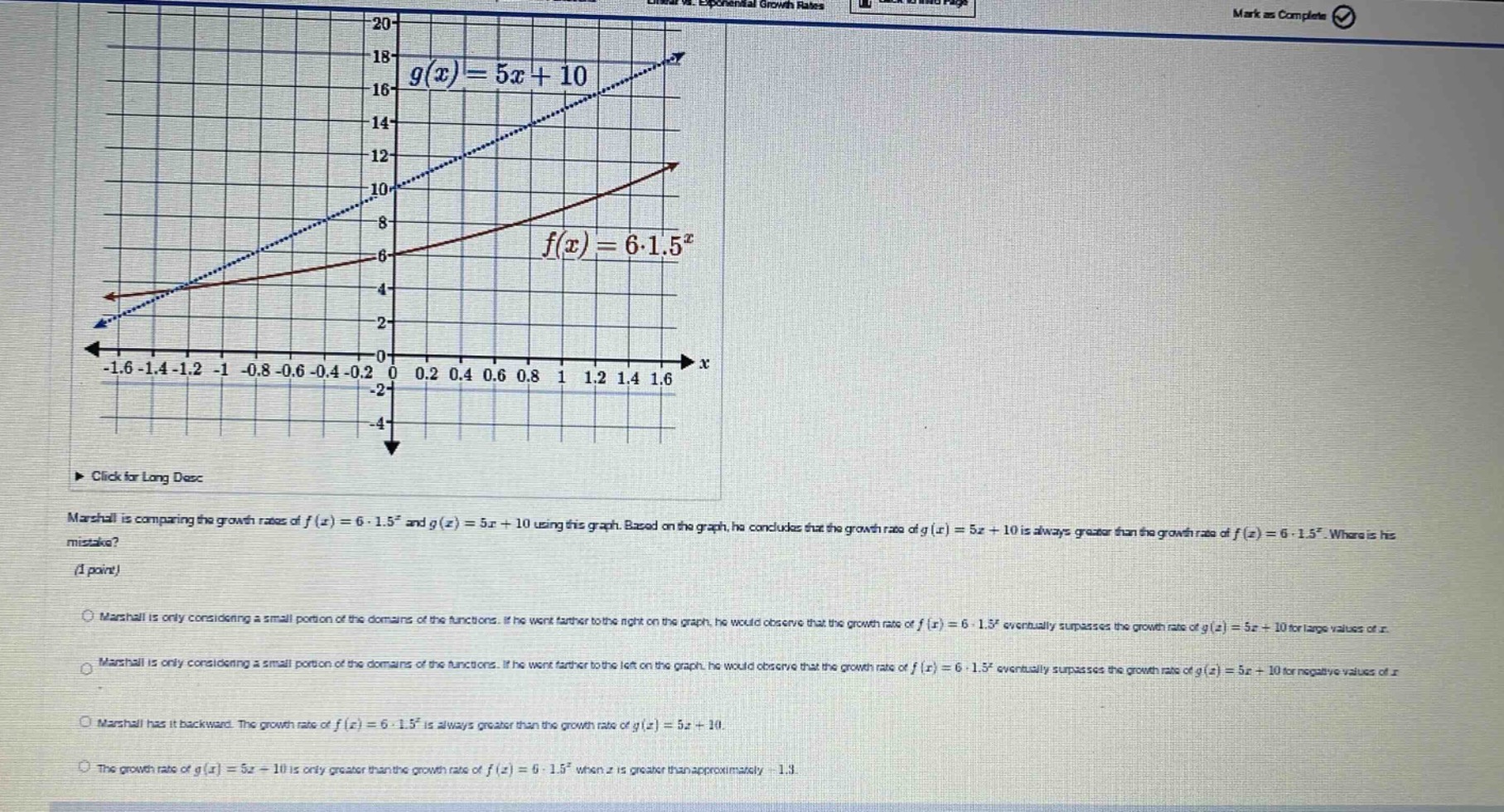
marshall is comparing the growth rates of $f(x) = 6 cdot 1.5^x$ and $g(x) = 5x + 10$ using this graph. based on the graph, he concludes that the growth rate of $g(x) = 5x + 10$ is always greater than the growth rate of $f(x) = 6 cdot 1.5^x$. where is his mistake?
(1 point)
- marshall is only considering a small portion of the domains of the functions. if he went farther to the right on the graph, he would observe that the growth rate of $f(x) = 6 cdot 1.5^x$ eventually surpasses the growth rate of $g(x) = 5x + 10$ for large values of $x$.
- marshall is only considering a small portion of the domains of the functions. if he went farther to the left on the graph, he would observe that the growth rate of $f(x) = 6 cdot 1.5^x$ eventually surpasses the growth rate of $g(x) = 5x + 10$ for negative values of $x$.
- marshall has it backward. the growth rate of $f(x) = 6 cdot 1.5^x$ is always greater than the growth rate of $g(x) = 5x + 10$.
- the growth rate of $g(x) = 5x + 10$ is only greater than the growth rate of $f(x) = 6 cdot 1.5^x$ when $x$ is greater than approximately $-1.3$.
To determine Marshall's mistake, we analyze the nature of the functions: \( f(x) = 6 \cdot 1.5^x \) is an exponential function (with base \( 1.5 > 1 \), so it grows exponentially), and \( g(x) = 5x + 10 \) is a linear function (grows at a constant rate). Exponential functions with a base greater than 1 eventually outpace linear functions as \( x \) becomes large (moves far to the right on the graph). Marshall only considers a small portion of the domain (the visible part of the graph). If he extended the graph to the right (for larger \( x \)), he would see that \( f(x) \)’s growth rate surpasses \( g(x) \)’s.
- The second option is incorrect because moving left (negative \( x \)) is not relevant to "eventual" growth (exponential growth dominates for large positive \( x \)).
- The third option is incorrect because initially (for small \( x \)), \( g(x) \)’s growth rate is greater.
- The fourth option is incorrect as it misinterprets the intersection point and the long - term behavior.

Snap & solve any problem in the app
Get step-by-step solutions on Sovi AI
Photo-based solutions with guided steps
Explore more problems and detailed explanations
A. Marshall is only considering a small portion of the domains of the functions. If he went farther to the right on the graph, he would observe that the growth rate of \( f(x)=6\cdot1.5^{x} \) eventually surpasses the growth rate of \( g(x)=5x + 10 \) for large values of \( x \).