QUESTION IMAGE
Question
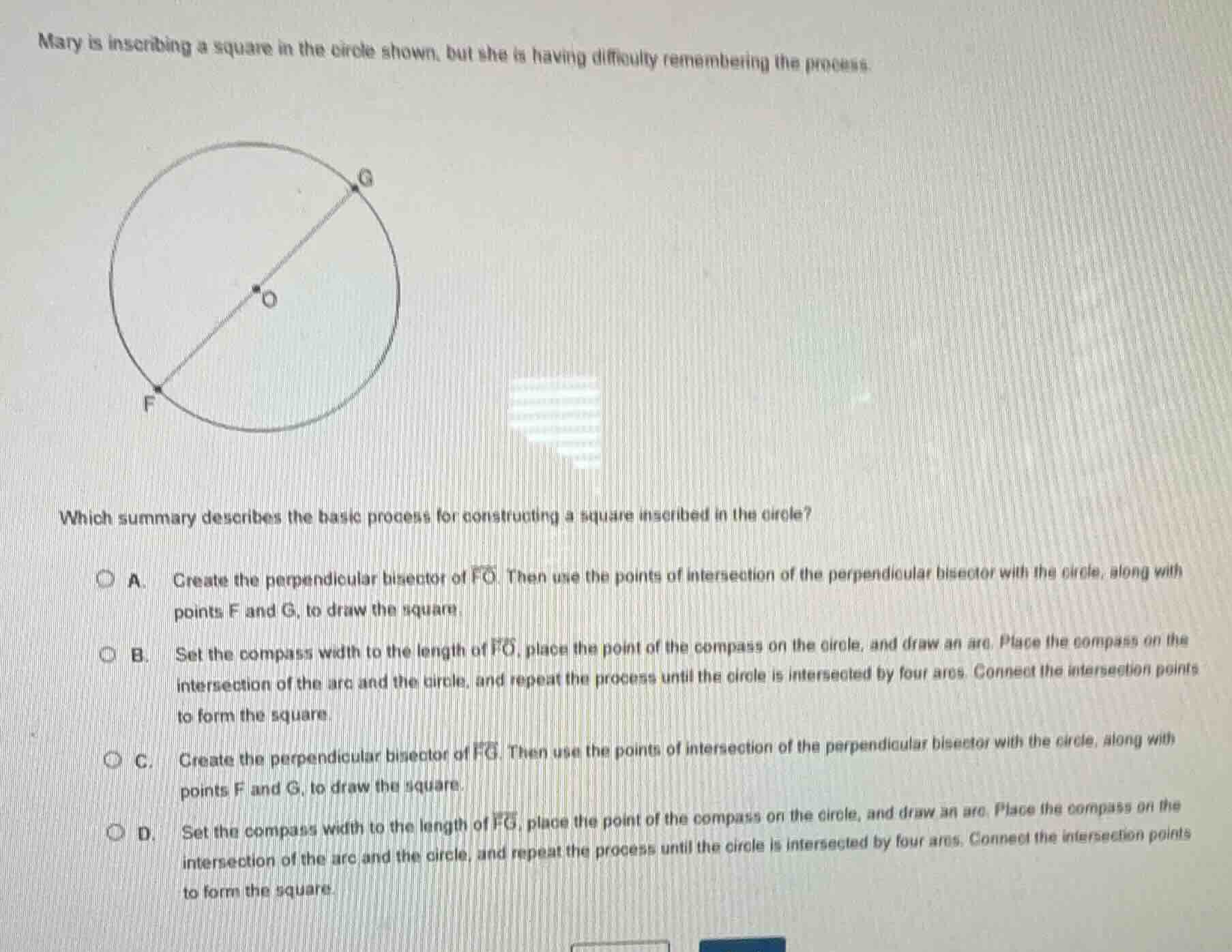
mary is inscribing a square in the circle shown, but she is having difficulty remembering the process.
which summary describes the basic process for constructing a square inscribed in the circle?
a. create the perpendicular bisector of (overline{fo}). then use the points of intersection of the perpendicular bisector with the circle, along with points f and g, to draw the square
b. set the compass width to the length of (overline{fo}), place the point of the compass on the circle, and draw an arc. place the compass on the intersection of the arc and the circle, and repeat the process until the circle is intersected by four arcs. connect the intersection points to form the square.
c. create the perpendicular bisector of (overline{fg}). then use the points of intersection of the perpendicular bisector with the circle, along with points f and g, to draw the square.
d. set the compass width to the length of (overline{fg}), place the point of the compass on the circle, and draw an arc. place the compass on the intersection of the arc and the circle, and repeat the process until the circle is intersected by four arcs. connect the intersection points to form the square.
$\overline{FG}$ is the circle's diameter. A square inscribed in a circle has its vertices on the circle, with its diagonals equal to the circle's diameter and perpendicular to each other. The perpendicular bisector of $\overline{FG}$ (a diameter) will be another perpendicular diameter, intersecting the circle at two new points. Connecting these four points (F, G, and the two new intersection points) forms the inscribed square. Options A uses a radius's bisector, which is incorrect. Options B and D use compass widths equal to radius/diameter to mark arcs, which does not create the right spacing for a square's vertices.

Snap & solve any problem in the app
Get step-by-step solutions on Sovi AI
Photo-based solutions with guided steps
Explore more problems and detailed explanations
C. Create the perpendicular bisector of $\overline{FG}$. Then use the points of intersection of the perpendicular bisector with the circle, along with points F and G, to draw the square.