QUESTION IMAGE
Question
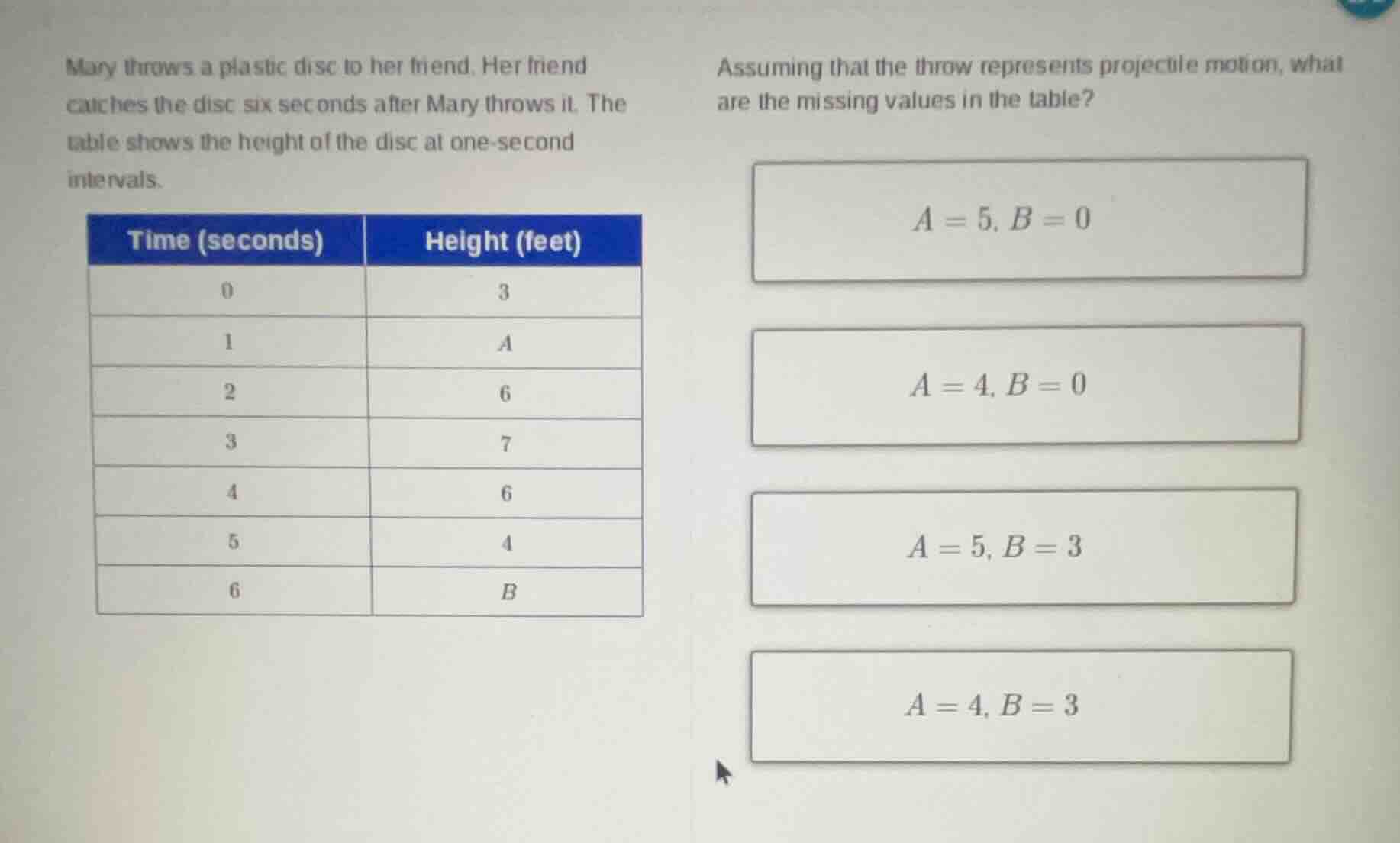
mary throws a plastic disc to her friend. her friend catches the disc six seconds after mary throws it. the table shows the height of the disc at one - second intervals.
| time (seconds) | height (feet) |
|---|---|
| 1 | a |
| 2 | 6 |
| 3 | 7 |
| 4 | 6 |
| 5 | 4 |
| 6 | b |
assuming that the throw represents projectile motion, what are the missing values in the table?
options:
$a = 5, b = 0$
$a = 4, b = 0$
$a = 5, b = 3$
$a = 4, b = 3$
Step1: Analyze projectile motion symmetry
Projectile motion is symmetric around the peak. The peak here is at \( t = 3 \) seconds (height = 7 feet). So, the height at \( t = 1 \) should mirror \( t = 5 \), and \( t = 0 \) should mirror \( t = 6 \).
Step2: Find value of \( A \)
At \( t = 5 \), height is 4. Wait, no, wait. Wait, the symmetry: the distance from peak (\( t = 3 \)): \( t = 1 \) is 2 seconds left of peak, \( t = 5 \) is 2 seconds right of peak. Wait, no, \( t = 0 \) to \( t = 3 \): let's check the heights. At \( t = 2 \), height is 6; \( t = 4 \), height is 6 (symmetric around \( t = 3 \)). So \( t = 1 \) should mirror \( t = 5 \). At \( t = 5 \), height is 4? Wait, no, wait the table: \( t = 0 \): 3, \( t = 1 \): \( A \), \( t = 2 \): 6, \( t = 3 \): 7, \( t = 4 \): 6, \( t = 5 \): 4, \( t = 6 \): \( B \). Wait, maybe symmetry around \( t = 3 \): so \( t = 0 \) and \( t = 6 \) should be equal (since 0 and 6 are 3 units from 3), \( t = 1 \) and \( t = 5 \) should be equal, \( t = 2 \) and \( t = 4 \) are equal (which they are, 6). So \( t = 1 \) (A) should equal \( t = 5 \) height? Wait \( t = 5 \) is 4? No, that can't be. Wait, maybe I messed up. Wait, let's check the time intervals. From \( t = 0 \) to \( t = 3 \), the height increases: 3, A, 6, 7. Then decreases: 7, 6, 4, B. Wait, the increase from \( t = 0 \) to \( t = 3 \): let's see the differences. From \( t = 0 \) to \( t = 1 \): 3 to A. \( t = 1 \) to \( t = 2 \): A to 6. \( t = 2 \) to \( t = 3 \): 6 to 7. Then decrease: \( t = 3 \) to \( t = 4 \): 7 to 6 (decrease by 1), \( t = 4 \) to \( t = 5 \): 6 to 4 (decrease by 2)? Wait, no, that's not symmetric. Wait, maybe the symmetry is around the peak, so the height at \( t = 0 \) should equal \( t = 6 \), and \( t = 1 \) equals \( t = 5 \), \( t = 2 \) equals \( t = 4 \). We see \( t = 2 \) (6) equals \( t = 4 \) (6), good. So \( t = 1 \) (A) should equal \( t = 5 \) (4)? No, that would make A = 4, but then \( t = 0 \) (3) should equal \( t = 6 \) (B), so B = 3. Wait, but let's check the options. One of the options is \( A = 5, B = 3 \)? No, wait the option \( A = 5, B = 3 \)? Wait no, the option \( A = 5, B = 3 \) or \( A = 4, B = 3 \)? Wait, let's re - evaluate. Wait, from \( t = 0 \) (3) to \( t = 1 \) (A) to \( t = 2 \) (6) to \( t = 3 \) (7). The increase: 3 to A: let's say the difference from 0 to 1 is \( A - 3 \), 1 to 2 is \( 6 - A \), 2 to 3 is \( 7 - 6 = 1 \). Then from 3 to 4: \( 6 - 7=- 1 \), 4 to 5: \( 4 - 6=-2 \), 5 to 6: \( B - 4 \). But due to symmetry, the path up and down should mirror. So the increase from 0 to 3 should mirror the decrease from 3 to 6. So the height at \( t = 0 \) (3) should equal \( t = 6 \) (B), so \( B = 3 \). Then, the height at \( t = 1 \) (A) should equal the height at \( t = 5 \) (4)? Wait no, \( t = 5 \) is 4, \( t = 1 \) would be 4? But then \( t = 0 \) is 3, \( t = 1 \) is 4, \( t = 2 \) is 6, \( t = 3 \) is 7, \( t = 4 \) is 6, \( t = 5 \) is 4, \( t = 6 \) is 3. But let's check the options. The option \( A = 5, B = 3 \): no, \( t = 5 \) is 4, so A can't be 5. Wait, wait maybe I made a mistake. Wait the table: \( t = 0 \): 3, \( t = 1 \): A, \( t = 2 \): 6, \( t = 3 \): 7, \( t = 4 \): 6, \( t = 5 \): 4, \( t = 6 \): B. Let's calculate the differences between consecutive times. From \( t = 0 \) to \( t = 1 \): \( A - 3 \). \( t = 1 \) to \( t = 2 \): \( 6 - A \). \( t = 2 \) to \( t = 3 \): \( 7 - 6 = 1 \). \( t = 3 \) to \( t = 4 \): \( 6 - 7=-1 \). \( t = 4 \) to \( t = 5 \): \( 4 - 6=-2 \). \( t = 5 \) to \( t = 6 \): \( B - 4 \). For projectile motion, the ac…

Snap & solve any problem in the app
Get step-by-step solutions on Sovi AI
Photo-based solutions with guided steps
Explore more problems and detailed explanations
\( A = 4, B = 3 \) (the option: \( A = 4, B = 3 \))