QUESTION IMAGE
Question
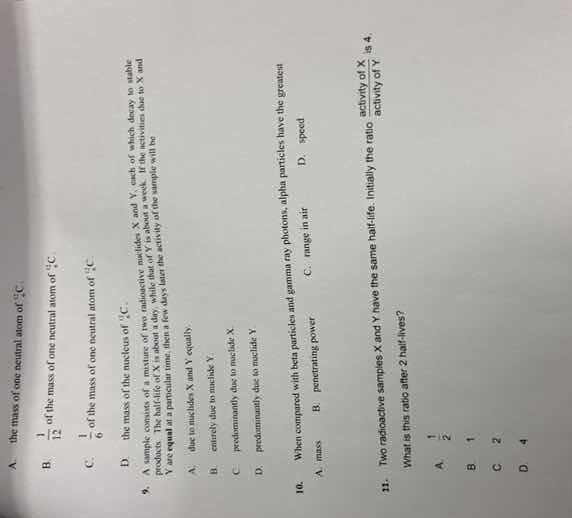
a. the mass of one neutral atom of ( _6^{12}\text{c} )\\b. ( \frac{1}{12} ) of the mass of one neutral atom of ( _6^{12}\text{c} )\\c. ( \frac{1}{6} ) of the mass of one neutral atom of ( _6^{12}\text{c} )\\d. the mass of the nucleus of one neutral atom of ( _6^{12}\text{c} )\\9. a sample contains a number of radioactive nuclides ( x ) and ( y ), which decay to stable nuclides. the graph of the activity of the sample with time is shown. after a few days, the activity of ( x ) is much less than that of ( y ), and the total activity of the sample (the sum of the activities of ( x ) and ( y )) is approximately equal to the activity of ( y ).\\a. ( x ) decays faster than ( y )\\b. ( x ) has a longer half - life than ( y )\\c. predominantly decays to ( x )\\d. predominantly decays to ( y )\\10. when a nucleus with beta particles and gamma ray photons, alpha particles have the greatest\\a. mass\\b. penetrating power\\c. range in air\\d. speed\\11. two radioactive samples ( x ) and ( y ) have the same initial activity. the ratio of the activity of ( x ) to that of ( y ) is 4. what is the ratio of their half - lives?\\a. ( \frac{1}{2} )\\b. 1\\c. 2\\d. 4
Question 9
Step1: Analyze half-life difference
Sample X has a half-life of ~1 day, sample Y has a half-life of ~1 week. After a few days, most of X will have decayed, while most of Y remains.
Step2: Determine dominant activity source
Since X decays faster, after days, its activity is nearly gone. Y's longer half-life means most remaining activity comes from Y.
Gamma rays have no mass or charge, beta particles have low mass/charge, and alpha particles have high mass/charge. Penetrating power correlates with the ability to pass through matter: gamma rays can travel through thick materials, beta through thin materials, and alpha is stopped by paper.
Step1: Define activity formula
Radioactive activity is given by $A = \lambda N$, where $\lambda = \frac{\ln2}{t_{1/2}}$ (decay constant, $t_{1/2}$ = half-life). Initial $N$ is equal for both samples.
Step2: Set up activity ratio
Initial activity ratio $\frac{A_X}{A_Y} = \frac{\lambda_X N}{\lambda_Y N} = \frac{t_{1/2,Y}}{t_{1/2,X}}$. Given $t_{1/2,X}=t_{1/2,Y}$, substitute values:
$\frac{A_X}{A_Y} = \frac{t_{1/2}}{t_{1/2}} = 1$

Snap & solve any problem in the app
Get step-by-step solutions on Sovi AI
Photo-based solutions with guided steps
Explore more problems and detailed explanations
D. predominantly due to nuclide Y
---