QUESTION IMAGE
Question
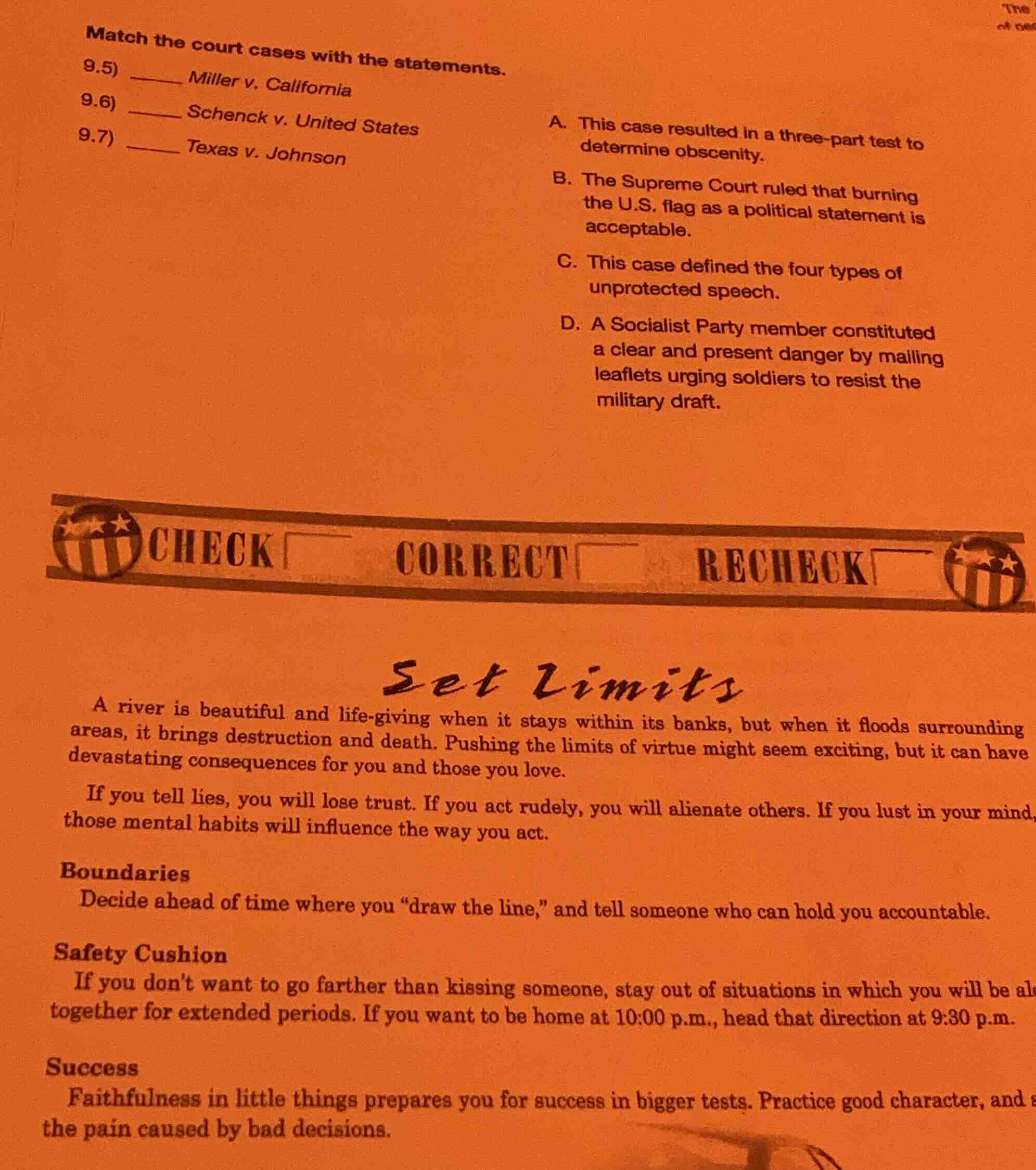
match the court cases with the statements.
9.5) ______ miller v. california
9.6) ______ schenck v. united states
9.7) ______ texas v. johnson
a. this case resulted in a three - part test to determine obscenity.
b. the supreme court ruled that burning the u.s. flag as a political statement is acceptable.
c. this case defined the four types of unprotected speech.
d. a socialist party member constituted a clear and present danger by mailing leaflets urging soldiers to resist the military draft.
set limits
a river is beautiful and life - giving when it stays within its banks, but when it floods surrounding areas, it brings destruction and death. pushing the limits of virtue might seem exciting, but it can have devastating consequences for you and those you love.
if you tell lies, you will lose trust. if you act rudely, you will alienate others. if you lust in your mind, those mental habits will influence the way you act.
boundaries
decide ahead of time where you \draw the line,\ and tell someone who can hold you accountable.
safety cushion
if you dont want to go farther than kissing someone, stay out of situations in which you will be alone together for extended periods. if you want to be home at 10:00 p.m., head that direction at 9:30 p.m.
success
faithfulness in little things prepares you for success in bigger tests. practice good character, and avoid the pain caused by bad decisions.
9.5) Miller v. California
Miller v. California established a three - part test (the Miller test) to determine obscenity. So it matches with option A.
In Schenck v. United States, a Socialist Party member was involved in mailing leaflets urging soldiers to resist the military draft, and the court considered it a clear and present danger. This matches option D.
Texas v. Johnson was the case where the Supreme Court ruled that burning the U.S. flag as a political statement is acceptable (protected by the First Amendment). This matches option B.

Snap & solve any problem in the app
Get step-by-step solutions on Sovi AI
Photo-based solutions with guided steps
Explore more problems and detailed explanations
A. This case resulted in a three - part test to determine obscenity.