QUESTION IMAGE
Question
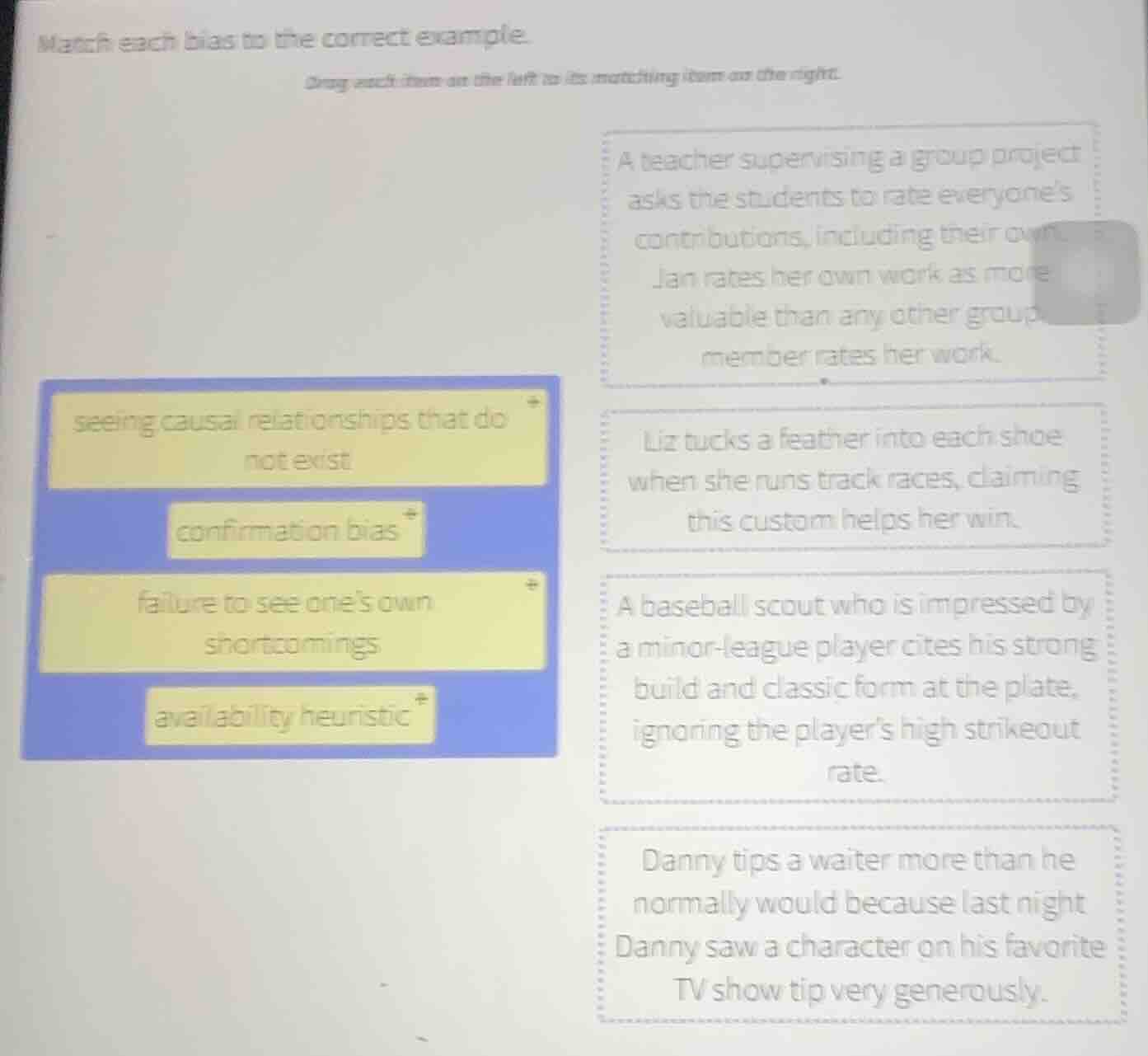
match each bias to the correct example. drag each item on the left to its matching item on the right. seeing causal relationships that do not exist confirmation bias failure to see ones own shortcomings availability heuristic a teacher supervising a group project asks the students to rate everyones contributions, including their own. jan rates her own work as more valuable than any other group member rates her work. liz tucks a feather into each shoe when she runs track races, claiming this custom helps her win. a baseball scout who is impressed by a minor - league player cites his strong build and classic form at the plate, ignoring the players high strikeout rate. danny tips a waiter more than he normally would because last night danny saw a character on his favorite tv show tip very generously.
- seeing causal relationships that do not exist: This bias assumes a cause-effect link where none exists. Liz believes her feather custom causes wins, with no actual evidence.
- confirmation bias: This bias focuses on information that supports existing beliefs while ignoring contradictory evidence. The scout highlights the player's positives and ignores his high strikeout rate.
- failure to see one's own shortcomings: This bias involves overestimating one's own abilities or work. Jan rates her own contribution higher than others do, failing to see her work's actual relative value.
- availability heuristic: This bias relies on recent, easily recalled information to make decisions. Danny's tipping is influenced by a recent TV scene he remembers.

Snap & solve any problem in the app
Get step-by-step solutions on Sovi AI
Photo-based solutions with guided steps
Explore more problems and detailed explanations
- seeing causal relationships that do not exist → Liz tucks a feather into each shoe when she runs track races, claiming this custom helps her win.
- confirmation bias → A baseball scout who is impressed by a minor-league player cites his strong build and classic form at the plate, ignoring the player's high strikeout rate.
- failure to see one's own shortcomings → A teacher supervising a group project asks the students to rate everyone's contributions, including their own. Jan rates her own work as more valuable than any other group member rates her work.
- availability heuristic → Danny tips a waiter more than he normally would because last night Danny saw a character on his favorite TV show tip very generously.