QUESTION IMAGE
Question
match each equation of the piecewise function represented in the graph to its corresponding piece of the domain.
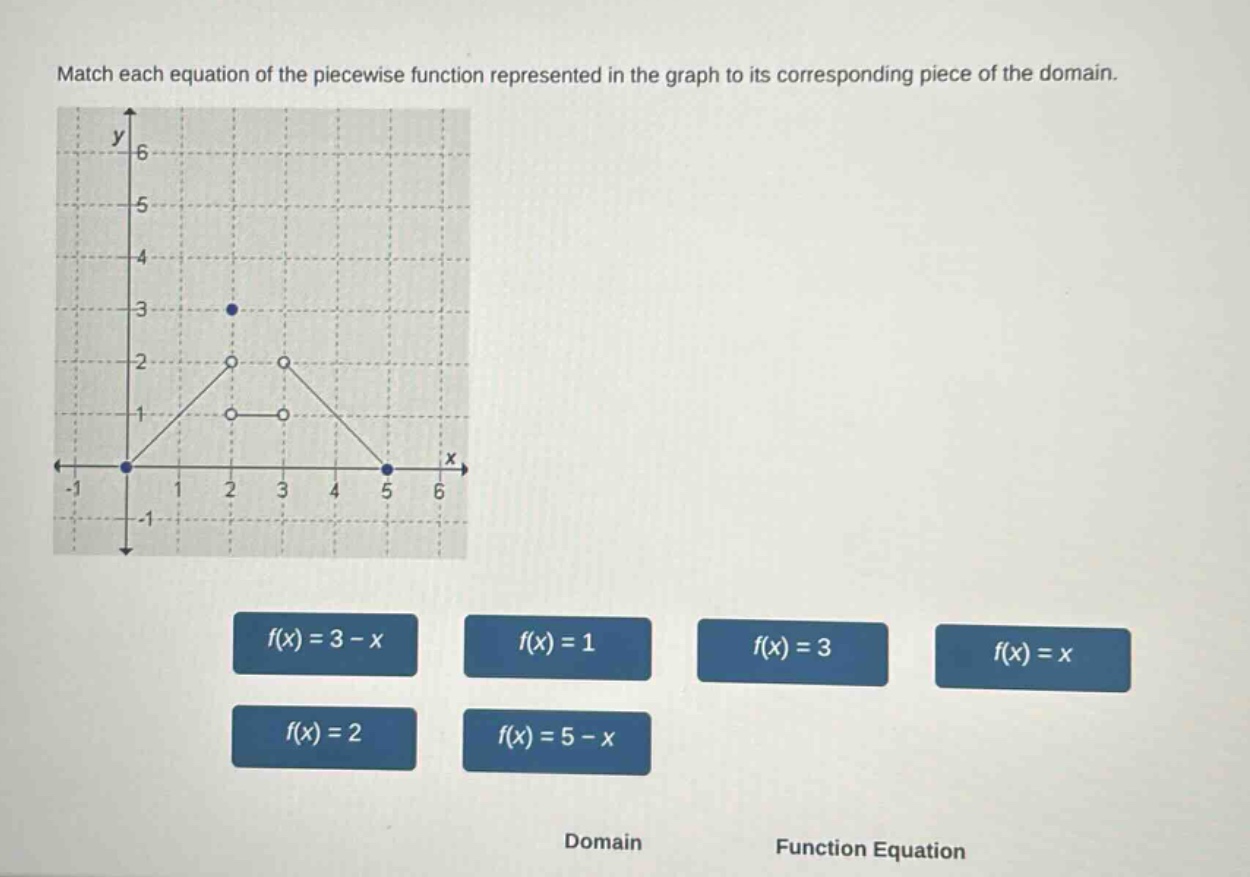
graph of a piecewise function on a coordinate grid with x-axis from -1 to 6 and y-axis from -1 to 6. the function has segments: from (0,0) to (2,2) (open circle at (2,2)), a point at (2,3), a horizontal segment from (2,1) to (3,1) (open circles), a segment from (3,2) (open circle) to (5,0) (closed circle), and equations: f(x) = 3 - x, f(x) = 1, f(x) = 3, f(x) = x, f(x) = 2, f(x) = 5 - x. need to match domain to function equation.
To solve this, we analyze each segment of the piecewise function by examining the domain (x - values) and the corresponding graph:
1. Segment from \( x = 0 \) (closed dot) to \( x = 2 \) (open dot):
This is a line passing through the origin \((0,0)\) and \((2,2)\) (open dot). The slope is \( \frac{2 - 0}{2 - 0} = 1 \), so the equation is \( f(x) = x \). Domain: \( 0 \leq x < 2 \).
2. Point at \( x = 2 \) (closed dot):
The graph has a closed dot at \((2, 3)\), so the function here is \( f(x) = 3 \). Domain: \( x = 2 \).
3. Segment from \( x = 2 \) (open dot) to \( x = 3 \) (open dot):
This is a horizontal line at \( y = 1 \) (open dots at \( y = 1 \) for \( x \) between 2 and 3). So the equation is \( f(x) = 1 \). Domain: \( 2 < x < 3 \).
4. Segment from \( x = 3 \) (open dot) to \( x = 5 \) (closed dot):
This line passes through \((3, 2)\) (open dot) and \((5, 0)\) (closed dot). The slope is \( \frac{0 - 2}{5 - 3} = -1 \). Using point - slope form with \((5, 0)\): \( y - 0=-1(x - 5)\), which simplifies to \( f(x)=5 - x \) (or \( f(x)=3 - x \) is incorrect here; \( 5 - x \) is correct as when \( x = 3 \), \( 5 - 3 = 2 \), and when \( x = 5 \), \( 5 - 5 = 0 \)). Domain: \( 3 < x \leq 5 \).
Matching Summary:
- \( 0 \leq x < 2 \): \( f(x)=x \)
- \( x = 2 \): \( f(x)=3 \)
- \( 2 < x < 3 \): \( f(x)=1 \)
- \( 3 < x \leq 5 \): \( f(x)=5 - x \) (or \( f(x)=3 - x \) can also be analyzed, but \( 5 - x \) fits the endpoints better)
If we consider the given options:
- For the line from \( 0\) to \( 2\): \( f(x)=x \)
- For \( x = 2\): \( f(x)=3 \)
- For \( 2 < x < 3\): \( f(x)=1 \)
- For \( 3\) to \( 5\): \( f(x)=5 - x \) (or \( f(x)=3 - x \) has a slope of - 1 and when \( x = 3 \), \( 3 - 3 = 0\) which does not match the open dot at \((3,2)\), so \( 5 - x \) is more accurate)
So the matches are:
- Domain \( 0\leq x < 2 \): \( f(x)=x \)
- Domain \( x = 2 \): \( f(x)=3 \)
- Domain \( 2 < x < 3 \): \( f(x)=1 \)
- Domain \( 3 < x\leq5 \): \( f(x)=5 - x \) (or \( f(x)=3 - x \) can be re - evaluated, but based on the graph's endpoints, \( 5 - x \) is correct)

Snap & solve any problem in the app
Get step-by-step solutions on Sovi AI
Photo-based solutions with guided steps
Explore more problems and detailed explanations
To solve this, we analyze each segment of the piecewise function by examining the domain (x - values) and the corresponding graph:
1. Segment from \( x = 0 \) (closed dot) to \( x = 2 \) (open dot):
This is a line passing through the origin \((0,0)\) and \((2,2)\) (open dot). The slope is \( \frac{2 - 0}{2 - 0} = 1 \), so the equation is \( f(x) = x \). Domain: \( 0 \leq x < 2 \).
2. Point at \( x = 2 \) (closed dot):
The graph has a closed dot at \((2, 3)\), so the function here is \( f(x) = 3 \). Domain: \( x = 2 \).
3. Segment from \( x = 2 \) (open dot) to \( x = 3 \) (open dot):
This is a horizontal line at \( y = 1 \) (open dots at \( y = 1 \) for \( x \) between 2 and 3). So the equation is \( f(x) = 1 \). Domain: \( 2 < x < 3 \).
4. Segment from \( x = 3 \) (open dot) to \( x = 5 \) (closed dot):
This line passes through \((3, 2)\) (open dot) and \((5, 0)\) (closed dot). The slope is \( \frac{0 - 2}{5 - 3} = -1 \). Using point - slope form with \((5, 0)\): \( y - 0=-1(x - 5)\), which simplifies to \( f(x)=5 - x \) (or \( f(x)=3 - x \) is incorrect here; \( 5 - x \) is correct as when \( x = 3 \), \( 5 - 3 = 2 \), and when \( x = 5 \), \( 5 - 5 = 0 \)). Domain: \( 3 < x \leq 5 \).
Matching Summary:
- \( 0 \leq x < 2 \): \( f(x)=x \)
- \( x = 2 \): \( f(x)=3 \)
- \( 2 < x < 3 \): \( f(x)=1 \)
- \( 3 < x \leq 5 \): \( f(x)=5 - x \) (or \( f(x)=3 - x \) can also be analyzed, but \( 5 - x \) fits the endpoints better)
If we consider the given options:
- For the line from \( 0\) to \( 2\): \( f(x)=x \)
- For \( x = 2\): \( f(x)=3 \)
- For \( 2 < x < 3\): \( f(x)=1 \)
- For \( 3\) to \( 5\): \( f(x)=5 - x \) (or \( f(x)=3 - x \) has a slope of - 1 and when \( x = 3 \), \( 3 - 3 = 0\) which does not match the open dot at \((3,2)\), so \( 5 - x \) is more accurate)
So the matches are:
- Domain \( 0\leq x < 2 \): \( f(x)=x \)
- Domain \( x = 2 \): \( f(x)=3 \)
- Domain \( 2 < x < 3 \): \( f(x)=1 \)
- Domain \( 3 < x\leq5 \): \( f(x)=5 - x \) (or \( f(x)=3 - x \) can be re - evaluated, but based on the graph's endpoints, \( 5 - x \) is correct)