QUESTION IMAGE
Question
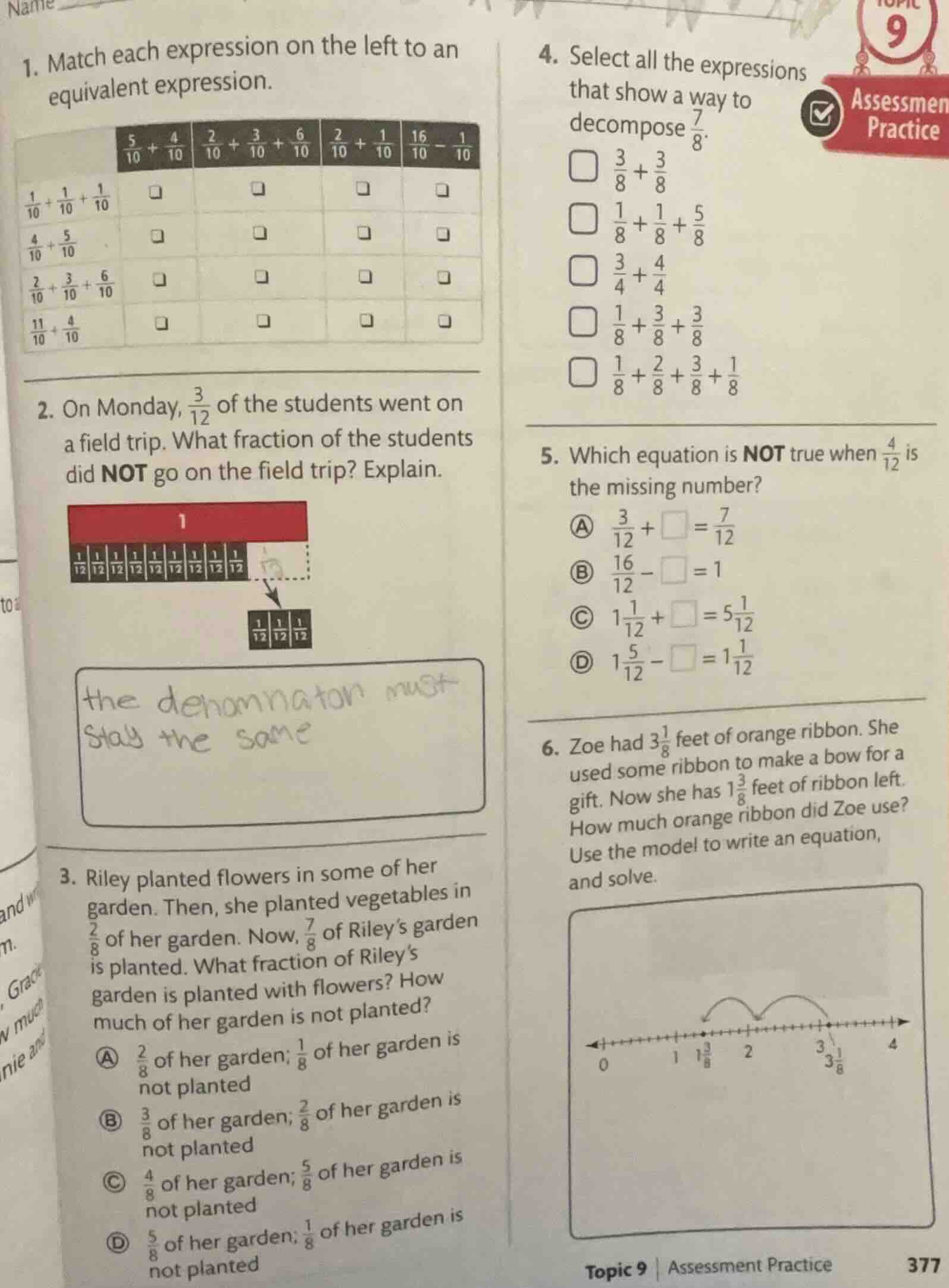
- match each expression on the left to an equivalent expression.
\\(\frac{5}{10}+\frac{4}{10}\\) \\(\frac{2}{10}+\frac{3}{10}+\frac{6}{10}\\) \\(\frac{2}{10}+\frac{1}{10}\\) \\(\frac{16}{10}-\frac{1}{10}\\)
\\(\frac{1}{10}+\frac{1}{10}+\frac{1}{10}\\)
\\(\frac{4}{10}+\frac{5}{10}\\)
\\(\frac{2}{10}+\frac{3}{10}+\frac{6}{10}\\)
\\(\frac{11}{10}+\frac{4}{10}\\)
- on monday, \\(\frac{3}{12}\\) of the students went on a field trip. what fraction of the students did not go on the field trip? explain.
- riley planted flowers in some of her garden. then, she planted vegetables in \\(\frac{2}{8}\\) of her garden. now, \\(\frac{7}{8}\\) of riley’s garden is planted. what fraction of riley’s garden is planted with flowers? how much of her garden is not planted?
a \\(\frac{2}{8}\\) of her garden; \\(\frac{1}{8}\\) of her garden is not planted
b \\(\frac{3}{8}\\) of her garden; \\(\frac{2}{8}\\) of her garden is not planted
c \\(\frac{4}{8}\\) of her garden; \\(\frac{5}{8}\\) of her garden is not planted
d \\(\frac{5}{8}\\) of her garden; \\(\frac{1}{8}\\) of her garden is not planted
- select all the expressions that show a way to decompose \\(\frac{7}{8}\\).
\\(\frac{3}{8}+\frac{3}{8}\\)
\\(\frac{1}{8}+\frac{1}{8}+\frac{5}{8}\\)
\\(\frac{3}{4}+\frac{4}{4}\\)
\\(\frac{1}{8}+\frac{3}{8}+\frac{3}{8}\\)
\\(\frac{1}{8}+\frac{2}{8}+\frac{3}{8}+\frac{1}{8}\\)
- which equation is not true when \\(\frac{4}{12}\\) is the missing number?
a \\(\frac{3}{12}+\square =\frac{7}{12}\\)
b \\(\frac{16}{12}-\square =1\\)
c \\(1\frac{1}{12}+\square =5\frac{1}{12}\\)
d \\(1\frac{5}{12}-\square =1\frac{1}{12}\\)
- zoe had \\(3\frac{1}{8}\\) feet of orange ribbon. she used some ribbon to make a bow for a gift. now she has \\(1\frac{3}{8}\\) feet of ribbon left. how much orange ribbon did zoe use? use the model to write an equation, and solve.
Question 2
Step1: Define total as 1 (whole)
The total fraction of students is \( 1=\frac{12}{12} \).
Step2: Subtract the fraction that went
Fraction not gone \( = 1-\frac{3}{12}=\frac{12}{12}-\frac{3}{12} \).
Step3: Calculate the subtraction
\( \frac{12 - 3}{12}=\frac{9}{12}=\frac{3}{4} \) (simplified, but keeping denominator 12: \( \frac{9}{12} \)). The explanation about denominator staying same is because when subtracting fractions with same denominator, we subtract numerators and keep denominator.
Step1: Find fraction with flowers
Let \( F \) be fraction with flowers. We know \( F+\frac{2}{8}=\frac{7}{8} \), so \( F=\frac{7}{8}-\frac{2}{8} \).
Step2: Calculate \( F \)
\( F = \frac{7 - 2}{8}=\frac{5}{8} \)? Wait, no, wait: Wait, the options have D as \( \frac{5}{8} \) for flowers? Wait no, wait the options: Wait the problem says "she planted vegetables in \( \frac{2}{8} \) of her garden. Now, \( \frac{7}{8} \) is planted." So flowers + vegetables = total planted. So flowers \( = \frac{7}{8}-\frac{2}{8}=\frac{5}{8} \). Then unplanted is \( 1-\frac{7}{8}=\frac{1}{8} \). So option D: \( \frac{5}{8} \) of her garden is planted with flowers; \( \frac{1}{8} \) of her garden is not planted.
Step3: Verify unplanted
Total garden is 1 (\( \frac{8}{8} \)). Unplanted \( = \frac{8}{8}-\frac{7}{8}=\frac{1}{8} \).
- \( \frac{1}{8}+\frac{1}{8}+\frac{5}{8} \): Sum of numerators \( 1 + 1+5 = 7 \), denominator 8, so \( \frac{7}{8} \).
- \( \frac{1}{8}+\frac{3}{8}+\frac{3}{8} \): Numerators \( 1+3 + 3=7 \), denominator 8, so \( \frac{7}{8} \).
- \( \frac{1}{8}+\frac{2}{8}+\frac{3}{8}+\frac{1}{8} \): Numerators \( 1+2 + 3+1 = 7 \), denominator 8, so \( \frac{7}{8} \).

Snap & solve any problem in the app
Get step-by-step solutions on Sovi AI
Photo-based solutions with guided steps
Explore more problems and detailed explanations
The fraction of students who did not go on the field trip is \( \frac{9}{12} \) (or \( \frac{3}{4} \)). We find this by subtracting the fraction that went (\( \frac{3}{12} \)) from 1 (represented as \( \frac{12}{12} \)): \( \frac{12}{12}-\frac{3}{12}=\frac{9}{12} \), and we keep the denominator the same during subtraction of fractions with equal denominators.