QUESTION IMAGE
Question
match each expression with its value.
-3 -7 5 undefined
$h(-1)$
$h(0.999)$
$h(1.0001)$
$h(9)$
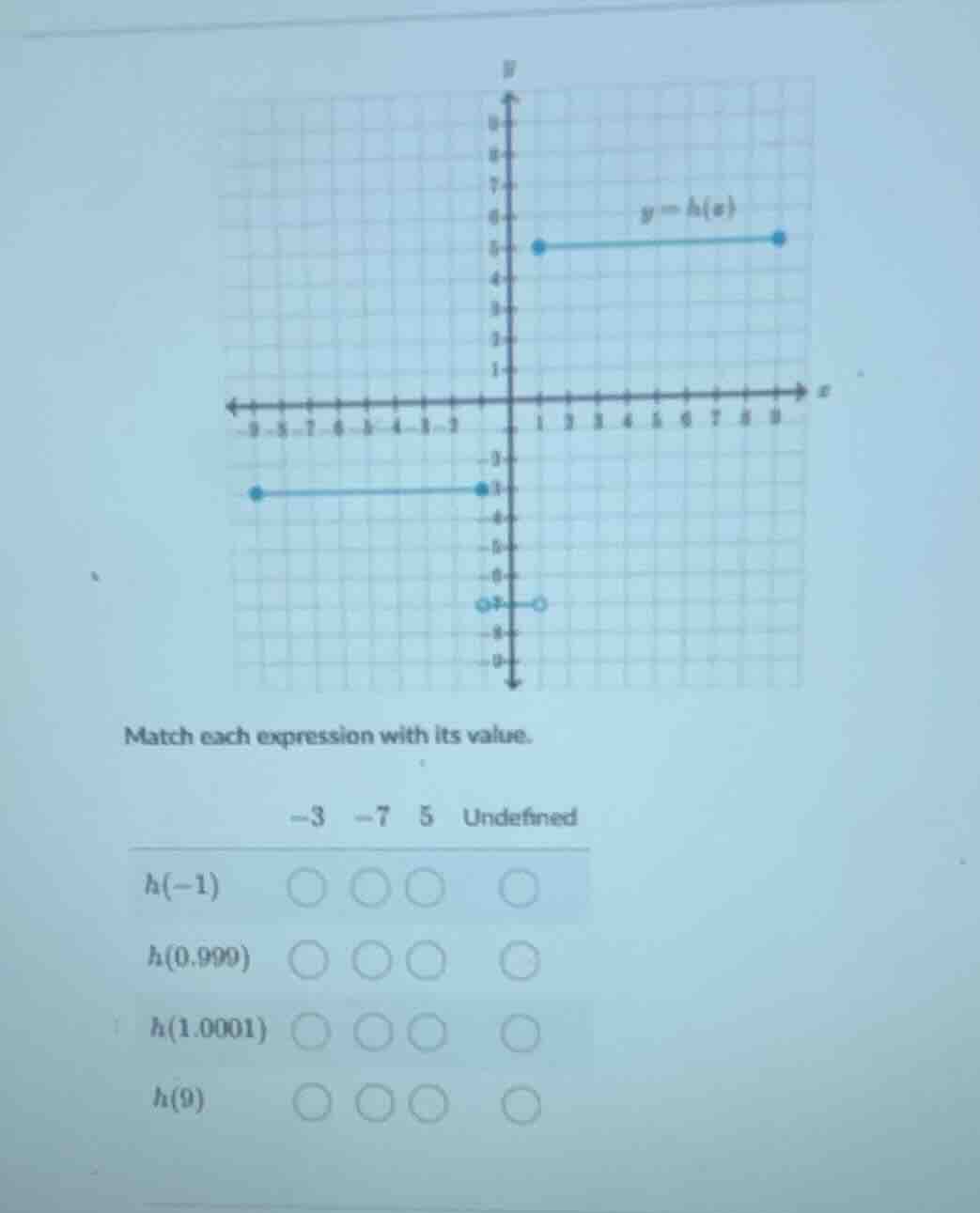
(there is a graph of $y = h(x)$ with coordinate grid, horizontal and vertical lines, and blue dots marking points.)
Step1: Analyze \( h(-1) \)
Looking at the graph, for \( x = -1 \), we check the horizontal line segment. The segment from \( x=-8 \) (approx) to \( x = -1 \) (maybe, need to see the y - value) has \( y=-3 \)? Wait, no, let's re - examine. Wait, the lower horizontal segment: the left end is at some \( x=-8 \) (blue dot) and right end at \( x=-1 \) (blue dot) with \( y = - 3 \)? Wait, no, the middle part: the open circles at \( x = 0 \) (maybe) with \( y=-7 \)? Wait, no, let's look again.
Wait, the graph:
- The upper horizontal line: from \( x = 0 \) (or \( x = 1 \)?) with \( y = 5 \), from \( x=0 \) (left blue dot) to \( x = 9 \) (right blue dot) with \( y = 5 \).
- The middle horizontal line: from \( x=-8 \) (left blue dot) to \( x=-1 \) (right blue dot) with \( y=-3 \).
- The lower part: open circles at \( x = 0 \) (maybe) with \( y=-7 \).
So:
- \( h(-1) \): \( x=-1 \) is on the middle horizontal line (from \( x=-8 \) to \( x=-1 \)) with \( y=-3 \)? Wait, no, the middle line's right end is at \( x=-1 \), so \( h(-1)=-3 \)? Wait, no, maybe I misread. Wait, the middle line: left blue dot at \( x=-8 \), right blue dot at \( x=-1 \), \( y=-3 \). So \( h(-1)=-3 \).
Step2: Analyze \( h(0.999) \)
\( x = 0.999 \) is close to \( x = 1 \), but the upper line starts at \( x = 0 \) (left blue dot) with \( y = 5 \)? Wait, no, the lower part: open circles at \( x = 0 \) (maybe) with \( y=-7 \). Wait, \( x=0.999 \) is between \( x = 0 \) and \( x = 1 \)? Wait, the lower part has open circles (so not included), and the middle part is for \( x\leq - 1 \), upper part for \( x\geq0 \)? Wait, maybe the domain:
- For \( x\in[-8,-1] \), \( h(x)=-3 \)
- For \( x\in[0,9] \), \( h(x)=5 \)
- For \( x\in(0,0) \)? No, the lower part: \( x\in(0,0) \)? No, open circles at \( x = 0 \) (maybe \( x\in(0,1) \)?) with \( y=-7 \). Wait, \( x = 0.999 \) is in \( (0,1) \), where the function has \( y=-7 \)? Wait, the open circles are at \( x = 0 \) (left open) and \( x = 1 \) (right open) with \( y=-7 \). So \( x = 0.999 \) is in \( (0,1) \), so \( h(0.999)=-7 \).
Step3: Analyze \( h(1.0001) \)
\( x = 1.0001 \) is greater than \( 1 \), so it's on the upper horizontal line (from \( x = 0 \) to \( x = 9 \)) with \( y = 5 \). So \( h(1.0001)=5 \).
Step4: Analyze \( h(9) \)
\( x = 9 \) is on the upper horizontal line (right blue dot at \( x = 9 \)), so \( h(9)=5 \). Wait, no, the upper line's right end is at \( x = 9 \), so \( h(9)=5 \). Wait, but also, the lower part: no, \( x = 9 \) is in \( [0,9] \), so \( h(9)=5 \).
Wait, also, the lower part: \( x\in(0,1) \), \( h(x)=-7 \) (open circles, so the function is not defined there? No, the open circles mean the function is not defined at the endpoints, but for \( x\in(0,1) \), the function has \( y=-7 \) (open circles, so maybe it's a jump discontinuity).
Wait, let's re - summarize:
- \( h(-1) \): \( x=-1 \) is in \( [-8,-1] \), so \( h(-1)=-3 \)
- \( h(0.999) \): \( x = 0.999\in(0,1) \), where the function has \( y=-7 \) (open circles, but the value is \( - 7 \))
- \( h(1.0001) \): \( x = 1.0001\geq0 \), so \( h(x)=5 \)
- \( h(9) \): \( x = 9\geq0 \), so \( h(x)=5 \)
Wait, maybe I made a mistake in \( h(0.999) \). Let's check the lower part: open circles at \( x = 0 \) (left open) and \( x = 1 \) (right open) with \( y=-7 \). So for \( x\in(0,1) \), \( h(x)=-7 \). So \( h(0.999)=-7 \).
And \( h(-1) \): \( x=-1 \) is in \( [-8,-1] \), so \( h(-1)=-3 \)
\( h(1.0001) \): \( x = 1.0001\geq0 \), so \( h(x)=5 \)
\( h(9) \): \( x = 9\geq0 \), so \( h(x)=5 \)

Snap & solve any problem in the app
Get step-by-step solutions on Sovi AI
Photo-based solutions with guided steps
Explore more problems and detailed explanations
- \( h(-1) \): \(-3\)
- \( h(0.999) \): \(-7\)
- \( h(1.0001) \): \(5\)
- \( h(9) \): \(5\)