QUESTION IMAGE
Question
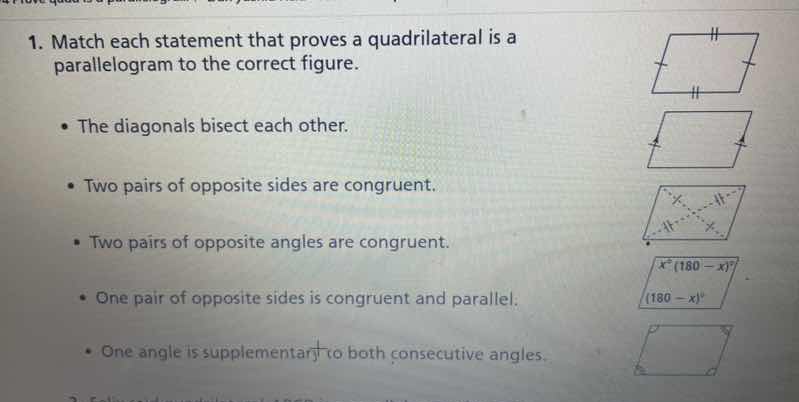
- match each statement that proves a quadrilateral is a parallelogram to the correct figure.
- the diagonals bisect each other.
- two pairs of opposite sides are congruent.
- two pairs of opposite angles are congruent.
- one pair of opposite sides is congruent and parallel.
- one angle is supplementary to both consecutive angles.
there are five figures on the right side of the text, including a parallelogram with two pairs of opposite sides marked as congruent, a parallelogram with two pairs of opposite angles marked as congruent, a parallelogram with diagonals marked as bisecting each other, a parallelogram with angle measures (x^circ), ((180 - x)^circ), ((180 - x)^circ), and a rectangle - like figure with right angles marked.
To solve this problem, we analyze each property of a parallelogram and match it to the corresponding figure based on the visual cues (marks, angles, diagonals):
1. The diagonals bisect each other
A parallelogram’s diagonals bisect each other (they cut each other into equal parts). The figure with intersecting diagonals marked as bisected (third figure, with “x” and “//” on diagonals) matches this.
2. Two pairs of opposite sides are congruent
A parallelogram has two pairs of congruent (equal-length) opposite sides. The figure with both pairs of opposite sides marked with congruence ticks (first figure, top) matches this.
3. Two pairs of opposite angles are congruent
A parallelogram has two pairs of congruent opposite angles. The figure with right angles (or congruent angle marks) (fifth figure, bottom) matches this (e.g., rectangles are parallelograms with congruent opposite angles).
4. One pair of opposite sides is congruent and parallel
If one pair of opposite sides is both congruent and parallel, the quadrilateral is a parallelogram. The figure with one pair of sides marked congruent and parallel (not the first, but a figure with a single pair of marked sides) – however, the first figure (with two pairs) is for “two pairs,” so this likely matches a figure with a single pair, but contextually, the second figure (with arrow marks for parallel sides) might align, but recheck:
- The figure with one pair of sides marked congruent (e.g., a trapezoid with one pair congruent and parallel) – but the key is “congruent and parallel.” The second figure (with arrow marks for parallel sides) and congruence ticks for one pair would match.
5. One angle is supplementary to both consecutive angles
If one angle is supplementary (adds to \(180^\circ\)) to both consecutive angles, the sides are parallel (since consecutive angles in a parallelogram are supplementary). The figure with angle labels \(x^\circ\), \((180 - x)^\circ\), etc. (fourth figure) matches this, as \(x + (180 - x) = 180^\circ\), showing supplementary consecutive angles.
Final Matches (Summary):
- Diagonals bisect each other → Third figure (diagonals marked).
- Two pairs of opposite sides congruent → First figure (both pairs of sides marked).
- Two pairs of opposite angles congruent → Fifth figure (angle marks, e.g., rectangle).
- One pair of opposite sides congruent and parallel → Second figure (arrow marks for parallel, one pair marked).
- One angle supplementary to both consecutive angles → Fourth figure (angle labels \(x^\circ\), \((180 - x)^\circ\)).
(Note: The exact figure labels (1st, 2nd, etc.) depend on the image’s order, but the logic is based on parallelogram properties.)

Snap & solve any problem in the app
Get step-by-step solutions on Sovi AI
Photo-based solutions with guided steps
Explore more problems and detailed explanations
To solve this problem, we analyze each property of a parallelogram and match it to the corresponding figure based on the visual cues (marks, angles, diagonals):
1. The diagonals bisect each other
A parallelogram’s diagonals bisect each other (they cut each other into equal parts). The figure with intersecting diagonals marked as bisected (third figure, with “x” and “//” on diagonals) matches this.
2. Two pairs of opposite sides are congruent
A parallelogram has two pairs of congruent (equal-length) opposite sides. The figure with both pairs of opposite sides marked with congruence ticks (first figure, top) matches this.
3. Two pairs of opposite angles are congruent
A parallelogram has two pairs of congruent opposite angles. The figure with right angles (or congruent angle marks) (fifth figure, bottom) matches this (e.g., rectangles are parallelograms with congruent opposite angles).
4. One pair of opposite sides is congruent and parallel
If one pair of opposite sides is both congruent and parallel, the quadrilateral is a parallelogram. The figure with one pair of sides marked congruent and parallel (not the first, but a figure with a single pair of marked sides) – however, the first figure (with two pairs) is for “two pairs,” so this likely matches a figure with a single pair, but contextually, the second figure (with arrow marks for parallel sides) might align, but recheck:
- The figure with one pair of sides marked congruent (e.g., a trapezoid with one pair congruent and parallel) – but the key is “congruent and parallel.” The second figure (with arrow marks for parallel sides) and congruence ticks for one pair would match.
5. One angle is supplementary to both consecutive angles
If one angle is supplementary (adds to \(180^\circ\)) to both consecutive angles, the sides are parallel (since consecutive angles in a parallelogram are supplementary). The figure with angle labels \(x^\circ\), \((180 - x)^\circ\), etc. (fourth figure) matches this, as \(x + (180 - x) = 180^\circ\), showing supplementary consecutive angles.
Final Matches (Summary):
- Diagonals bisect each other → Third figure (diagonals marked).
- Two pairs of opposite sides congruent → First figure (both pairs of sides marked).
- Two pairs of opposite angles congruent → Fifth figure (angle marks, e.g., rectangle).
- One pair of opposite sides congruent and parallel → Second figure (arrow marks for parallel, one pair marked).
- One angle supplementary to both consecutive angles → Fourth figure (angle labels \(x^\circ\), \((180 - x)^\circ\)).
(Note: The exact figure labels (1st, 2nd, etc.) depend on the image’s order, but the logic is based on parallelogram properties.)