QUESTION IMAGE
Question
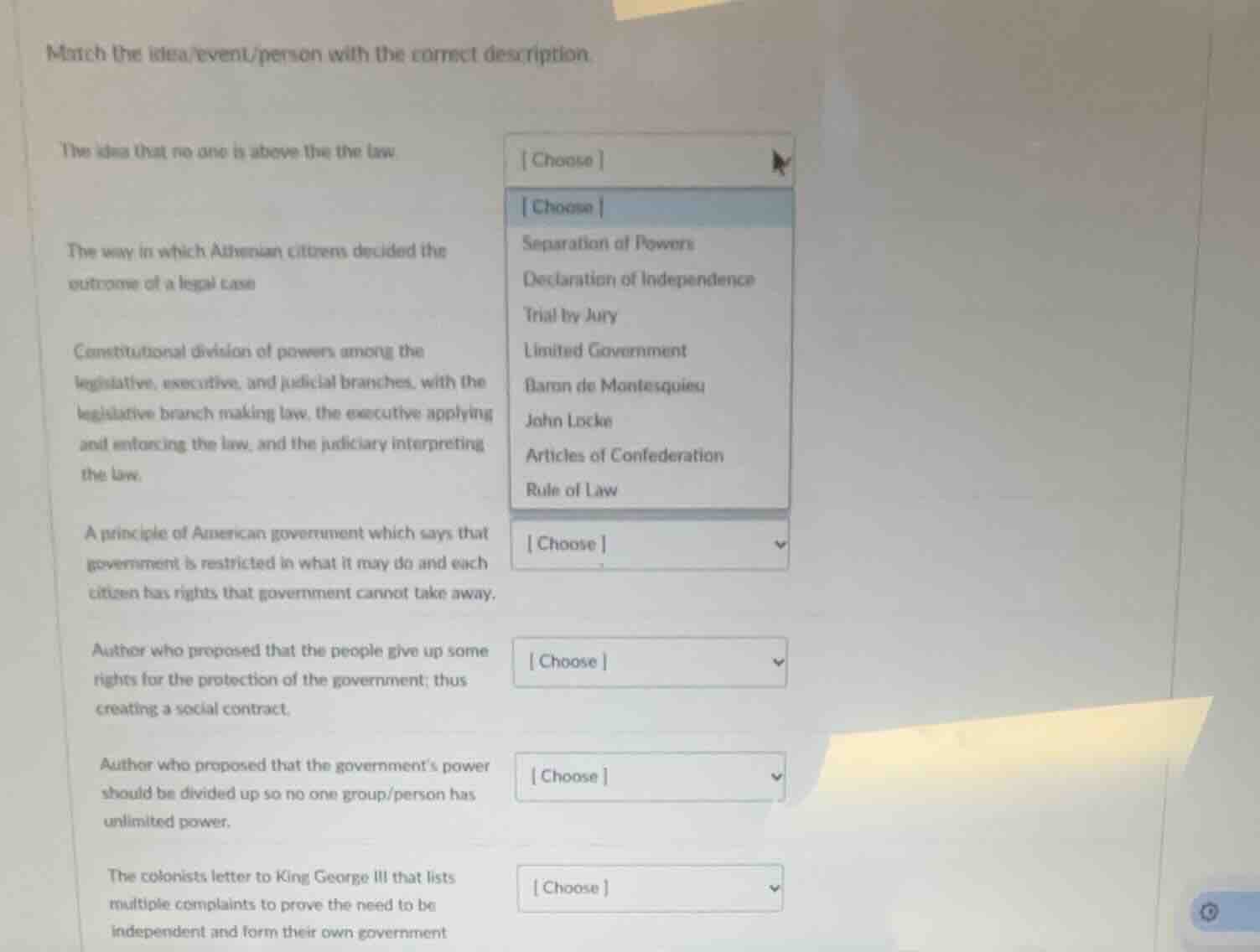
match the idea/event/person with the correct description
the idea that no one is above the the law
choose
the way in which athenian citizens decided the outcome of a legal case
choose
separation of powers
declaration of independence
trial by jury
limited government
baron de montesquieu
john locke
articles of confederation
rule of law
constitutional division of powers among the legislative, executive, and judicial branches, with the legislative branch making law, the executive applying and enforcing the law, and the judiciary interpreting the law.
choose
a principle of american government which says that government is restricted in what it may do and each citizen has rights that government cannot take away.
choose
author who proposed that the people give up some rights for the protection of the government; thus creating a social contract.
choose
author who proposed that the government’s power should be divided up so no one group/person has unlimited power.
choose
the colonists letter to king george iii that lists multiple complaints to prove the need to be independent and form their own government
choose
Each match is based on core definitions and historical context of political and legal concepts/figures:
- "Rule of Law" is defined as the principle that all people and institutions are subject to and accountable under the law, meaning no one is above it.
- "Trial by Jury" originated in ancient Athens, where citizens decided legal case outcomes.
- "Separation of Powers" refers to dividing government authority into legislative, executive, and judicial branches with distinct functions.
- "Limited Government" is the American principle that restricts government actions and protects citizen rights the government cannot infringe.
- John Locke was a philosopher who argued for the social contract, where people surrender some rights to government for protection.
- Baron de Montesquieu proposed the separation of powers to prevent unlimited government authority.
- The "Declaration of Independence" was the colonists' formal letter to King George III listing grievances justifying independence.

Snap & solve any problem in the app
Get step-by-step solutions on Sovi AI
Photo-based solutions with guided steps
Explore more problems and detailed explanations
- The idea that no one is above the the law. → Rule of Law
- The way in which Athenian citizens decided the outcome of a legal case → Trial by Jury
- Constitutional division of powers among the legislative, executive, and judicial branches, with the legislative branch making law, the executive applying and enforcing the law, and the judiciary interpreting the law. → Separation of Powers
- A principle of American government which says that government is restricted in what it may do and each citizen has rights that government cannot take away. → Limited Government
- Author who proposed that the people give up some rights for the protection of the government; thus creating a social contract. → John Locke
- Author who proposed that the government's power should be divided up so no one group/person has unlimited power. → Baron de Montesquieu
- The colonists letter to King George III that lists multiple complaints to prove the need to be independent and form their own government → Declaration of Independence