QUESTION IMAGE
Question
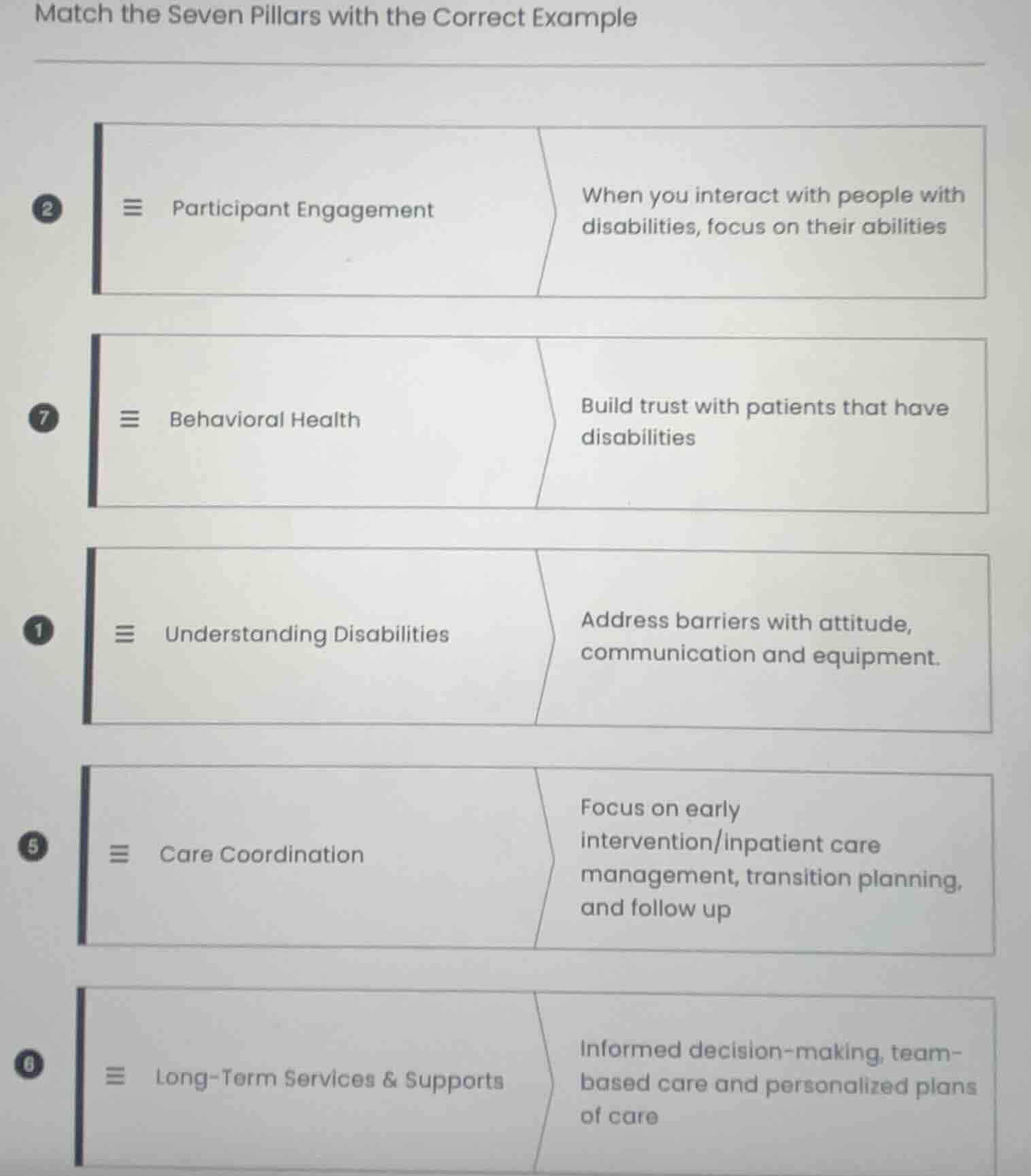
match the seven pillars with the correct example
2 participant engagement when you interact with people with disabilities, focus on their abilities
7 behavioral health build trust with patients that have disabilities
1 understanding disabilities address barriers with attitude, communication and equipment.
5 care coordination focus on early intervention/inpatient care management, transition planning, and follow up
6 long - term services & supports informed decision - making, team - based care and personalized plans of care
To solve this matching problem, we analyze each pillar and its corresponding example based on the context of disability - related care and support:
1. Participant Engagement
The key aspect of participant engagement in the context of people with disabilities is building a good relationship. The example "Build trust with patients that have disabilities" is about establishing a connection with disabled patients, which is in line with the idea of engaging participants. So, Participant Engagement should be matched with "Build trust with patients that have disabilities".
2. Behavioral Health
Behavioral Health in this context is about the psychological and behavioral aspects of care. The example "When you interact with people with disabilities, focus on their abilities" is related to the behavioral approach of interacting with disabled people, as it influences how we behave towards them. So, Behavioral Health should be matched with "When you interact with people with disabilities, focus on their abilities".
3. Understanding Disabilities
Understanding disabilities involves knowing about the challenges they face. The example "Address barriers with attitude, communication and equipment" is about dealing with the barriers that come with disabilities, which is a part of understanding how to support them. So, Understanding Disabilities should be matched with "Address barriers with attitude, communication and equipment".
4. Care Coordination
Care Coordination is about managing the care process over time. The example "Focus on early intervention/inpatient care management, transition planning, and follow up" is about the different stages of care management, which is the core of care coordination. So, Care Coordination should be matched with "Focus on early intervention/inpatient care management, transition planning, and follow up".
5. Long - Term Services & Supports
Long - Term Services & Supports are about the long - term care plans. The example "Informed decision - making, team - based care and personalized plans of care" is about creating personalized and team - based long - term care plans, which is related to long - term services and supports. So, Long - Term Services & Supports should be matched with "Informed decision - making, team - based care and personalized plans of care".
Final Matches:
- Participant Engagement: Build trust with patients that have disabilities
- Behavioral Health: When you interact with people with disabilities, focus on their abilities
- Understanding Disabilities: Address barriers with attitude, communication and equipment
- Care Coordination: Focus on early intervention/inpatient care management, transition planning, and follow up
- Long - Term Services & Supports: Informed decision - making, team - based care and personalized plans of care

Snap & solve any problem in the app
Get step-by-step solutions on Sovi AI
Photo-based solutions with guided steps
Explore more problems and detailed explanations
To solve this matching problem, we analyze each pillar and its corresponding example based on the context of disability - related care and support:
1. Participant Engagement
The key aspect of participant engagement in the context of people with disabilities is building a good relationship. The example "Build trust with patients that have disabilities" is about establishing a connection with disabled patients, which is in line with the idea of engaging participants. So, Participant Engagement should be matched with "Build trust with patients that have disabilities".
2. Behavioral Health
Behavioral Health in this context is about the psychological and behavioral aspects of care. The example "When you interact with people with disabilities, focus on their abilities" is related to the behavioral approach of interacting with disabled people, as it influences how we behave towards them. So, Behavioral Health should be matched with "When you interact with people with disabilities, focus on their abilities".
3. Understanding Disabilities
Understanding disabilities involves knowing about the challenges they face. The example "Address barriers with attitude, communication and equipment" is about dealing with the barriers that come with disabilities, which is a part of understanding how to support them. So, Understanding Disabilities should be matched with "Address barriers with attitude, communication and equipment".
4. Care Coordination
Care Coordination is about managing the care process over time. The example "Focus on early intervention/inpatient care management, transition planning, and follow up" is about the different stages of care management, which is the core of care coordination. So, Care Coordination should be matched with "Focus on early intervention/inpatient care management, transition planning, and follow up".
5. Long - Term Services & Supports
Long - Term Services & Supports are about the long - term care plans. The example "Informed decision - making, team - based care and personalized plans of care" is about creating personalized and team - based long - term care plans, which is related to long - term services and supports. So, Long - Term Services & Supports should be matched with "Informed decision - making, team - based care and personalized plans of care".
Final Matches:
- Participant Engagement: Build trust with patients that have disabilities
- Behavioral Health: When you interact with people with disabilities, focus on their abilities
- Understanding Disabilities: Address barriers with attitude, communication and equipment
- Care Coordination: Focus on early intervention/inpatient care management, transition planning, and follow up
- Long - Term Services & Supports: Informed decision - making, team - based care and personalized plans of care