QUESTION IMAGE
Question
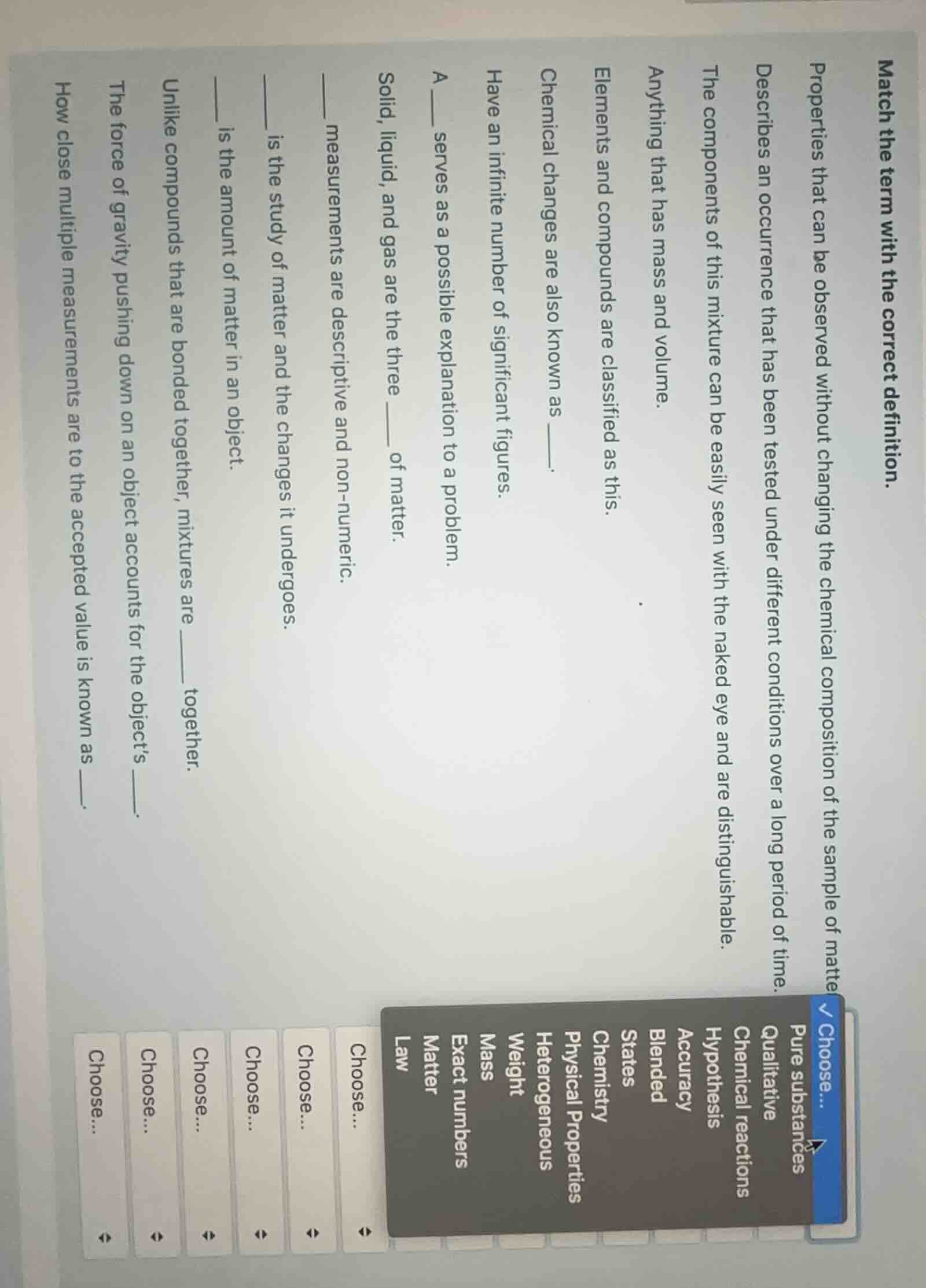
match the term with the correct definition.
properties that can be observed without changing the chemical composition of the sample of matte.
describes an occurrence that has been tested under different conditions over a long period of time.
the components of this mixture can be easily seen with the naked eye and are distinguishable.
anything that has mass and volume.
elements and compounds are classified as this.
chemical changes are also known as ______.
have an infinite number of significant figures.
a ______ serves as a possible explanation to a problem.
solid, liquid, and gas are the three ______ of matter.
______ measurements are descriptive and non - numeric.
______ is the study of matter and the changes it undergoes.
______ is the amount of matter in an object.
unlike compounds that are bonded together, mixtures are ______ together.
the force of gravity pushing down on an object accounts for the object’s ______.
how close multiple measurements are to the accepted value is known as ______.
choose...
choose...
choose...
choose...
choose...
choose...
choose...
choose...
choose...
choose...
choose...
choose...
choose...
choose...
choose...
pure substances
qualitative
chemical reactions
hypothesis
accuracy
blended
states
chemistry
physical properties
heterogeneous
weight
mass
exact numbers
matter
law
Each term is matched based on standard definitions in basic chemistry:
- Physical properties are observable without altering chemical identity.
- A scientific law is a repeatedly confirmed observed phenomenon.
- Heterogeneous mixtures have visibly distinct components.
- Matter is defined as anything with mass and volume.
- Pure substances include elements and chemically bonded compounds.
- Chemical changes involve forming new substances via chemical reactions.
- Exact numbers (e.g., counts) have unlimited significant figures.
- A hypothesis is a testable proposed explanation for a problem.
- Solid, liquid, gas are the three common states of matter.
- Qualitative data uses descriptive, non-numeric observations.
- Chemistry is the study of matter and its transformations.
- Mass is the measure of the amount of matter in an object.
- Mixtures are physically blended (not chemically bonded) materials.
- Weight is the gravitational force acting on an object's mass.
- Accuracy refers to how close measurements are to a true/accepted value.

Snap & solve any problem in the app
Get step-by-step solutions on Sovi AI
Photo-based solutions with guided steps
Explore more problems and detailed explanations
- Properties that can be observed without changing the chemical composition of the sample of matter: Physical Properties
- Describes an occurrence that has been tested under different conditions over a long period of time: Law
- The components of this mixture can be easily seen with the naked eye and are distinguishable: Heterogeneous
- Anything that has mass and volume: Matter
- Elements and compounds are classified as this: Pure substances
- Chemical changes are also known as: Chemical reactions
- Have an infinite number of significant figures: Exact numbers
- A ___ serves as a possible explanation to a problem: Hypothesis
- Solid, liquid, and gas are the three ___ of matter: States
- ___ measurements are descriptive and non-numeric: Qualitative
- ___ is the study of matter and the changes it undergoes: Chemistry
- ___ is the amount of matter in an object: Mass
- Unlike compounds that are bonded together, mixtures are ___ together: Blended
- The force of gravity pushing down on an object accounts for the object's ___: Weight
- How close multiple measurements are to the accepted value is known as ___: Accuracy