QUESTION IMAGE
Question
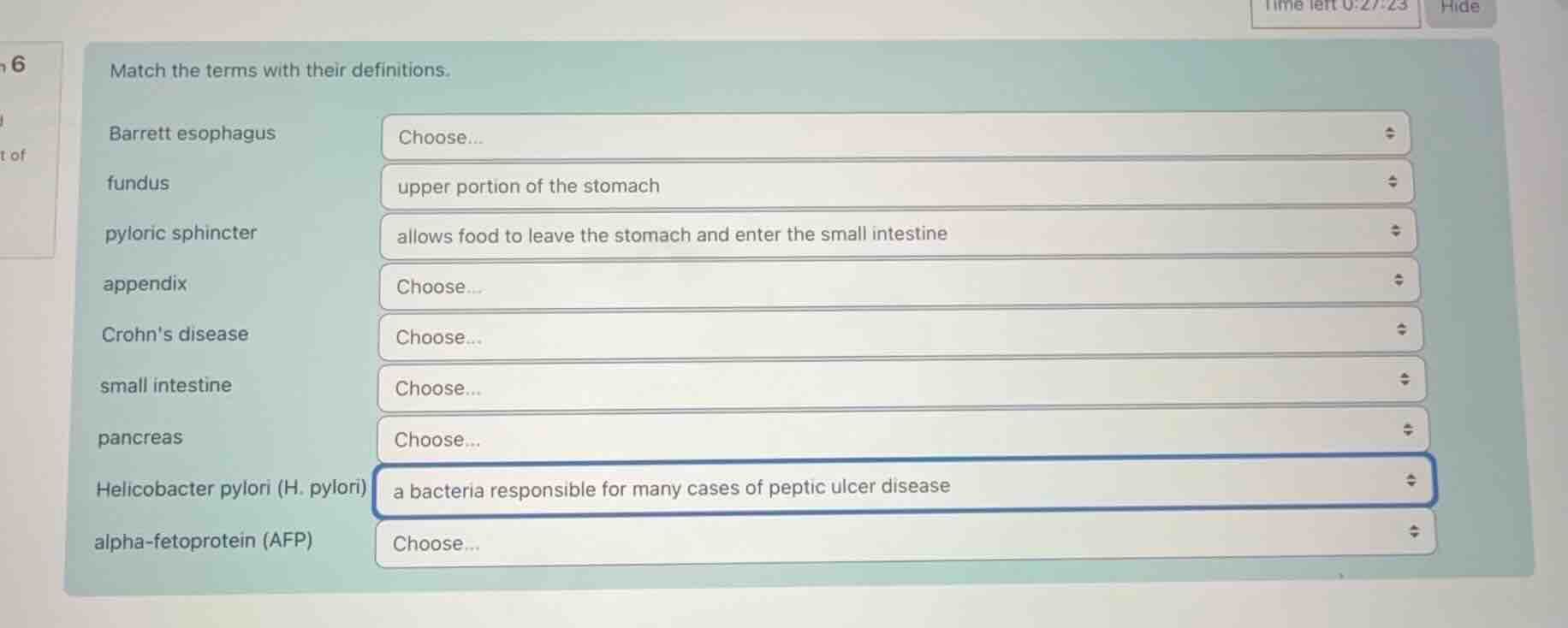
match the terms with their definitions.
barrett esophagus choose...
fundus upper portion of the stomach
pyloric sphincter allows food to leave the stomach and enter the small intestine
appendix choose...
crohns disease choose...
small intestine choose...
pancreas choose...
helicobacter pylori (h. pylori) a bacteria responsible for many cases of peptic ulcer disease
alpha - fetoprotein (afp) choose...
Brief Explanations
Each term is matched to its standard medical definition based on human anatomy and pathophysiology:
- Barrett esophagus: A condition where esophageal lining is replaced with intestinal-like tissue, often from acid reflux.
- Fundus: The upper curved part of the stomach.
- Pyloric sphincter: The muscle valve controlling stomach to small intestine food passage.
- Appendix: A small, finger-shaped pouch attached to the large intestine.
- Crohn's disease: A chronic inflammatory bowel disease affecting any part of the digestive tract.
- Small intestine: The long digestive organ where most nutrient absorption occurs.
- Pancreas: An organ that produces digestive enzymes and hormone (insulin, glucagon).
- Helicobacter pylori (H. pylori): A bacterium linked to peptic ulcers and stomach inflammation.
- Alpha-fetoprotein (AFP): A protein often elevated in liver cancer or fetal abnormalities.

Snap & solve any problem in the app
Get step-by-step solutions on Sovi AI
Photo-based solutions with guided steps
Explore more problems and detailed explanations
- Barrett esophagus: a condition where the lining of the esophagus is replaced with tissue similar to that found in the intestine, often caused by chronic acid reflux
- fundus: upper portion of the stomach
- pyloric sphincter: allows food to leave the stomach and enter the small intestine
- appendix: a small, finger-shaped pouch that projects from the colon on the lower right side of the abdomen
- Crohn's disease: a chronic inflammatory bowel disease that can affect any part of the digestive tract from the mouth to the anus
- small intestine: the long, narrow tube in the digestive system where most digestion and absorption of nutrients takes place
- pancreas: an organ that produces digestive enzymes and hormones (such as insulin and glucagon) to regulate blood sugar
- Helicobacter pylori (H. pylori): a bacteria responsible for many cases of peptic ulcer disease
- alpha-fetoprotein (AFP): a protein that is often elevated in people with liver cancer, as well as in some other conditions including certain fetal abnormalities