QUESTION IMAGE
Question
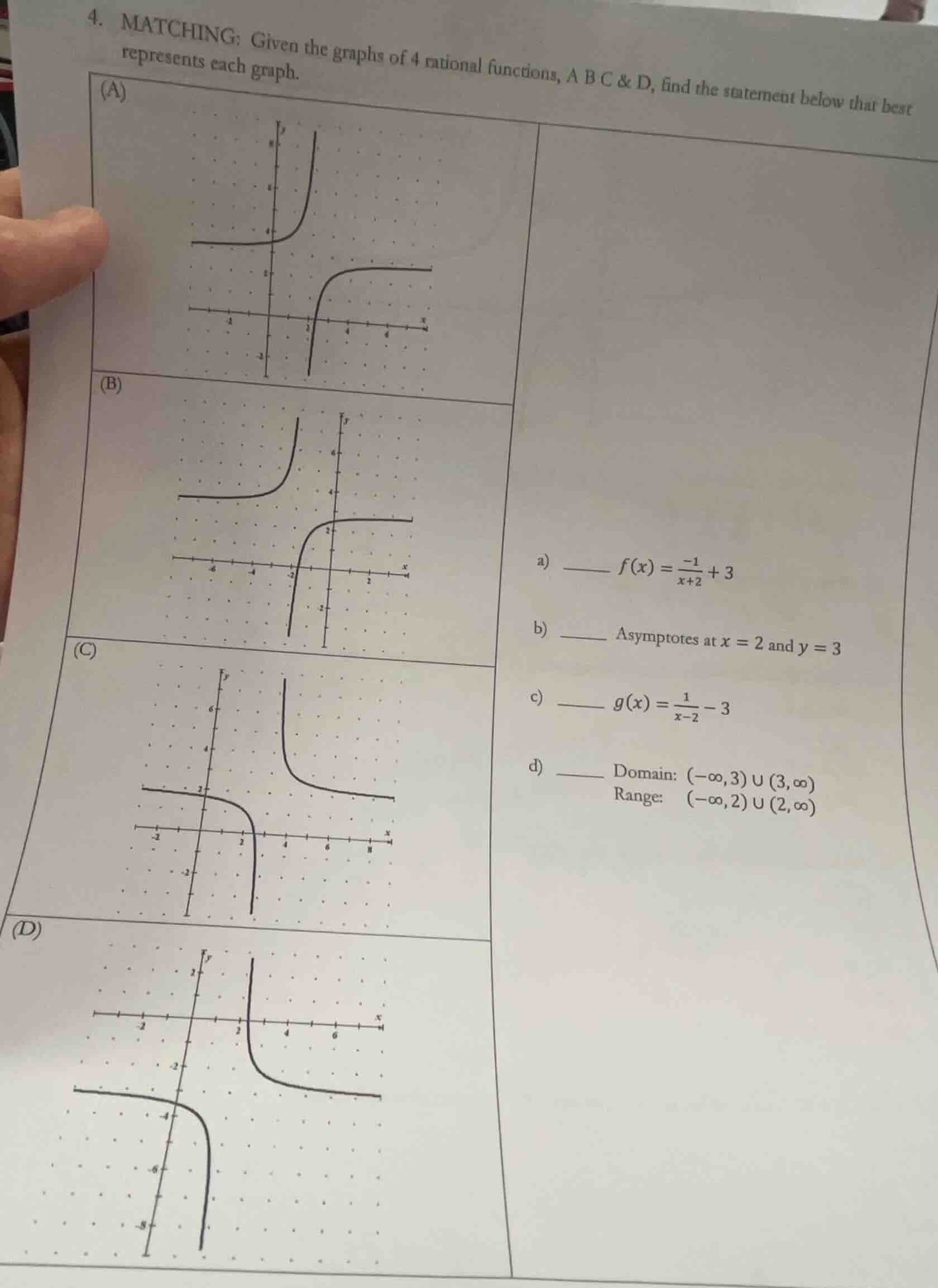
- matching: given the graphs of 4 rational functions, a b c & d, find the statement below that best represents each graph.
(a) graph
(b) graph
(c) graph
(d) graph
a) ____ ( f(x) = \frac{-1}{x + 2} + 3 )
b) ____ asymptotes at ( x = 2 ) and ( y = 3 )
c) ____ ( g(x) = \frac{1}{x - 2} - 3 )
d) ____ domain: ( (-infty, 3) cup (3, infty) )
range: ( (-infty, 2) cup (2, infty) )
Response
To solve this matching problem, we analyze each function and statement by examining vertical asymptotes (from the denominator), horizontal asymptotes (from the constant term in transformed rational functions), and the shape of the graphs.
Analyzing each part:
Part (a): \( f(x) = \frac{-1}{x + 2} + 3 \)
- Vertical Asymptote: Denominator \( x + 2 = 0 \implies x = -2 \).
- Horizontal Asymptote: The constant term is \( 3 \), so \( y = 3 \).
- The negative numerator reflects the graph over the horizontal asymptote. Looking at the graphs, Graph B has a vertical asymptote at \( x = -2 \) (since the vertical dashed line is at \( x = -2 \)) and a horizontal asymptote around \( y = 3 \), matching this function.
Part (b): Asymptotes at \( x = 2 \) and \( y = 3 \)
- A vertical asymptote at \( x = 2 \) means the denominator has a root at \( x = 2 \) (e.g., \( x - 2 \) in the denominator).
- A horizontal asymptote at \( y = 3 \) means the constant term (for a transformed \( \frac{1}{x} \) function) is \( 3 \).
- Graph A has a vertical asymptote at \( x = 2 \) (vertical dashed line at \( x = 2 \)) and a horizontal asymptote at \( y = 3 \) (horizontal dashed line at \( y = 3 \)), matching this description.
Part (c): \( g(x) = \frac{1}{x - 2} - 3 \)
- Vertical Asymptote: Denominator \( x - 2 = 0 \implies x = 2 \).
- Horizontal Asymptote: The constant term is \( -3 \), so \( y = -3 \).
- The graph should have a vertical asymptote at \( x = 2 \) and a horizontal asymptote at \( y = -3 \). Graph D has a vertical asymptote at \( x = 2 \) and a horizontal asymptote around \( y = -3 \) (the lower horizontal dashed line), matching this function.
Part (d): Domain \( (-\infty, 3) \cup (3, \infty) \), Range \( (-\infty, 2) \cup (2, \infty) \)
- Domain: Excludes \( x = 3 \), so vertical asymptote at \( x = 3 \).
- Range: Excludes \( y = 2 \), so horizontal asymptote at \( y = 2 \).
- Graph C has a vertical asymptote at \( x = 3 \) (vertical dashed line at \( x = 3 \)) and a horizontal asymptote at \( y = 2 \) (horizontal dashed line at \( y = 2 \)), matching this domain and range.
Final Matches:
- (a) \( f(x) = \frac{-1}{x + 2} + 3 \) → B
- (b) Asymptotes at \( x = 2 \) and \( y = 3 \) → A
- (c) \( g(x) = \frac{1}{x - 2} - 3 \) → D
- (d) Domain \( (-\infty, 3) \cup (3, \infty) \), Range \( (-\infty, 2) \cup (2, \infty) \) → C

Snap & solve any problem in the app
Get step-by-step solutions on Sovi AI
Photo-based solutions with guided steps
Explore more problems and detailed explanations
s:
a) \(\boldsymbol{B}\)
b) \(\boldsymbol{A}\)
c) \(\boldsymbol{D}\)
d) \(\boldsymbol{C}\)