QUESTION IMAGE
Question
matching 5 points
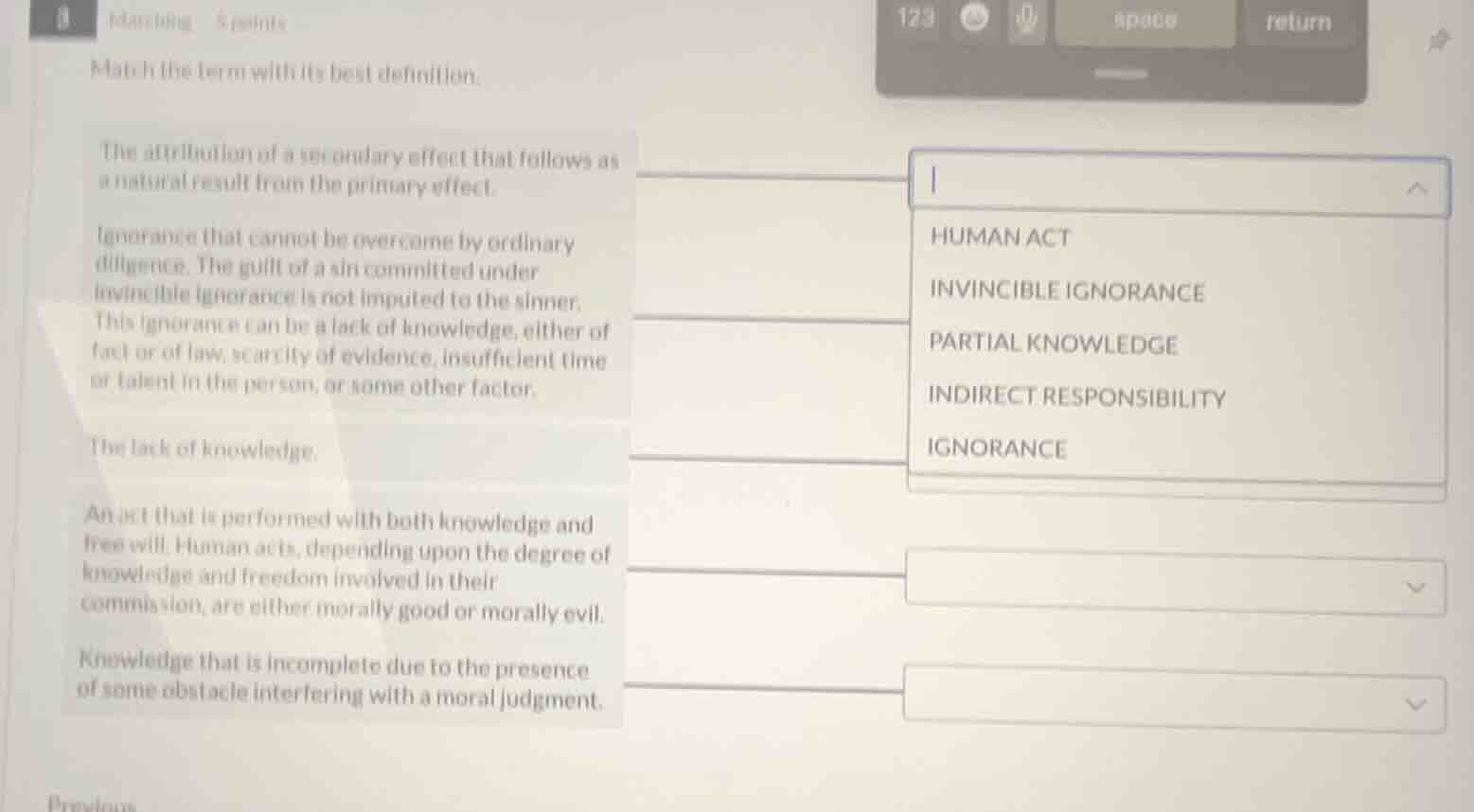
match the term with its best definition.
the attribution of a secondary effect that follows as
a natural result from the primary effect.
ignorance that cannot be overcome by ordinary
diligence. the guilt of a sin committed under
invincible ignorance is not imputed to the sinner.
this ignorance can be a lack of knowledge, either of
fact or of law, scarcity of evidence, insufficient time
or talent in the person, or some other factor.
the lack of knowledge.
an act that is performed with both knowledge and
free will. human acts, depending upon the degree of
knowledge and freedom involved in their
commission, are either morally good or morally evil.
knowledge that is incomplete due to the presence
of some obstacle interfering with a moral judgment.
human act
invincible ignorance
partial knowledge
indirect responsibility
ignorance
- For "The attribution of a secondary effect that follows as a natural result from the primary effect" - this matches "INDIRECT RESPONSIBILITY" as it's about responsibility for indirect (secondary) effects.
- For "Ignorance that cannot be overcome by ordinary diligence... " - this is the definition of "INVINCIBLE IGNORANCE".
- For "The lack of knowledge" - this is the basic definition of "IGNORANCE".
- For "An act that is performed with both knowledge and free will... " - this is the definition of "HUMAN ACT".
- For "Knowledge that is incomplete due to the presence of some obstacle... " - this matches "PARTIAL KNOWLEDGE".

Snap & solve any problem in the app
Get step-by-step solutions on Sovi AI
Photo-based solutions with guided steps
Explore more problems and detailed explanations
- The attribution of a secondary effect that follows as a natural result from the primary effect. - INDIRECT RESPONSIBILITY
- Ignorance that cannot be overcome by ordinary diligence. The guilt of a sin committed under invincible ignorance is not imputed to the sinner. This ignorance can be a lack of knowledge, either of fact or of law, scarcity of evidence, insufficient time or talent in the person, or some other factor. - INVINCIBLE IGNORANCE
- The lack of knowledge. - IGNORANCE
- An act that is performed with both knowledge and free will. Human acts, depending upon the degree of knowledge and freedom involved in their commission, are either morally good or morally evil. - HUMAN ACT
- Knowledge that is incomplete due to the presence of some obstacle interfering with a moral judgment. - PARTIAL KNOWLEDGE