QUESTION IMAGE
Question
math 10 unit 4
applications of expanding and simplifying polynomials
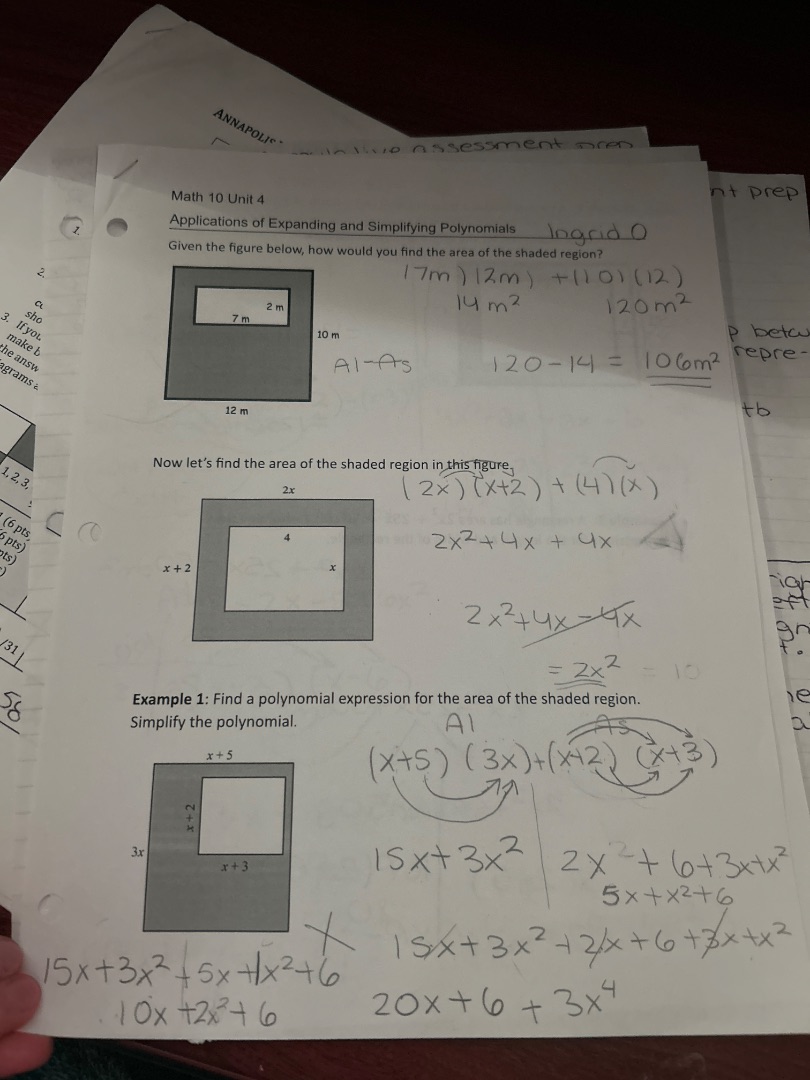
given the figure below, how would you find the area of the shaded region?
now lets find the area of the shaded region in this figure.
example 1: find a polynomial expression for the area of the shaded region.
simplify the polynomial.
To find the area of the shaded region in such problems, we typically use the subtraction method: find the area of the larger shape and subtract the area of the unshaded (inner) shape. Let’s apply this to the first figure (with numbers) and then to the algebraic figures.
First Figure (12 m × 10 m rectangle with a 7 m × 2 m inner rectangle)
Step 1: Area of the larger rectangle
The larger rectangle has length \( 12 \, \text{m} \) and width \( 10 \, \text{m} \).
Area formula for a rectangle: \( \text{Area} = \text{length} \times \text{width} \).
So, \( A_{\text{large}} = 12 \times 10 = 120 \, \text{m}^2 \).
Step 2: Area of the inner (unshaded) rectangle
The inner rectangle has length \( 7 \, \text{m} \) and width \( 2 \, \text{m} \).
Using the same formula: \( A_{\text{inner}} = 7 \times 2 = 14 \, \text{m}^2 \).
Step 3: Area of the shaded region
Subtract the inner area from the larger area:
\( A_{\text{shaded}} = A_{\text{large}} - A_{\text{inner}} = 120 - 14 = 106 \, \text{m}^2 \).
Second Figure (Algebraic: \( 2x \times (x+2) \) outer rectangle with a \( 4 \times x \) inner rectangle)
Step 1: Area of the outer rectangle
Length \( = 2x \), Width \( = x + 2 \).
\( A_{\text{outer}} = 2x \times (x + 2) = 2x^2 + 4x \).
Step 2: Area of the inner (unshaded) rectangle
Length \( = 4 \), Width \( = x \).
\( A_{\text{inner}} = 4 \times x = 4x \).
Step 3: Area of the shaded region
Subtract: \( A_{\text{shaded}} = (2x^2 + 4x) - 4x = 2x^2 \).
Example 1 (Polynomial: \( 3x \times (x+5) \) outer rectangle with a \( (x+2) \times (x+3) \) inner rectangle)
Step 1: Area of the outer rectangle
Length \( = 3x \), Width \( = x + 5 \).
\( A_{\text{outer}} = 3x \times (x + 5) = 3x^2 + 15x \).
Step 2: Area of the inner (unshaded) rectangle
Length \( = x + 2 \), Width \( = x + 3 \).
Expand: \( (x + 2)(x + 3) = x^2 + 3x + 2x + 6 = x^2 + 5x + 6 \).
Step 3: Area of the shaded region
Subtract: \( A_{\text{shaded}} = (3x^2 + 15x) - (x^2 + 5x + 6) \).
Simplify: \( 3x^2 + 15x - x^2 - 5x - 6 = 2x^2 + 10x - 6 \).
Key Takeaway
For any “shaded region” problem with a larger shape and a smaller inner shape, the formula is:
\( \boldsymbol{A_{\text{shaded}} = A_{\text{larger}} - A_{\text{inner}}} \).
(Adjust the steps for algebraic expressions by expanding and simplifying polynomials.)

Snap & solve any problem in the app
Get step-by-step solutions on Sovi AI
Photo-based solutions with guided steps
Explore more problems and detailed explanations
To find the area of the shaded region in such problems, we typically use the subtraction method: find the area of the larger shape and subtract the area of the unshaded (inner) shape. Let’s apply this to the first figure (with numbers) and then to the algebraic figures.
First Figure (12 m × 10 m rectangle with a 7 m × 2 m inner rectangle)
Step 1: Area of the larger rectangle
The larger rectangle has length \( 12 \, \text{m} \) and width \( 10 \, \text{m} \).
Area formula for a rectangle: \( \text{Area} = \text{length} \times \text{width} \).
So, \( A_{\text{large}} = 12 \times 10 = 120 \, \text{m}^2 \).
Step 2: Area of the inner (unshaded) rectangle
The inner rectangle has length \( 7 \, \text{m} \) and width \( 2 \, \text{m} \).
Using the same formula: \( A_{\text{inner}} = 7 \times 2 = 14 \, \text{m}^2 \).
Step 3: Area of the shaded region
Subtract the inner area from the larger area:
\( A_{\text{shaded}} = A_{\text{large}} - A_{\text{inner}} = 120 - 14 = 106 \, \text{m}^2 \).
Second Figure (Algebraic: \( 2x \times (x+2) \) outer rectangle with a \( 4 \times x \) inner rectangle)
Step 1: Area of the outer rectangle
Length \( = 2x \), Width \( = x + 2 \).
\( A_{\text{outer}} = 2x \times (x + 2) = 2x^2 + 4x \).
Step 2: Area of the inner (unshaded) rectangle
Length \( = 4 \), Width \( = x \).
\( A_{\text{inner}} = 4 \times x = 4x \).
Step 3: Area of the shaded region
Subtract: \( A_{\text{shaded}} = (2x^2 + 4x) - 4x = 2x^2 \).
Example 1 (Polynomial: \( 3x \times (x+5) \) outer rectangle with a \( (x+2) \times (x+3) \) inner rectangle)
Step 1: Area of the outer rectangle
Length \( = 3x \), Width \( = x + 5 \).
\( A_{\text{outer}} = 3x \times (x + 5) = 3x^2 + 15x \).
Step 2: Area of the inner (unshaded) rectangle
Length \( = x + 2 \), Width \( = x + 3 \).
Expand: \( (x + 2)(x + 3) = x^2 + 3x + 2x + 6 = x^2 + 5x + 6 \).
Step 3: Area of the shaded region
Subtract: \( A_{\text{shaded}} = (3x^2 + 15x) - (x^2 + 5x + 6) \).
Simplify: \( 3x^2 + 15x - x^2 - 5x - 6 = 2x^2 + 10x - 6 \).
Key Takeaway
For any “shaded region” problem with a larger shape and a smaller inner shape, the formula is:
\( \boldsymbol{A_{\text{shaded}} = A_{\text{larger}} - A_{\text{inner}}} \).
(Adjust the steps for algebraic expressions by expanding and simplifying polynomials.)