QUESTION IMAGE
Question
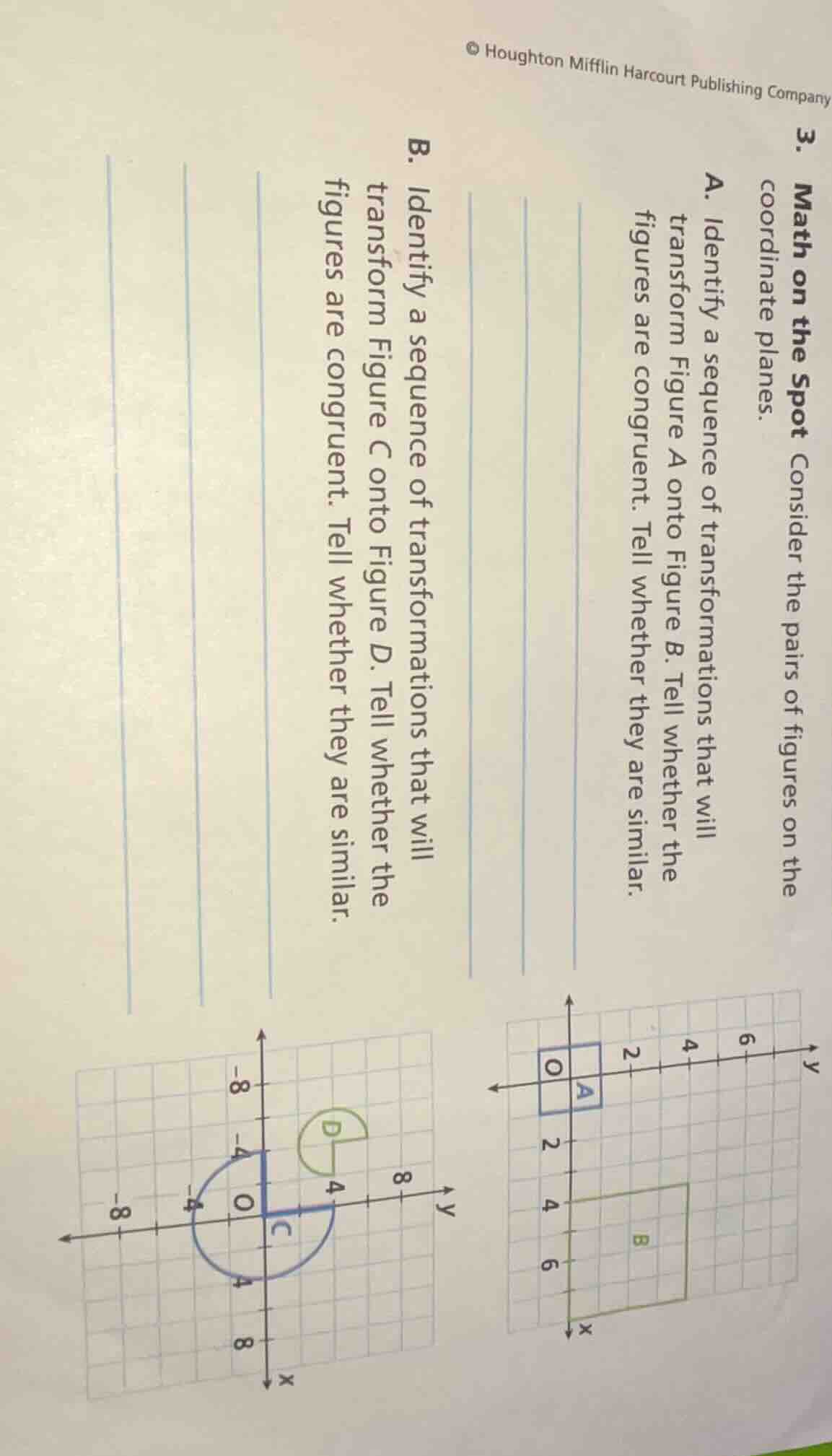
- math on the spot consider the pairs of figures on the coordinate planes.
a. identify a sequence of transformations that will transform figure a onto figure b. tell whether the figures are congruent. tell whether they are similar.
b. identify a sequence of transformations that will transform figure c onto figure d. tell whether the figures are congruent. tell whether they are similar.
© houghton mifflin harcourt publishing company
Step1: Analyze Figure A to B
- Identify transformation type: Figure A is a small square, Figure B is a larger square. This is a dilation (scaling).
- Find scale factor: Side length of A = 2 units, side length of B = 4 units. Scale factor $k = \frac{4}{2}=2$.
- Check congruence/similarity: Congruent figures require equal size; these have different sizes, so not congruent. Similar figures have proportional sides and equal angles; squares have right angles, sides are scaled by 2, so they are similar.
- Full sequence: Dilate Figure A by a scale factor of 2 centered at the origin, then translate the dilated figure right 2 units and down 2 units (or translate first then dilate, but dilation is key for size change).
Step2: Analyze Figure C to D
- Identify transformation type: Figure C and D have the same size (quarter-circle with radius 4 units). This is a rigid transformation (no size change).
- Describe sequence: Rotate Figure C 90° counterclockwise around the origin, then translate the rotated figure up 4 units and right 4 units (or use reflection + translation, rotation is simpler).
- Check congruence/similarity: Rigid transformations preserve size and shape, so the figures are congruent. All congruent figures are also similar (scale factor = 1).

Snap & solve any problem in the app
Get step-by-step solutions on Sovi AI
Photo-based solutions with guided steps
Explore more problems and detailed explanations
A. One possible sequence: Dilate Figure A by a scale factor of 2 with the origin as the center, then translate the result 2 units right and 2 units down.
The figures are not congruent (different sizes) and are similar (proportional sides, equal angles).
B. One possible sequence: Rotate Figure C 90° counterclockwise about the origin, then translate the result 4 units right and 4 units up.
The figures are congruent (rigid transformation preserves size/shape) and are similar (all congruent figures are similar).