QUESTION IMAGE
Question
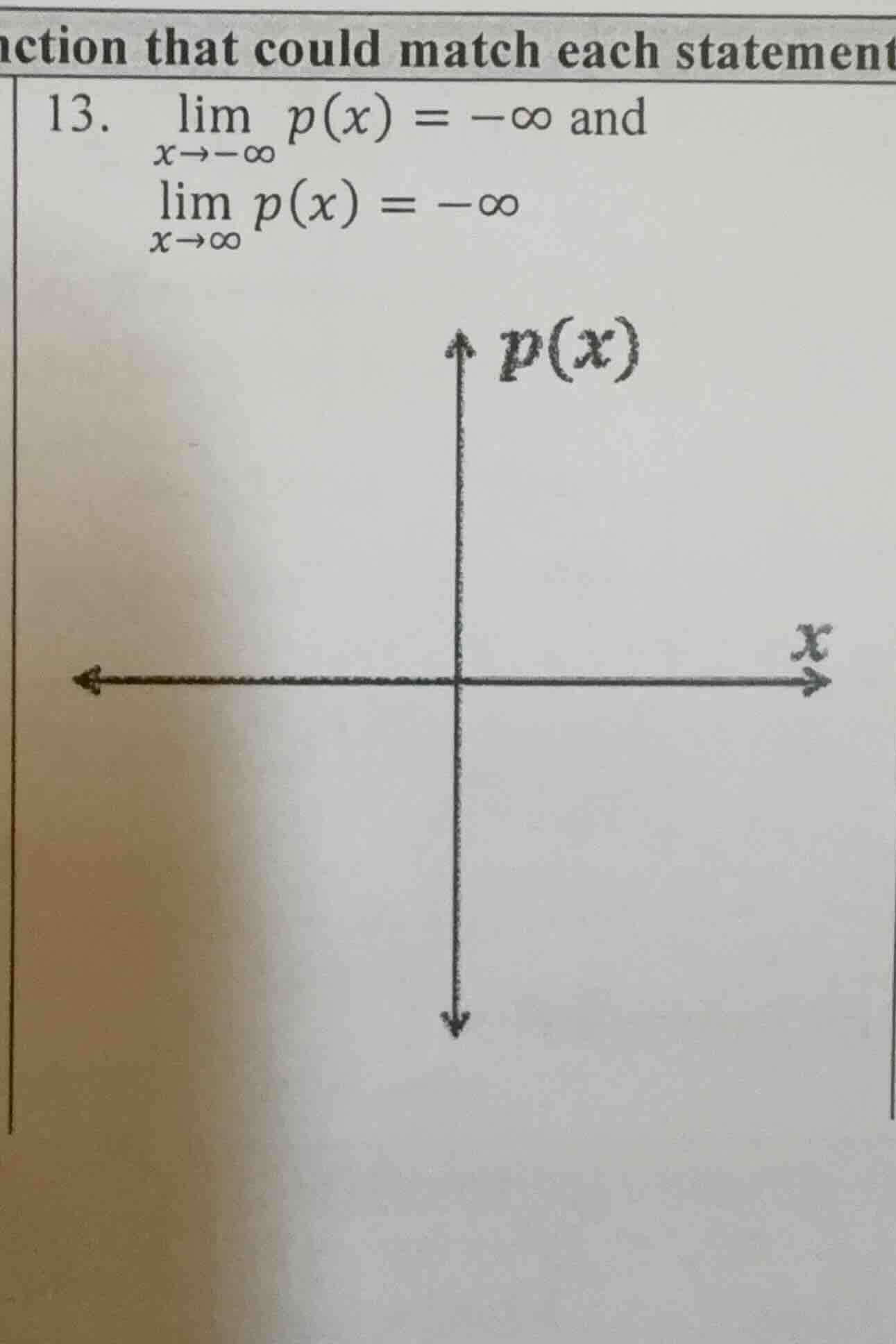
- \\(\lim\limits_{x\to -\infty} p(x) = -\infty\\) and \\(\lim\limits_{x\to \infty} p(x) = -\infty\\)
Step1: Identify polynomial end behavior
For a polynomial $p(x) = a_nx^n + ... + a_0$, end behavior depends on leading coefficient $a_n$ and degree $n$.
Step2: Match limits to degree/coefficient
We need $\lim_{x\to-\infty} p(x) = -\infty$ and $\lim_{x\to\infty} p(x) = -\infty$. This requires even degree ($n$ even) and negative leading coefficient ($a_n < 0$).
Step3: Choose a simple example
Select lowest even degree ($n=2$) and negative leading coefficient, e.g., $a_n=-1$.
<Expression>
$p(x) = -x^2$
</Expression>
Step4: Verify end behavior
For $p(x)=-x^2$:
$\lim_{x\to\infty} -x^2 = -\infty$, $\lim_{x\to-\infty} -x^2 = -\infty$

Snap & solve any problem in the app
Get step-by-step solutions on Sovi AI
Photo-based solutions with guided steps
Explore more problems and detailed explanations
A valid function is $\boldsymbol{p(x) = -x^2}$ (any even-degree polynomial with a negative leading coefficient is acceptable, e.g., $p(x)=-2x^4 + 3x^2 -1$ also works)