QUESTION IMAGE
Question
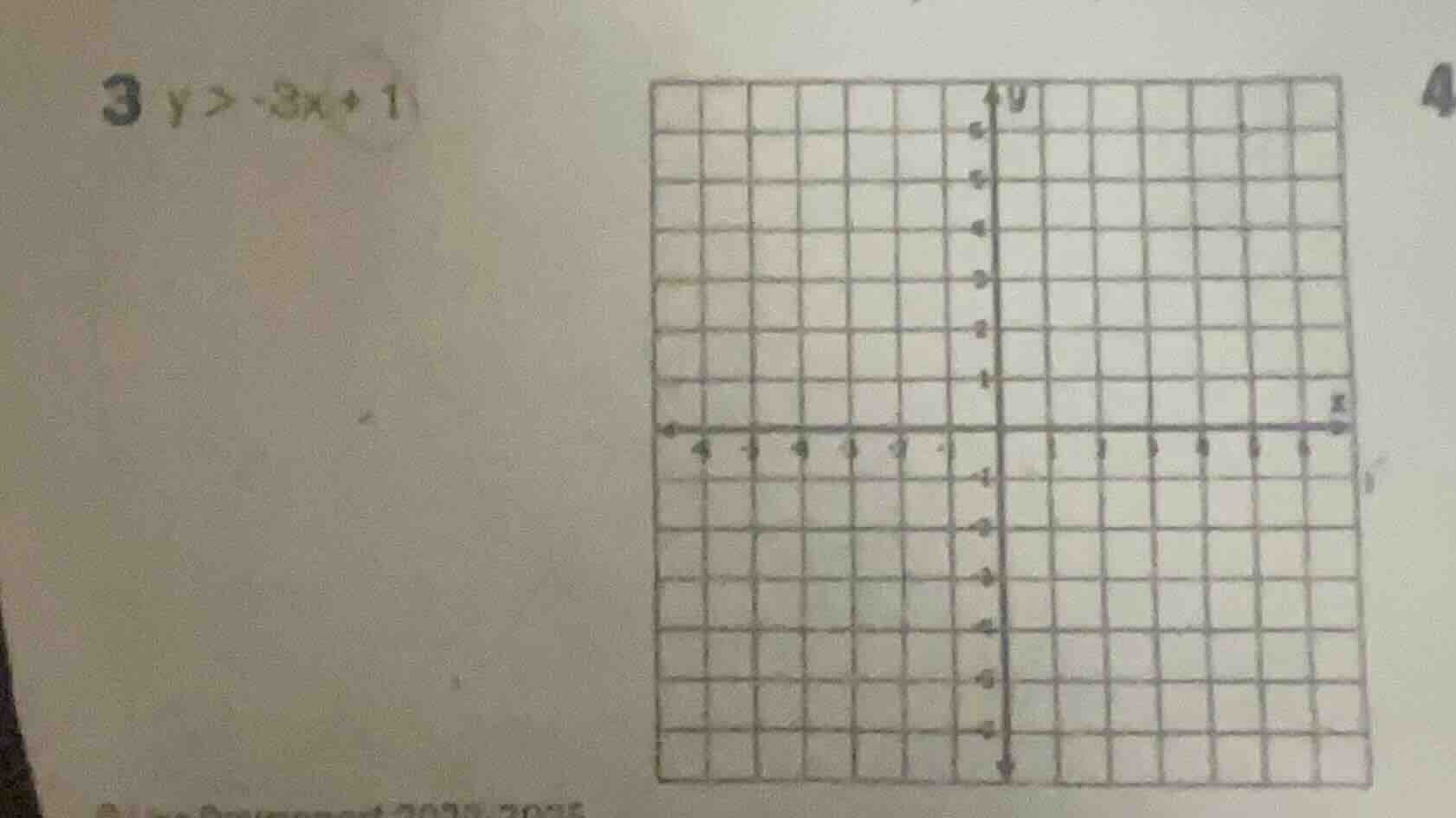
3 $y > -3x + 1$
Step1: Identify the boundary line
The inequality is \( y > -3x + 1 \). First, we consider the boundary line \( y=-3x + 1 \). Since the inequality is "greater than" (not "greater than or equal to"), the boundary line will be dashed.
Step2: Find two points on the boundary line
To graph the line \( y=-3x + 1 \), we can find two points.
- When \( x = 0 \), \( y=-3(0)+1=1 \), so the point is \( (0,1) \).
- When \( x = 1 \), \( y=-3(1)+1=-2 \), so the point is \( (1, - 2) \).
Step3: Determine the shading region
We test a point not on the line, usually the origin \( (0,0) \), in the inequality \( y > -3x + 1 \). Substitute \( x = 0 \) and \( y = 0 \): \( 0>-3(0)+1\) which simplifies to \( 0 > 1 \), this is false. So we shade the region that does not include the origin. In other words, we shade the region above the dashed line \( y=-3x + 1 \) (because the inequality is \( y>\) the line, so we shade above the line; and since the test with origin was false, the origin is not in the shaded region, so the shaded region is above the line).
To graph:
- Draw the dashed line passing through \( (0,1) \) and \( (1, - 2) \) (using the slope \( m=-3 \) and y - intercept \( b = 1 \)).
- Shade the region above the dashed line.

Snap & solve any problem in the app
Get step-by-step solutions on Sovi AI
Photo-based solutions with guided steps
Explore more problems and detailed explanations
The graph of \( y > -3x + 1 \) has a dashed line \( y=-3x + 1 \) (passing through \( (0,1) \) and \( (1, - 2) \)) and the region above this dashed line is shaded.