QUESTION IMAGE
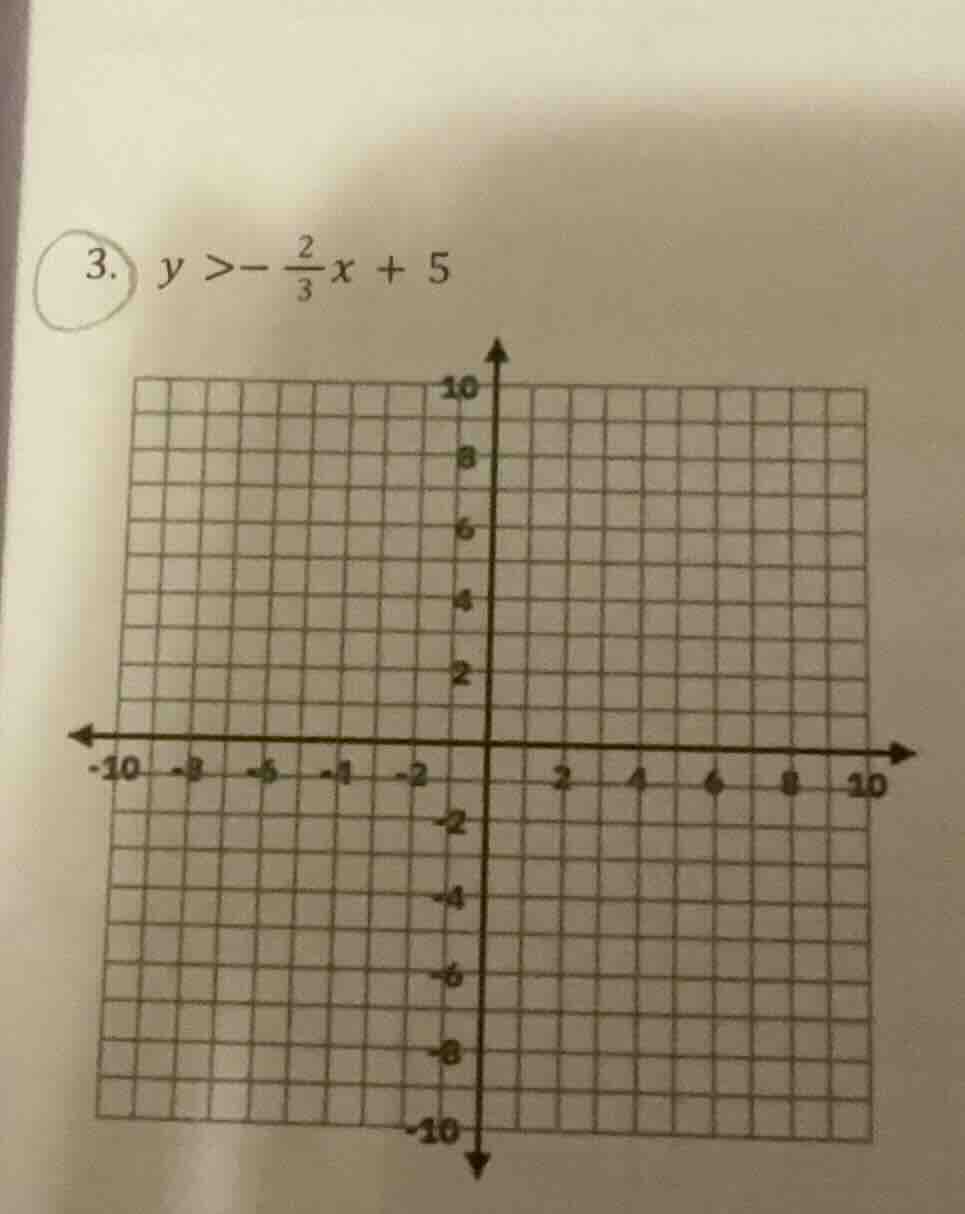
Question
- $y > -\frac{2}{3}x + 5$
Step1: Identify boundary line
The inequality is $y > -\frac{2}{3}x + 5$, so the boundary line is $y = -\frac{2}{3}x + 5$. Since the inequality uses $>$ (not $\geq$), the line will be dashed.
Step2: Find intercepts of boundary
- y-intercept: When $x=0$, $y = -\frac{2}{3}(0) + 5 = 5$. So the point is $(0, 5)$.
- x-intercept: When $y=0$, $0 = -\frac{2}{3}x + 5$
$\frac{2}{3}x = 5$
$x = 5 \times \frac{3}{2} = 7.5$. So the point is $(7.5, 0)$.
Step3: Plot and draw boundary
Plot $(0, 5)$ and $(7.5, 0)$, then draw a dashed straight line through these points.
Step4: Test a point for shading
Choose a test point not on the line, e.g., $(0, 0)$:
Substitute into $y > -\frac{2}{3}x + 5$:
$0 > -\frac{2}{3}(0) + 5$ → $0 > 5$, which is false.
So we shade the region opposite of the test point (above the dashed line).

Snap & solve any problem in the app
Get step-by-step solutions on Sovi AI
Photo-based solutions with guided steps
Explore more problems and detailed explanations
- Draw a dashed line through $(0, 5)$ and $(7.5, 0)$ (representing $y = -\frac{2}{3}x + 5$).
- Shade the entire region above this dashed line.