QUESTION IMAGE
Question
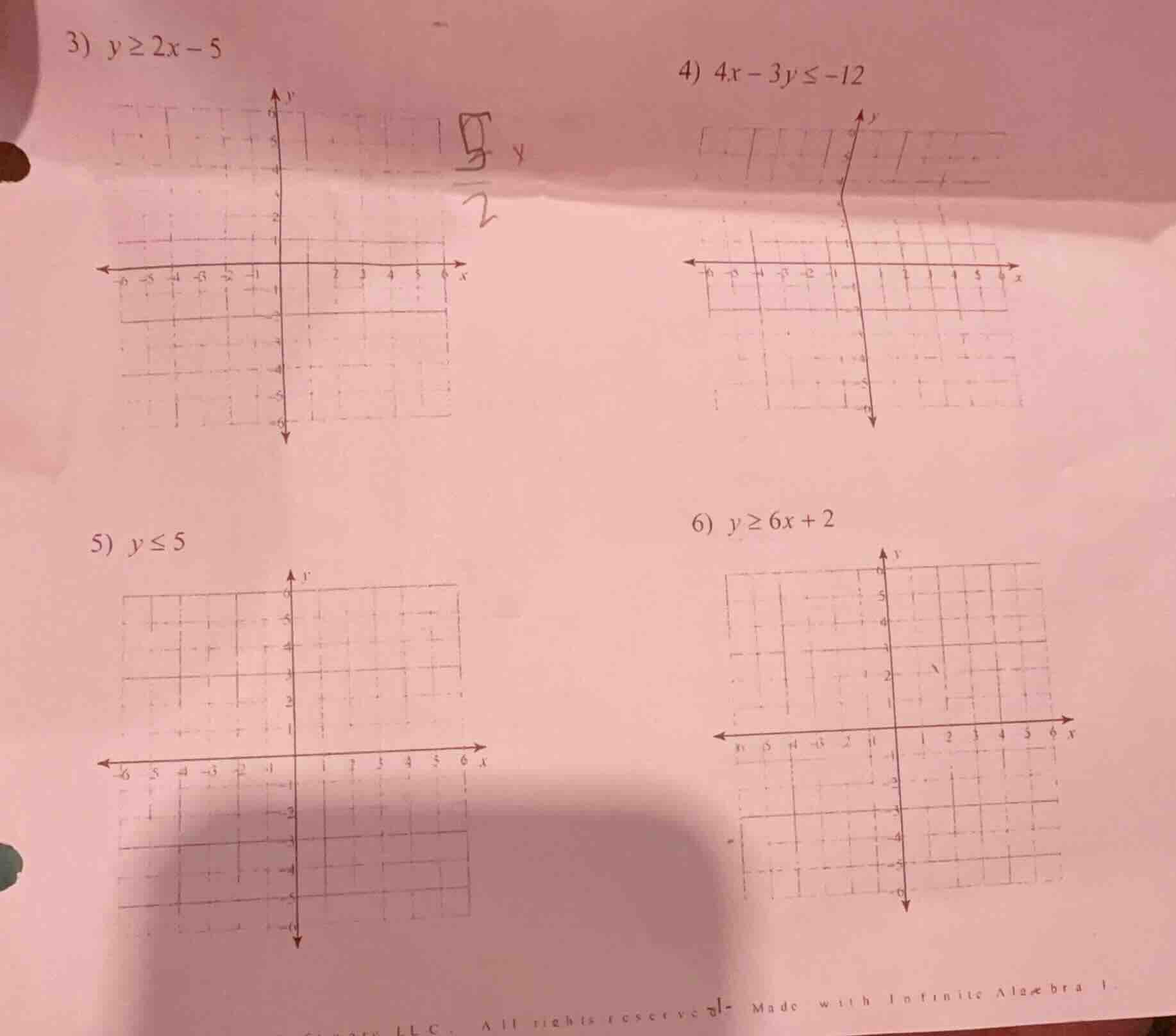
- $y \geq 2x - 5$
- $4x - 3y \leq -12$
- $y \leq 5$
- $y \geq 6x + 2$
To solve the problem of graphing linear inequalities, we follow these steps for each inequality:
Problem 3: \( y \geq 2x - 5 \)
Step 1: Identify the boundary line
The inequality is \( y \geq 2x - 5 \). The boundary line is \( y = 2x - 5 \), which is a straight line with a slope of \( 2 \) and a y-intercept of \( -5 \). Since the inequality is \( \geq \), the line should be solid (not dashed).
Step 2: Determine the region to shade
To determine which side of the line to shade, we can test a point not on the line. Let's use the origin \( (0, 0) \):
\[
0 \geq 2(0) - 5 \implies 0 \geq -5
\]
This is true, so we shade the region that includes the origin.
Problem 4: \( 4x - 3y \leq -12 \)
Step 1: Rewrite in slope-intercept form
Solve for \( y \):
\[
4x - 3y \leq -12 \\
-3y \leq -4x - 12 \\
y \geq \frac{4}{3}x + 4
\]
The boundary line is \( y = \frac{4}{3}x + 4 \), with a slope of \( \frac{4}{3} \) and a y-intercept of \( 4 \). Since the inequality is \( \geq \), the line is solid.
Step 2: Determine the region to shade
Test the origin \( (0, 0) \):
\[
0 \geq \frac{4}{3}(0) + 4 \implies 0 \geq 4
\]
This is false, so we shade the region that does not include the origin.
Problem 5: \( y \leq 5 \)
Step 1: Identify the boundary line
The inequality is \( y \leq 5 \). The boundary line is \( y = 5 \), which is a horizontal line. Since the inequality is \( \leq \), the line is solid.
Step 2: Determine the region to shade
Test the origin \( (0, 0) \):
\[
0 \leq 5
\]
This is true, so we shade the region below the line \( y = 5 \).
Problem 6: \( y \geq 6x + 2 \)
Step 1: Identify the boundary line
The inequality is \( y \geq 6x + 2 \). The boundary line is \( y = 6x + 2 \), with a slope of \( 6 \) and a y-intercept of \( 2 \). Since the inequality is \( \geq \), the line is solid.
Step 2: Determine the region to shade
Test the origin \( (0, 0) \):
\[
0 \geq 6(0) + 2 \implies 0 \geq 2
\]
This is false, so we shade the region that does not include the origin.
Final Graphs
- For \( y \geq 2x - 5 \): Solid line \( y = 2x - 5 \), shade above the line (including the origin).
- For \( 4x - 3y \leq -12 \) (or \( y \geq \frac{4}{3}x + 4 \)): Solid line \( y = \frac{4}{3}x + 4 \), shade above the line (excluding the origin).
- For \( y \leq 5 \): Solid line \( y = 5 \), shade below the line (including the origin).
- For \( y \geq 6x + 2 \): Solid line \( y = 6x + 2 \), shade above the line (excluding the origin).

Snap & solve any problem in the app
Get step-by-step solutions on Sovi AI
Photo-based solutions with guided steps
Explore more problems and detailed explanations
The graphs are as described above, with the appropriate boundary lines (solid) and shaded regions.