QUESTION IMAGE
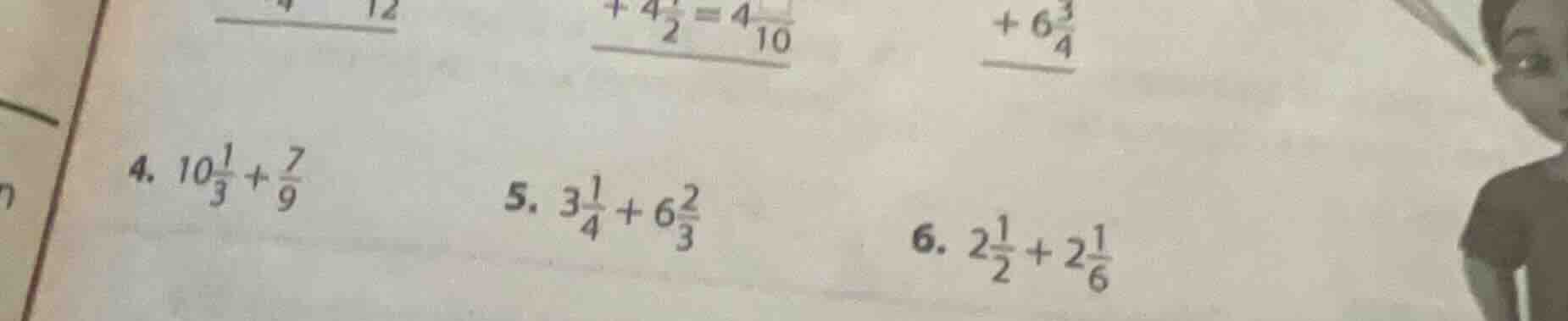
Question
- $10\frac{1}{3}+\frac{7}{9}$
- $3\frac{1}{4}+6\frac{2}{3}$
- $2\frac{1}{2}+2\frac{1}{6}$
Problem 4: \( 10\frac{1}{3} + \frac{7}{9} \)
Step 1: Convert mixed number to improper fraction (or find common denominator)
The mixed number \( 10\frac{1}{3} \) can be written as \( \frac{31}{3} \), but we can also find a common denominator for the fractions. The denominators are 3 and 9, so the common denominator is 9.
\( 10\frac{1}{3} = 10 + \frac{1}{3} = 10 + \frac{1\times3}{3\times3} = 10 + \frac{3}{9} = 10\frac{3}{9} \)
Step 2: Add the fractions
Now we add \( 10\frac{3}{9} + \frac{7}{9} \). Add the fractional parts: \( \frac{3}{9} + \frac{7}{9} = \frac{10}{9} \)
Step 3: Simplify the result
\( \frac{10}{9} = 1\frac{1}{9} \), so add this to the whole number part: \( 10 + 1\frac{1}{9} = 11\frac{1}{9} \)
Step 1: Find common denominator
The denominators are 4 and 3, so the common denominator is 12.
Convert the fractional parts:
\( \frac{1}{4} = \frac{1\times3}{4\times3} = \frac{3}{12} \)
\( \frac{2}{3} = \frac{2\times4}{3\times4} = \frac{8}{12} \)
Step 2: Add the whole numbers and fractional parts separately
Whole numbers: \( 3 + 6 = 9 \)
Fractional parts: \( \frac{3}{12} + \frac{8}{12} = \frac{11}{12} \)
Step 3: Combine the results
\( 9 + \frac{11}{12} = 9\frac{11}{12} \)
Step 1: Find common denominator
The denominators are 2 and 6, so the common denominator is 6.
Convert the fractional parts:
\( \frac{1}{2} = \frac{1\times3}{2\times3} = \frac{3}{6} \)
\( \frac{1}{6} \) remains as is.
Step 2: Add the whole numbers and fractional parts separately
Whole numbers: \( 2 + 2 = 4 \)
Fractional parts: \( \frac{3}{6} + \frac{1}{6} = \frac{4}{6} = \frac{2}{3} \)
Step 3: Combine the results
\( 4 + \frac{2}{3} = 4\frac{2}{3} \)

Snap & solve any problem in the app
Get step-by-step solutions on Sovi AI
Photo-based solutions with guided steps
Explore more problems and detailed explanations
\( 11\frac{1}{9} \)