QUESTION IMAGE
Question
4)
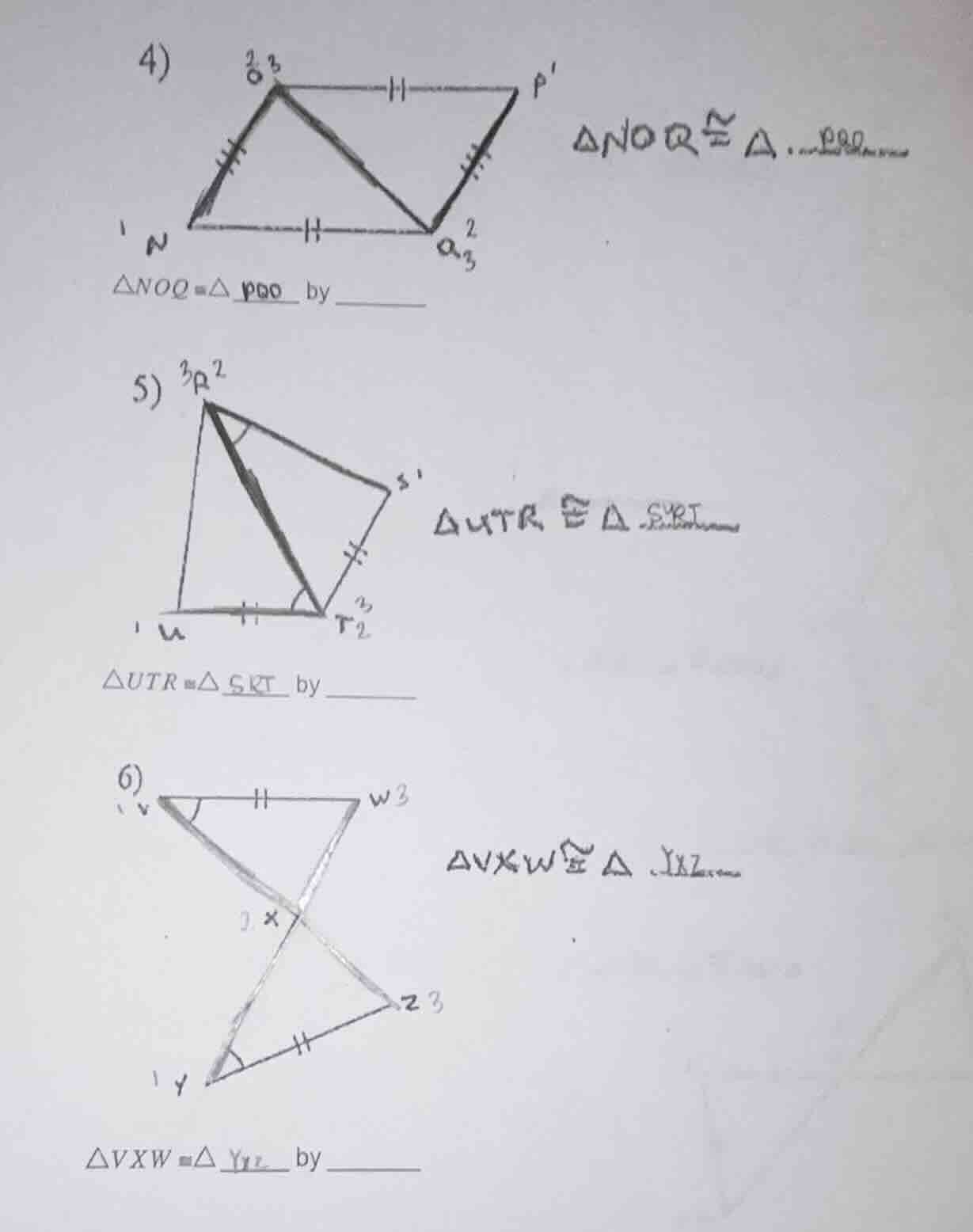
$\triangle noq cong \triangle$ _ by __
5)
$\triangle utr cong \triangle$ _ by __
6)
$\triangle vxw cong \triangle$ _ by __
Problem 4
Step1: Identify congruent parts
In the diagram, \( NO = PQ \) (marked with single tick), \( OQ = QP'? \) Wait, looking at the markings: \( NO \) and \( PQ \) (wait, the sides \( NQ \) and \( OP' \) have single ticks, \( NO \) and \( P'Q \) have double ticks, and \( OQ \) is common? Wait, actually, the triangles \( \triangle NOQ \) and \( \triangle PQO \) (assuming \( PQO \) is the other triangle). Wait, the sides: \( NO = PQ \) (double ticks), \( NQ = OP' \) (single ticks), and \( OQ = QO \) (common side). Wait, no, the correct correspondence: \( NO \) and \( PQ \) (double ticks), \( NQ \) and \( PO \) (single ticks), and \( OQ \) is common. So by SSS (Side - Side - Side) congruence, since three sides are equal. Wait, \( NO = PQ \) (double ticks), \( NQ = PO \) (single ticks), \( OQ = QO \) (common). So \( \triangle NOQ \cong \triangle PQO \) by SSS.
Step2: Confirm congruence criterion
SSS (Side - Side - Side) congruence states that if three sides of one triangle are equal to three sides of another triangle, the triangles are congruent. Here, \( NO = PQ \), \( NQ = PO \), \( OQ = QO \), so SSS applies.
Step1: Identify congruent parts
In \( \triangle UTR \) and \( \triangle SRT \): \( UT = SR \) (single ticks), \( TR = RT \) (common side), and \( \angle UTR=\angle SRT \)? Wait, no, the markings: \( UT \) and \( SR \) have single ticks, \( TR \) is common, and \( \angle URT=\angle STR \) (marked angles) and \( RT = TR \), \( UT = SR \). Wait, actually, \( UT = SR \) (single ticks), \( TR = RT \) (common), and \( \angle UTR=\angle SRT \)? No, looking at the diagram, \( UT \) and \( SR \) are equal (single ticks), \( TR \) is common, and the included angle? Wait, no, the triangles \( \triangle UTR \) and \( \triangle SRT \): \( UT = SR \), \( TR = RT \), and \( \angle UTR=\angle SRT \)? Wait, no, the correct correspondence: \( UT = SR \) (single ticks), \( TR = RT \) (common), and \( \angle URT=\angle STR \) (marked angles). Wait, actually, \( UT = SR \), \( TR = RT \), and \( \angle UTR=\angle SRT \)? No, the SAS (Side - Angle - Side) criterion: if two sides and the included angle are equal. Here, \( UT = SR \), \( TR = RT \), and the included angle \( \angle UTR=\angle SRT \)? Wait, no, \( UT = SR \), \( TR = RT \), and \( \angle URT=\angle STR \). Wait, maybe \( UT = SR \), \( TR = RT \), and \( \angle UTR=\angle SRT \) is not. Wait, the correct way: \( UT \) and \( SR \) are equal (single ticks), \( TR \) is common, and \( \angle UTR=\angle SRT \) (if the angles between the equal sides are equal). Wait, actually, the triangles \( \triangle UTR \) and \( \triangle SRT \) have \( UT = SR \), \( TR = RT \), and \( \angle UTR=\angle SRT \) (marked angles), so by SAS. Wait, no, \( UT = SR \), \( TR = RT \), and the included angle between \( UT \) and \( TR \) is \( \angle UTR \), and between \( SR \) and \( RT \) is \( \angle SRT \), which are equal. So SAS (Side - Angle - Side) congruence.
Step2: Confirm congruence criterion
SAS (Side - Angle - Side) congruence states that if two sides and the included angle of one triangle are equal to two sides and the included angle of another triangle, the triangles are congruent. Here, \( UT = SR \), \( TR = RT \), \( \angle UTR=\angle SRT \), so SAS applies.
Step1: Identify congruent parts
In \( \triangle VXW \) and \( \triangle YXZ \): \( VX = YX \)? Wait, no, the markings: \( VW \) and \( YZ \) have single ticks, \( \angle V=\angle Y \) (marked angles), and \( \angle VXW=\angle YXZ \) (vertical angles, which are equal). So we have two angles and a non - included side? Wait, no, \( \angle V=\angle Y \), \( \angle VXW=\angle YXZ \) (vertical angles), and \( VW = YZ \) (single ticks). So by AAS (Angle - Angle - Side) congruence. Wait, AAS states that if two angles and a non - included side of one triangle are equal to two angles and the corresponding non - included side of another triangle, the triangles are congruent. Here, \( \angle V=\angle Y \), \( \angle VXW=\angle YXZ \), \( VW = YZ \), so AAS.
Step2: Confirm congruence criterion
AAS (Angle - Angle - Side) congruence: two angles and a non - included side. \( \angle V=\angle Y \), \( \angle VXW=\angle YXZ \) (vertical angles), \( VW = YZ \), so AAS applies.

Snap & solve any problem in the app
Get step-by-step solutions on Sovi AI
Photo-based solutions with guided steps
Explore more problems and detailed explanations
\( \triangle NOQ \cong \triangle \boldsymbol{PQO} \) by \(\boldsymbol{SSS}\)