QUESTION IMAGE
Question
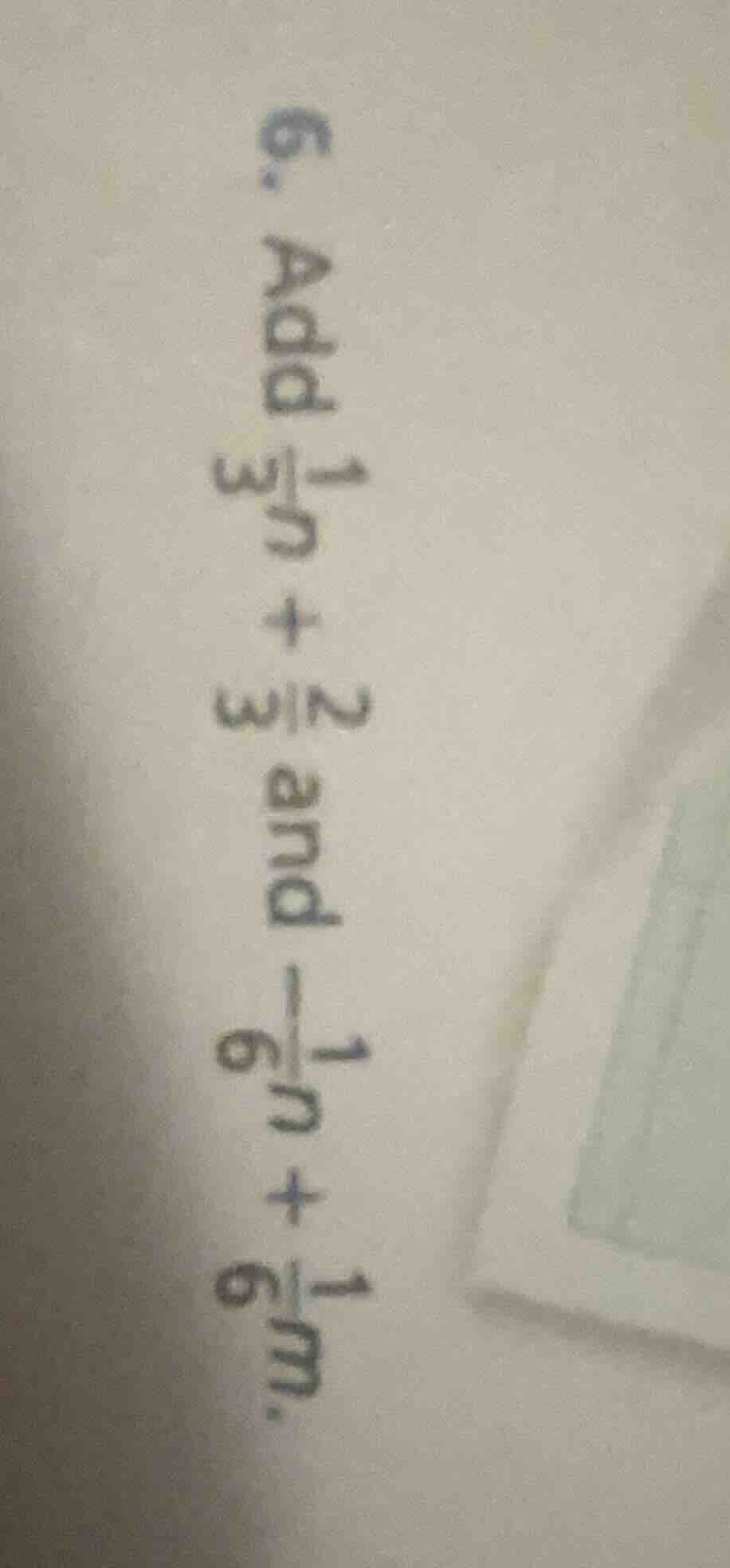
- add $\frac{1}{3}n + \frac{2}{3}$ and $\frac{1}{6}n + \frac{1}{6}m$.
Step1: Identify like terms
We have two expressions: $\frac{1}{3}n + \frac{2}{3}$ and $\frac{1}{6}n + \frac{1}{6}m$. The like terms are the $n$ terms and the constant terms (but there's only one constant term in the first expression, and the second has a $m$ term which is unique). So we add the $n$ terms and the constant terms (and keep the $m$ term as is).
First, add the $n$ terms: $\frac{1}{3}n + \frac{1}{6}n$. To add these, find a common denominator, which is 6. So $\frac{1}{3}n = \frac{2}{6}n$. Then $\frac{2}{6}n + \frac{1}{6}n = \frac{3}{6}n = \frac{1}{2}n$.
Step2: Add the constant terms
Now add the constant terms: $\frac{2}{3} + 0$ (wait, no, the second expression has no constant term, only the first has $\frac{2}{3}$? Wait, no, the second expression is $\frac{1}{6}n + \frac{1}{6}m$, so the constant terms: first expression has $\frac{2}{3}$, second has 0? Wait, no, maybe I misread. Wait the problem is to add $\frac{1}{3}n + \frac{2}{3}$ and $\frac{1}{6}n + \frac{1}{6}m$. So the terms are:
- $n$ terms: $\frac{1}{3}n$ and $\frac{1}{6}n$
- $m$ term: $\frac{1}{6}m$ (only in the second expression)
- constant term: $\frac{2}{3}$ (only in the first expression)
So adding the $n$ terms: $\frac{1}{3}n + \frac{1}{6}n = \frac{2}{6}n + \frac{1}{6}n = \frac{3}{6}n = \frac{1}{2}n$.
Adding the constant term: $\frac{2}{3}$ (since the second expression has no constant term, we just keep it? Wait, no, the second expression is $\frac{1}{6}n + \frac{1}{6}m$, so when we add the two expressions:
$(\frac{1}{3}n + \frac{2}{3}) + (\frac{1}{6}n + \frac{1}{6}m)$
= $\frac{1}{3}n + \frac{1}{6}n + \frac{2}{3} + \frac{1}{6}m$
As we did before, $\frac{1}{3}n = \frac{2}{6}n$, so $\frac{2}{6}n + \frac{1}{6}n = \frac{3}{6}n = \frac{1}{2}n$.
Then the constant term is $\frac{2}{3}$, and the $m$ term is $\frac{1}{6}m$. Wait, but maybe I made a mistake. Wait, the problem says "Add $\frac{1}{3}n + \frac{2}{3}$ and $\frac{1}{6}n + \frac{1}{6}m$". So combining like terms:
For $n$: $\frac{1}{3}n + \frac{1}{6}n = \frac{2}{6}n + \frac{1}{6}n = \frac{3}{6}n = \frac{1}{2}n$
For $m$: $\frac{1}{6}m$ (only in the second expression, so we keep it)
For constants: $\frac{2}{3}$ (only in the first expression, so we keep it)
Wait, but maybe the problem was written as $\frac{1}{3}n + \frac{2}{3}$ and $\frac{1}{6}n + \frac{1}{6}$? Wait, the image shows " $\frac{1}{6}n + \frac{1}{6}m$"? Wait, maybe I misread the second term. Let me check again. The user's image: "Add $\frac{1}{3}n + \frac{2}{3}$ and $\frac{1}{6}n + \frac{1}{6}m$". So that's correct.
Wait, but maybe the problem is to add $\frac{1}{3}n + \frac{2}{3}$ and $\frac{1}{6}n + \frac{1}{6}$ (maybe a typo, $m$ instead of a constant). But assuming the image is correct, with $\frac{1}{6}m$, then the result is $\frac{1}{2}n + \frac{1}{6}m + \frac{2}{3}$.
But maybe I made a mistake. Wait, let's re-express all terms with common denominators.
First expression: $\frac{1}{3}n + \frac{2}{3} = \frac{2}{6}n + \frac{4}{6}$
Second expression: $\frac{1}{6}n + \frac{1}{6}m = \frac{1}{6}n + \frac{1}{6}m + 0$
Now add them:
$\frac{2}{6}n + \frac{4}{6} + \frac{1}{6}n + \frac{1}{6}m$
Combine like terms:
$n$ terms: $\frac{2}{6}n + \frac{1}{6}n = \frac{3}{6}n = \frac{1}{2}n$
$m$ term: $\frac{1}{6}m$
constant term: $\frac{4}{6} = \frac{2}{3}$
So the sum is $\frac{1}{2}n + \frac{1}{6}m + \frac{2}{3}$.
Wait, but maybe the original problem had a typo, and the second term is $\frac{1}{6}n + \frac{1}{6}$ (without $m$). Let's check that case too, in case of a typo.
If the second term is $\frac{1}{6}n + \frac{1}{6}$, then:
Firs…

Snap & solve any problem in the app
Get step-by-step solutions on Sovi AI
Photo-based solutions with guided steps
Explore more problems and detailed explanations
$\frac{1}{2}n + \frac{1}{6}m + \frac{2}{3}$ (or if there was a typo and the second term is $\frac{1}{6}n + \frac{1}{6}$, then $\frac{1}{2}n + \frac{5}{6}$)