QUESTION IMAGE
Question
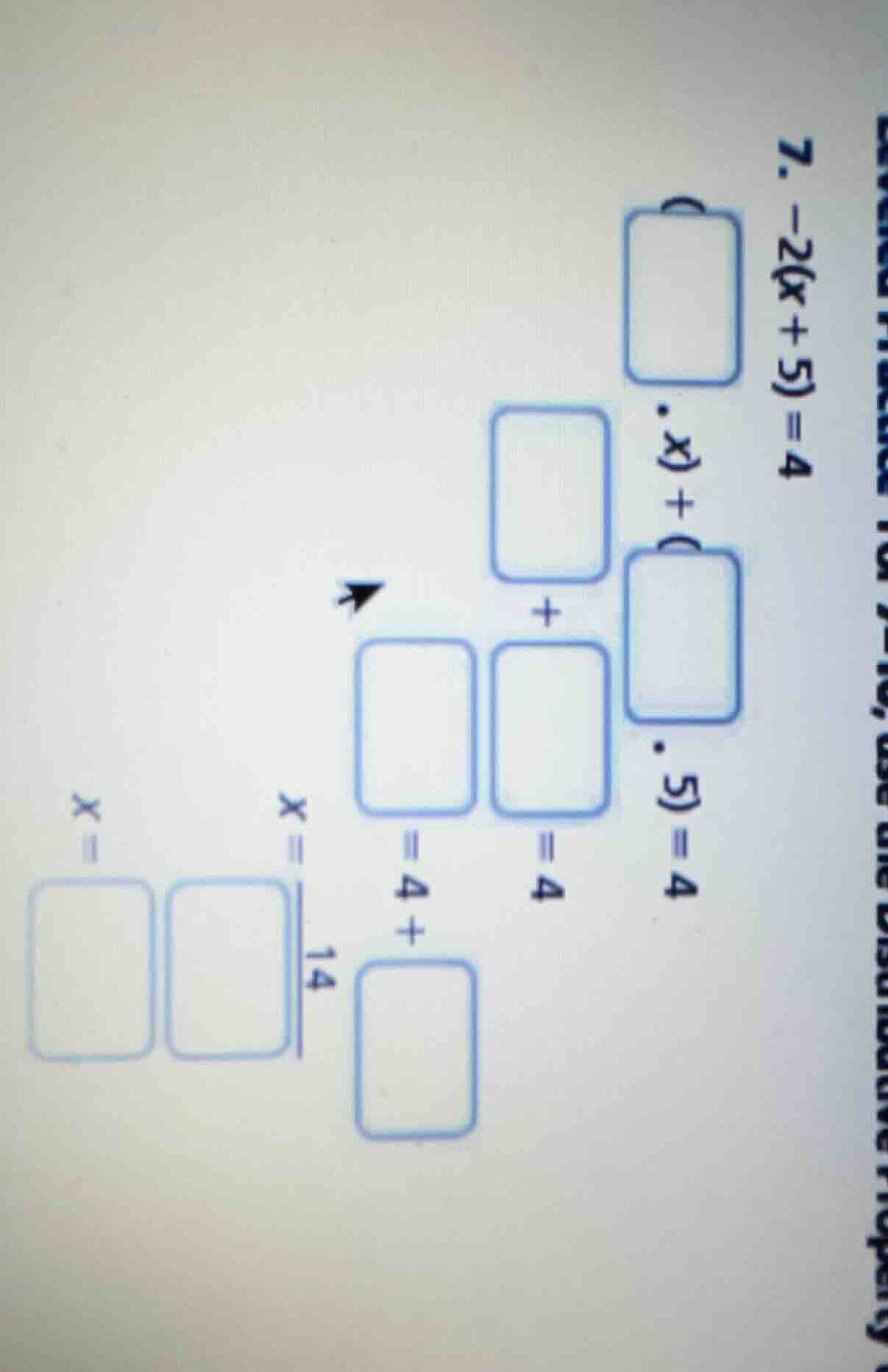
- -2(x + 5) = 4
(□·x) + (□·5) = 4
□ + □ = 4
□ = 4 + □
x = \frac{14}{□}
x = □
Step1: Apply Distributive Property
We use the distributive property \(a(b + c)=ab+ac\). Here \(a = - 2\), \(b=x\) and \(c = 5\). So \(-2(x + 5)=-2\cdot x+(-2)\cdot5\)
\(-2x-10 = 4\)
Step2: Add 10 to Both Sides
To isolate the term with \(x\), we add 10 to both sides of the equation.
\(-2x-10 + 10=4 + 10\)
\(-2x=14\)
Step3: Divide by - 2
Divide both sides of the equation by \(-2\) to solve for \(x\).
\(x=\frac{14}{-2}\)
\(x=-7\)

Snap & solve any problem in the app
Get step-by-step solutions on Sovi AI
Photo-based solutions with guided steps
Explore more problems and detailed explanations
The filled - in steps are: \(-2\) (for the first box), \(-2\) (for the second box), \(-2x-10\) (for the next box), \(10\) (the box after \(4+\)), \(-2x\) (the box above \(\frac{14}{-2}\)), \(-2\) (the denominator box), and the final answer \(x = - 7\) (the last box). The value of \(x\) is \(-7\).