QUESTION IMAGE
Question
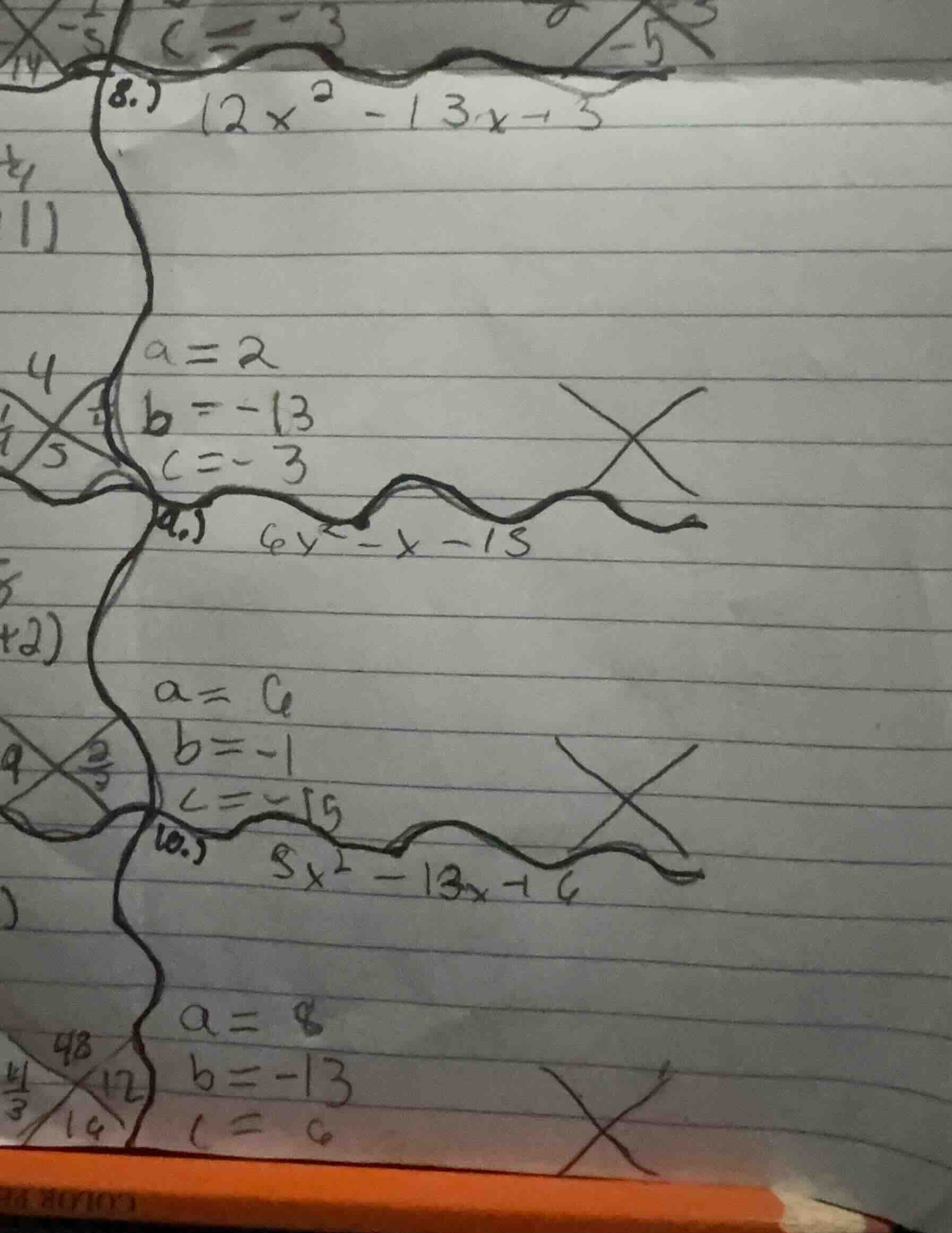
8.) $12x^2 - 13x - 3$
$a = 2$
$b = -13$
$c = -3$
9.) $6y^2 - x - 15$
$a = 6$
$b = -1$
$c = -15$
10.) $8x^2 - 13x + 6$
$a = 8$
$b = -13$
$c = 6$
Let's solve the quadratic equation \(12x^2 - 13x - 3\) (assuming it's to be factored).
Step1: Multiply \(a\) and \(c\)
For \(ax^2 + bx + c\), here \(a = 12\), \(b = -13\), \(c = -3\). Multiply \(a\) and \(c\): \(12\times(-3)= - 36\)
Step2: Find two numbers
Find two numbers that multiply to \(-36\) and add up to \(b=-13\). The numbers are \(-12\) and \( - 1\) (since \(-12\times(-1)=12\)? Wait, no, correction: \( - 18\) and \(2\)? Wait, no, let's recalculate. Wait, \(a = 2\) in the first problem? Wait, the first problem is \(2x^2 - 13x - 3\) (maybe a typo in the image, \(12\) is \(2\)). Let's correct: if \(a = 2\), \(b=-13\), \(c = - 3\). Then \(a\times c=2\times(-3)=-6\). We need two numbers that multiply to \(-6\) and add to \(-13\)? No, that can't be. Wait, maybe the first problem is \(2x^2 - 13x - 3\) is wrong, or maybe factoring by grouping. Wait, let's take the first problem as \(2x^2 - 13x - 3\) (assuming \(a = 2\), \(b=-13\), \(c=-3\)). Then \(a\times c=2\times(-3)=-6\). We need two numbers that multiply to \(-6\) and add to \(-13\)? No, that's not possible. Wait, maybe the first problem is \(12x^2 - 13x - 3\) with \(a = 12\), \(b=-13\), \(c=-3\). Then \(a\times c=12\times(-3)=-36\). We need two numbers that multiply to \(-36\) and add to \(-13\). The numbers are \(-18\) and \(2\) (since \(-18\times2=-36\) and \(-18 + 2=-16\)? No. Wait, \(-12\) and \(3\): \(-12\times3=-36\), \(-12 + 3=-9\). No. Wait, \(-9\) and \(4\): \(-9\times4=-36\), \(-9 + 4=-5\). No. Wait, maybe the first problem is \(2x^2 - 13x - 3\) is incorrect. Alternatively, let's take the second problem: \(6x^2 - x - 15\) (with \(a = 6\), \(b=-1\), \(c=-15\)). Then \(a\times c=6\times(-15)=-90\). We need two numbers that multiply to \(-90\) and add to \(-1\). The numbers are \(-10\) and \(9\) (since \(-10\times9=-90\) and \(-10 + 9=-1\)). Then we rewrite the middle term: \(6x^2 - 10x + 9x - 15\). Group: \((6x^2 - 10x)+(9x - 15)=2x(3x - 5)+3(3x - 5)=(2x + 3)(3x - 5)\).
Wait, let's focus on the first problem as \(2x^2 - 13x - 3\) (assuming \(a = 2\), \(b=-13\), \(c=-3\)). Then \(a\times c=2\times(-3)=-6\). We need two numbers that multiply to \(-6\) and add to \(-13\). There are no such integers, so maybe it's a quadratic formula problem. The quadratic formula is \(x=\frac{-b\pm\sqrt{b^2 - 4ac}}{2a}\). For \(2x^2 - 13x - 3\), \(a = 2\), \(b=-13\), \(c=-3\). Then \(b^2 - 4ac=(-13)^2-4\times2\times(-3)=169 + 24=193\). So \(x=\frac{13\pm\sqrt{193}}{4}\).
But maybe the first problem is \(12x^2 - 13x - 3\) with \(a = 12\), \(b=-13\), \(c=-3\). Then \(b^2 - 4ac=(-13)^2-4\times12\times(-3)=169 + 144=313\). So \(x=\frac{13\pm\sqrt{313}}{24}\).
Since the image is a bit unclear, let's take the first problem as \(2x^2 - 13x - 3\) (with \(a = 2\), \(b=-13\), \(c=-3\)) and solve using quadratic formula:
Step1: Identify \(a\), \(b\), \(c\)
\(a = 2\), \(b=-13\), \(c=-3\)
Step2: Calculate discriminant \(D\)
\(D=b^2 - 4ac=(-13)^2-4\times2\times(-3)=169 + 24=193\)
Step3: Apply quadratic formula
\(x=\frac{-b\pm\sqrt{D}}{2a}=\frac{13\pm\sqrt{193}}{4}\)

Snap & solve any problem in the app
Get step-by-step solutions on Sovi AI
Photo-based solutions with guided steps
Explore more problems and detailed explanations
For \(2x^2 - 13x - 3\), the solutions are \(x=\frac{13 + \sqrt{193}}{4}\) and \(x=\frac{13 - \sqrt{193}}{4}\)