QUESTION IMAGE
Question
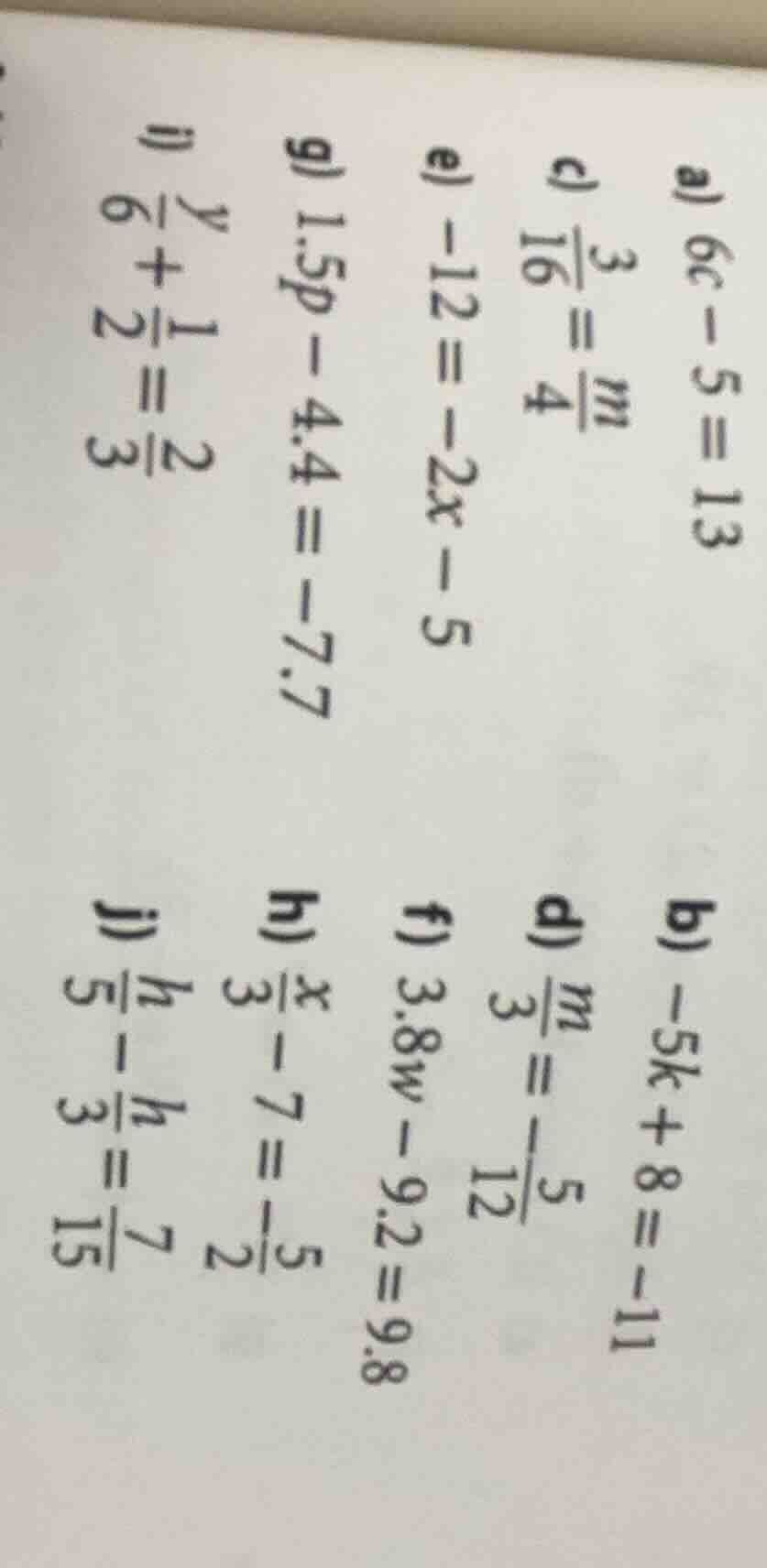
a) $6c - 5 = 13$
b) $-5k + 8 = -11$
c) $\frac{3}{16} = \frac{m}{4}$
d) $\frac{m}{3} = -\frac{5}{12}$
e) $-12 = -2x - 5$
f) $3.8w - 9.2 = 9.8$
g) $1.5p - 4.4 = -7.7$
h) $\frac{x}{3} - 7 = -\frac{5}{2}$
i) $\frac{y}{6} + \frac{1}{2} = \frac{2}{3}$
j) $\frac{h}{5} - \frac{h}{3} = \frac{7}{15}$
Let's solve each equation one by one:
Part a) \( 6c - 5 = 13 \)
Step 1: Add 5 to both sides
To isolate the term with \( c \), we add 5 to both sides of the equation.
\( 6c - 5 + 5 = 13 + 5 \)
Simplifying, we get \( 6c = 18 \)
Step 2: Divide both sides by 6
Now, to solve for \( c \), we divide both sides by 6.
\( \frac{6c}{6} = \frac{18}{6} \)
Simplifying, we find \( c = 3 \)
Part b) \( -5k + 8 = -11 \)
Step 1: Subtract 8 from both sides
To isolate the term with \( k \), we subtract 8 from both sides.
\( -5k + 8 - 8 = -11 - 8 \)
Simplifying, we get \( -5k = -19 \)
Step 2: Divide both sides by -5
Now, to solve for \( k \), we divide both sides by -5.
\( k = \frac{-19}{-5} = \frac{19}{5} = 3.8 \)
Part c) \( \frac{3}{16} = \frac{m}{4} \)
Step 1: Cross - multiply
We can cross - multiply to solve for \( m \). Cross - multiplying gives us \( 16m = 3\times4 \)
Step 2: Simplify and solve for \( m \)
Simplify the right - hand side: \( 16m = 12 \)
Then divide both sides by 16: \( m=\frac{12}{16}=\frac{3}{4} \)
Part d) \( \frac{m}{3}=-\frac{5}{12} \)
Step 1: Multiply both sides by 3
To solve for \( m \), we multiply both sides of the equation by 3.
\( m = -\frac{5}{12}\times3 \)
Step 2: Simplify
Simplify the right - hand side: \( m = -\frac{5}{4}=-1.25 \)
Part e) \( - 12=-2x - 5 \)
Step 1: Add 5 to both sides
To isolate the term with \( x \), we add 5 to both sides.
\( -12 + 5=-2x-5 + 5 \)
Simplifying, we get \( -7=-2x \)
Step 2: Divide both sides by - 2
Now, to solve for \( x \), we divide both sides by - 2.
\( x=\frac{-7}{-2}=\frac{7}{2} = 3.5 \)
Part f) \( 3.8w-9.2 = 9.8 \)
Step 1: Add 9.2 to both sides
To isolate the term with \( w \), we add 9.2 to both sides.
\( 3.8w-9.2 + 9.2=9.8 + 9.2 \)
Simplifying, we get \( 3.8w = 19 \)
Step 2: Divide both sides by 3.8
Now, to solve for \( w \), we divide both sides by 3.8.
\( w=\frac{19}{3.8}=5 \)
Part g) \( 1.5p-4.4=-7.7 \)
Step 1: Add 4.4 to both sides
To isolate the term with \( p \), we add 4.4 to both sides.
\( 1.5p-4.4 + 4.4=-7.7 + 4.4 \)
Simplifying, we get \( 1.5p=-3.3 \)
Step 2: Divide both sides by 1.5
Now, to solve for \( p \), we divide both sides by 1.5.
\( p=\frac{-3.3}{1.5}=-2.2 \)
Part h) \( \frac{x}{3}-7 = -\frac{5}{2} \)
Step 1: Add 7 to both sides
To isolate the term with \( x \), we add 7 to both sides.
\( \frac{x}{3}-7 + 7=-\frac{5}{2}+7 \)
Simplify the right - hand side: \( -\frac{5}{2}+\frac{14}{2}=\frac{9}{2} \)
So, \( \frac{x}{3}=\frac{9}{2} \)
Step 2: Multiply both sides by 3
Now, to solve for \( x \), we multiply both sides by 3.
\( x=\frac{9}{2}\times3=\frac{27}{2}=13.5 \)
Part i) \( \frac{y}{6}+\frac{1}{2}=\frac{2}{3} \)
Step 1: Subtract \(\frac{1}{2}\) from both sides
To isolate the term with \( y \), we subtract \(\frac{1}{2}\) from both sides.
\( \frac{y}{6}+\frac{1}{2}-\frac{1}{2}=\frac{2}{3}-\frac{1}{2} \)
Find a common denominator for the right - hand side, which is 6.
\( \frac{4}{6}-\frac{3}{6}=\frac{1}{6} \)
So, \( \frac{y}{6}=\frac{1}{6} \)
Step 2: Multiply both sides by 6
Now, to solve for \( y \), we multiply both sides by 6.
\( y = 1 \)
Part j) \( \frac{h}{5}-\frac{h}{3}=\frac{7}{15} \)
Step 1: Find a common denominator for the left - hand side
The common denominator of 5 and 3 is 15.
\( \frac{3h}{15}-\frac{5h}{15}=\frac{7}{15} \)
Simplify the left - hand side: \( \frac{3h - 5h}{15}=\frac{-2h}{15} \)
So, \( \frac{-2h}{15}=\frac{7}{15} \)
Step 2: Multiply both sides by 15
Multiply both sides by 15 to get rid of the denominators.
\( - 2h=7 \)…

Snap & solve any problem in the app
Get step-by-step solutions on Sovi AI
Photo-based solutions with guided steps
Explore more problems and detailed explanations
Let's solve each equation one by one:
Part a) \( 6c - 5 = 13 \)
Step 1: Add 5 to both sides
To isolate the term with \( c \), we add 5 to both sides of the equation.
\( 6c - 5 + 5 = 13 + 5 \)
Simplifying, we get \( 6c = 18 \)
Step 2: Divide both sides by 6
Now, to solve for \( c \), we divide both sides by 6.
\( \frac{6c}{6} = \frac{18}{6} \)
Simplifying, we find \( c = 3 \)
Part b) \( -5k + 8 = -11 \)
Step 1: Subtract 8 from both sides
To isolate the term with \( k \), we subtract 8 from both sides.
\( -5k + 8 - 8 = -11 - 8 \)
Simplifying, we get \( -5k = -19 \)
Step 2: Divide both sides by -5
Now, to solve for \( k \), we divide both sides by -5.
\( k = \frac{-19}{-5} = \frac{19}{5} = 3.8 \)
Part c) \( \frac{3}{16} = \frac{m}{4} \)
Step 1: Cross - multiply
We can cross - multiply to solve for \( m \). Cross - multiplying gives us \( 16m = 3\times4 \)
Step 2: Simplify and solve for \( m \)
Simplify the right - hand side: \( 16m = 12 \)
Then divide both sides by 16: \( m=\frac{12}{16}=\frac{3}{4} \)
Part d) \( \frac{m}{3}=-\frac{5}{12} \)
Step 1: Multiply both sides by 3
To solve for \( m \), we multiply both sides of the equation by 3.
\( m = -\frac{5}{12}\times3 \)
Step 2: Simplify
Simplify the right - hand side: \( m = -\frac{5}{4}=-1.25 \)
Part e) \( - 12=-2x - 5 \)
Step 1: Add 5 to both sides
To isolate the term with \( x \), we add 5 to both sides.
\( -12 + 5=-2x-5 + 5 \)
Simplifying, we get \( -7=-2x \)
Step 2: Divide both sides by - 2
Now, to solve for \( x \), we divide both sides by - 2.
\( x=\frac{-7}{-2}=\frac{7}{2} = 3.5 \)
Part f) \( 3.8w-9.2 = 9.8 \)
Step 1: Add 9.2 to both sides
To isolate the term with \( w \), we add 9.2 to both sides.
\( 3.8w-9.2 + 9.2=9.8 + 9.2 \)
Simplifying, we get \( 3.8w = 19 \)
Step 2: Divide both sides by 3.8
Now, to solve for \( w \), we divide both sides by 3.8.
\( w=\frac{19}{3.8}=5 \)
Part g) \( 1.5p-4.4=-7.7 \)
Step 1: Add 4.4 to both sides
To isolate the term with \( p \), we add 4.4 to both sides.
\( 1.5p-4.4 + 4.4=-7.7 + 4.4 \)
Simplifying, we get \( 1.5p=-3.3 \)
Step 2: Divide both sides by 1.5
Now, to solve for \( p \), we divide both sides by 1.5.
\( p=\frac{-3.3}{1.5}=-2.2 \)
Part h) \( \frac{x}{3}-7 = -\frac{5}{2} \)
Step 1: Add 7 to both sides
To isolate the term with \( x \), we add 7 to both sides.
\( \frac{x}{3}-7 + 7=-\frac{5}{2}+7 \)
Simplify the right - hand side: \( -\frac{5}{2}+\frac{14}{2}=\frac{9}{2} \)
So, \( \frac{x}{3}=\frac{9}{2} \)
Step 2: Multiply both sides by 3
Now, to solve for \( x \), we multiply both sides by 3.
\( x=\frac{9}{2}\times3=\frac{27}{2}=13.5 \)
Part i) \( \frac{y}{6}+\frac{1}{2}=\frac{2}{3} \)
Step 1: Subtract \(\frac{1}{2}\) from both sides
To isolate the term with \( y \), we subtract \(\frac{1}{2}\) from both sides.
\( \frac{y}{6}+\frac{1}{2}-\frac{1}{2}=\frac{2}{3}-\frac{1}{2} \)
Find a common denominator for the right - hand side, which is 6.
\( \frac{4}{6}-\frac{3}{6}=\frac{1}{6} \)
So, \( \frac{y}{6}=\frac{1}{6} \)
Step 2: Multiply both sides by 6
Now, to solve for \( y \), we multiply both sides by 6.
\( y = 1 \)
Part j) \( \frac{h}{5}-\frac{h}{3}=\frac{7}{15} \)
Step 1: Find a common denominator for the left - hand side
The common denominator of 5 and 3 is 15.
\( \frac{3h}{15}-\frac{5h}{15}=\frac{7}{15} \)
Simplify the left - hand side: \( \frac{3h - 5h}{15}=\frac{-2h}{15} \)
So, \( \frac{-2h}{15}=\frac{7}{15} \)
Step 2: Multiply both sides by 15
Multiply both sides by 15 to get rid of the denominators.
\( - 2h=7 \)
Step 3: Divide both sides by - 2
Now, to solve for \( h \), we divide both sides by - 2.
\( h=-\frac{7}{2}=-3.5 \)
Final Answers:
a) \( c = 3 \)
b) \( k=\frac{19}{5}=3.8 \)
c) \( m=\frac{3}{4} \)
d) \( m = -\frac{5}{4}=-1.25 \)
e) \( x=\frac{7}{2}=3.5 \)
f) \( w = 5 \)
g) \( p=-2.2 \)
h) \( x=\frac{27}{2}=13.5 \)
i) \( y = 1 \)
j) \( h=-\frac{7}{2}=-3.5 \)