QUESTION IMAGE
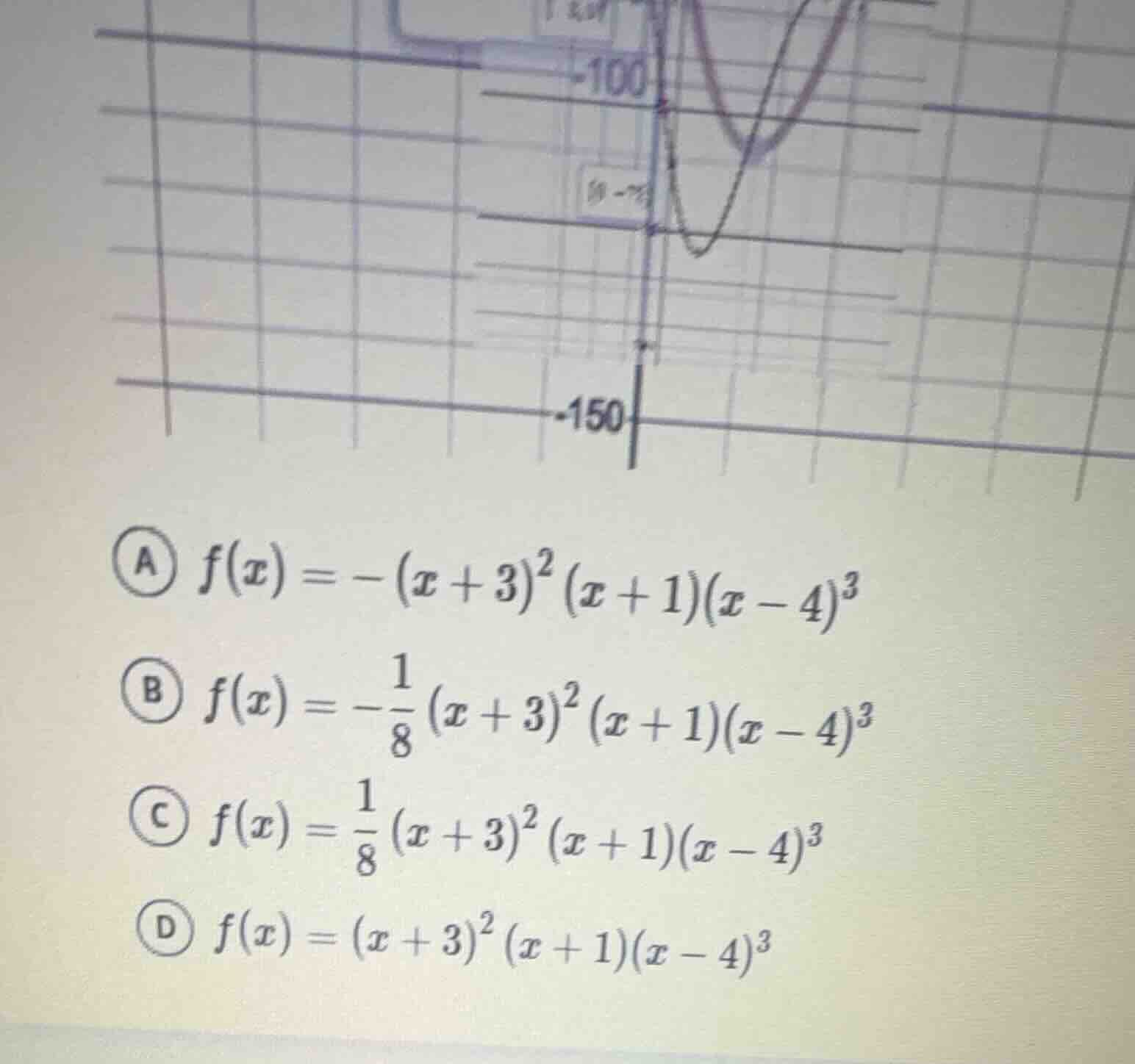
Question
a $f(x) = -(x+3)^2(x+1)(x-4)^3$
b $f(x) = -\frac{1}{8}(x+3)^2(x+1)(x-4)^3$
c $f(x) = \frac{1}{8}(x+3)^2(x+1)(x-4)^3$
d $f(x) = (x+3)^2(x+1)(x-4)^3$
Step1: Identify end behavior
As $x\to+\infty$, the graph rises (goes to $+\infty$). For a polynomial $f(x)=a_nx^n$, the degree here is $2+1+3=6$ (even). For even degree, if $a_n>0$, $x\to+\infty$ gives $f(x)\to+\infty$; if $a_n<0$, $f(x)\to-\infty$. So the leading coefficient must be positive, eliminating options A and B.
Step2: Use y-intercept to test
The y-intercept is when $x=0$. Calculate $f(0)$ for remaining options:
For option C: $f(0)=\frac{1}{8}(0+3)^2(0+1)(0-4)^3=\frac{1}{8}\times9\times1\times(-64)=\frac{1}{8}\times(-576)=-72$
For option D: $f(0)=(0+3)^2(0+1)(0-4)^3=9\times1\times(-64)=-576$
From the graph, the y-intercept is around -72, matching option C.

Snap & solve any problem in the app
Get step-by-step solutions on Sovi AI
Photo-based solutions with guided steps
Explore more problems and detailed explanations
C. $f(x)=\frac{1}{8}(x+3)^2(x+1)(x-4)^3$