QUESTION IMAGE
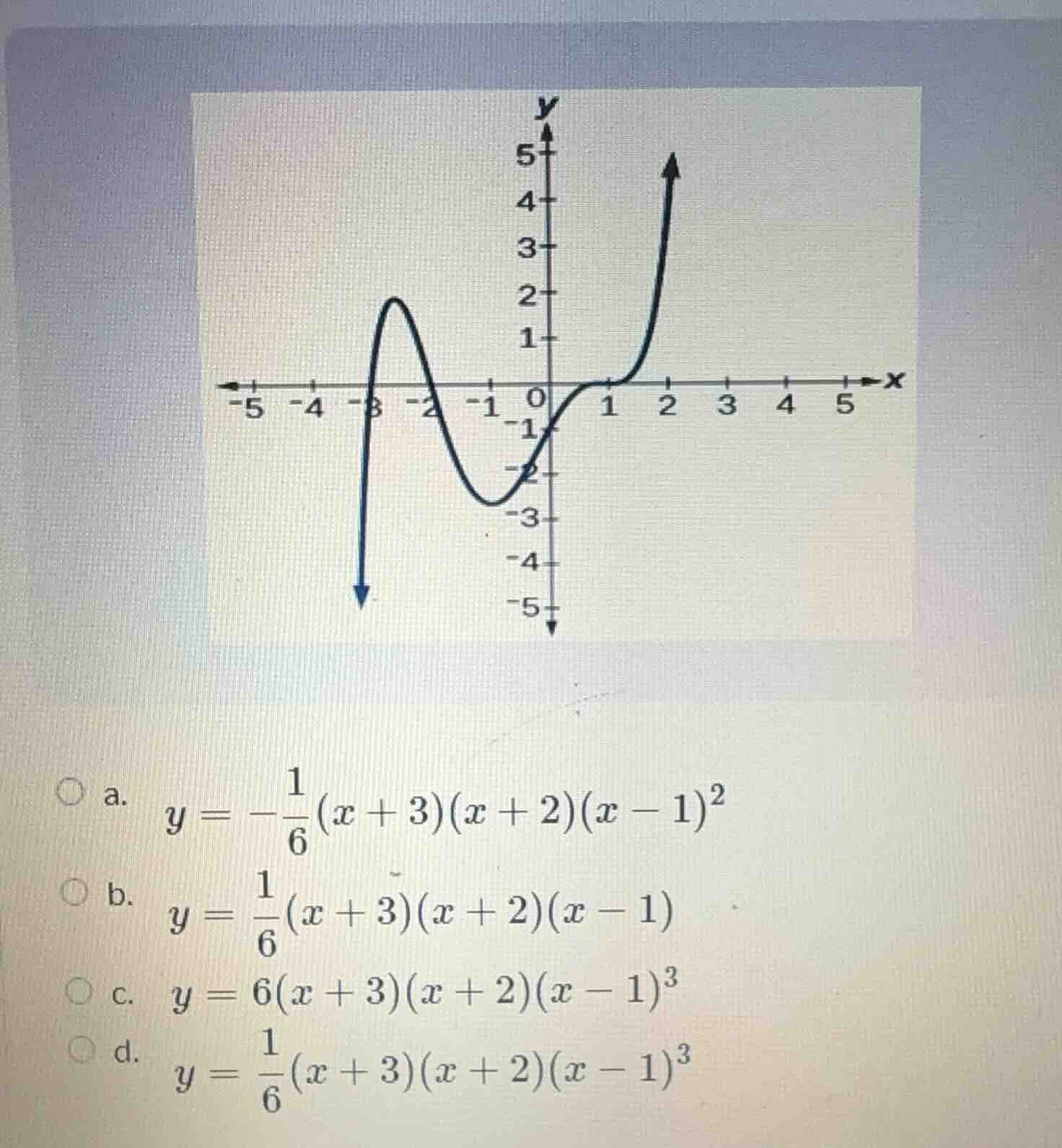
Question
a. $y = -\frac{1}{6}(x + 3)(x + 2)(x - 1)^2$
b. $y = \frac{1}{6}(x + 3)(x + 2)(x - 1)$
c. $y = 6(x + 3)(x + 2)(x - 1)^3$
d. $y = \frac{1}{6}(x + 3)(x + 2)(x - 1)^3$
Step1: Identify x-intercepts
From the graph, the x-intercepts are $x=-3$, $x=-2$, and $x=1$ (with a touch at $x=1$, meaning even multiplicity, or a cubic "flat pass" which is odd multiplicity but higher order; we check end behavior next).
Step2: Check end behavior
As $x\to+\infty$, $y\to+\infty$; as $x\to-\infty$, $y\to-\infty$. This means the leading coefficient is positive, and the degree is odd.
Step3: Match degree and intercepts
- Option a: Degree $1+1+2=4$ (even, invalid, since end behavior matches odd degree).
- Option b: Degree $1+1+1=3$ (odd), but $x=1$ is a single root (graph would cross, not touch/flat pass, invalid).
- Option c: Leading coefficient 6 (positive), but when $x=0$, $y=6(3)(2)(-1)^3=-36$, which does not match the graph's $y$-value near 0 (graph has $y\approx-1$ at $x=0$, invalid).
- Option d: Degree $1+1+3=5$ (odd, matches end behavior). $x=1$ has multiplicity 3 (graph flattens then crosses, matches the plot). Calculate $x=0$: $y=\frac{1}{6}(3)(2)(-1)^3=\frac{1}{6}(-6)=-1$, which matches the graph's $y$-value at $x=0$.

Snap & solve any problem in the app
Get step-by-step solutions on Sovi AI
Photo-based solutions with guided steps
Explore more problems and detailed explanations
d. $y = \frac{1}{6}(x + 3)(x + 2)(x - 1)^3$