QUESTION IMAGE
Question
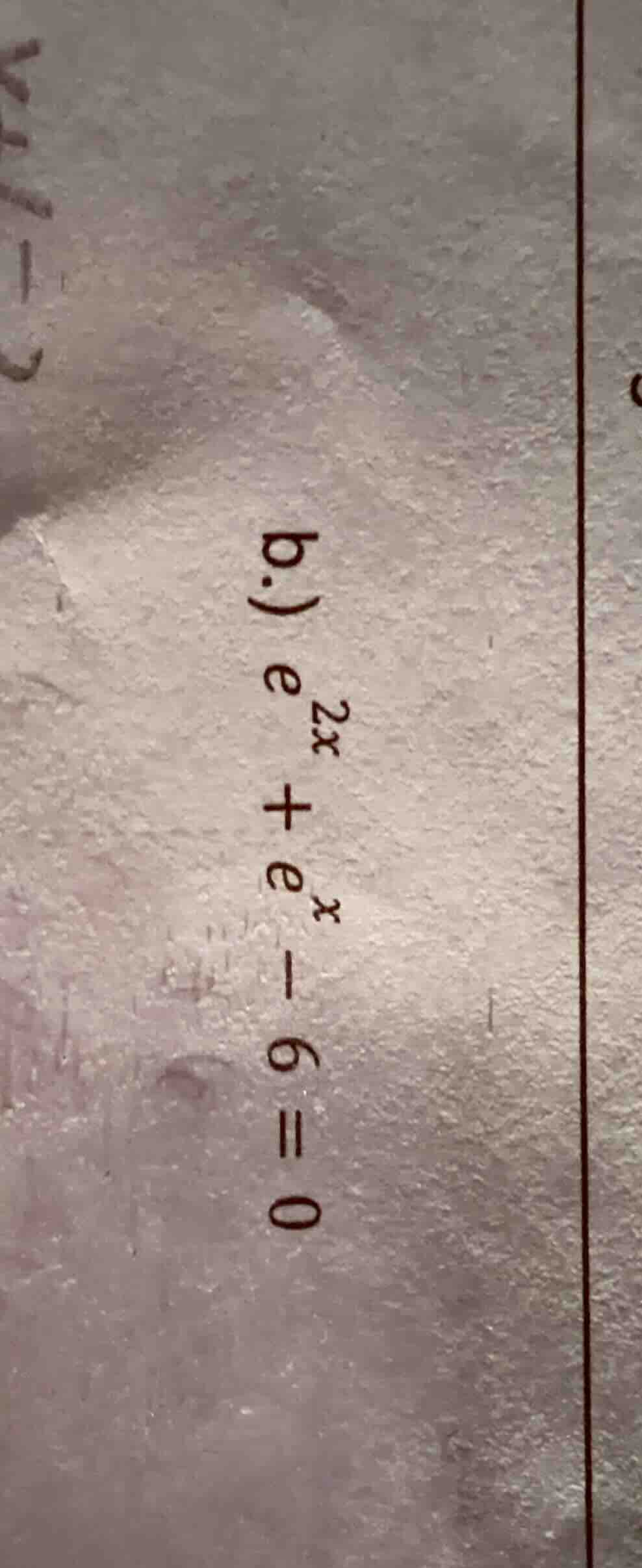
b.) $e^{2x} + e^{x} - 6 = 0$
Step1: Substitute \( y = e^x \)
Let \( y = e^x \), then \( e^{2x}=(e^x)^2 = y^2 \). The equation \( e^{2x}+e^x - 6 = 0 \) becomes \( y^2 + y - 6 = 0 \).
Step2: Solve the quadratic equation
For the quadratic equation \( y^2 + y - 6 = 0 \), we factor it as \( (y + 3)(y - 2)=0 \). So \( y+3 = 0 \) or \( y - 2 = 0 \), which gives \( y=-3 \) or \( y = 2 \).
Step3: Substitute back \( y = e^x \)
Since \( y = e^x \), for \( y=-3 \), \( e^x=-3 \) has no real solutions because the exponential function \( e^x>0 \) for all real \( x \). For \( y = 2 \), we have \( e^x=2 \), then \( x=\ln 2 \) (taking the natural logarithm of both sides).

Snap & solve any problem in the app
Get step-by-step solutions on Sovi AI
Photo-based solutions with guided steps
Explore more problems and detailed explanations
\( x = \ln 2 \)