QUESTION IMAGE
Question
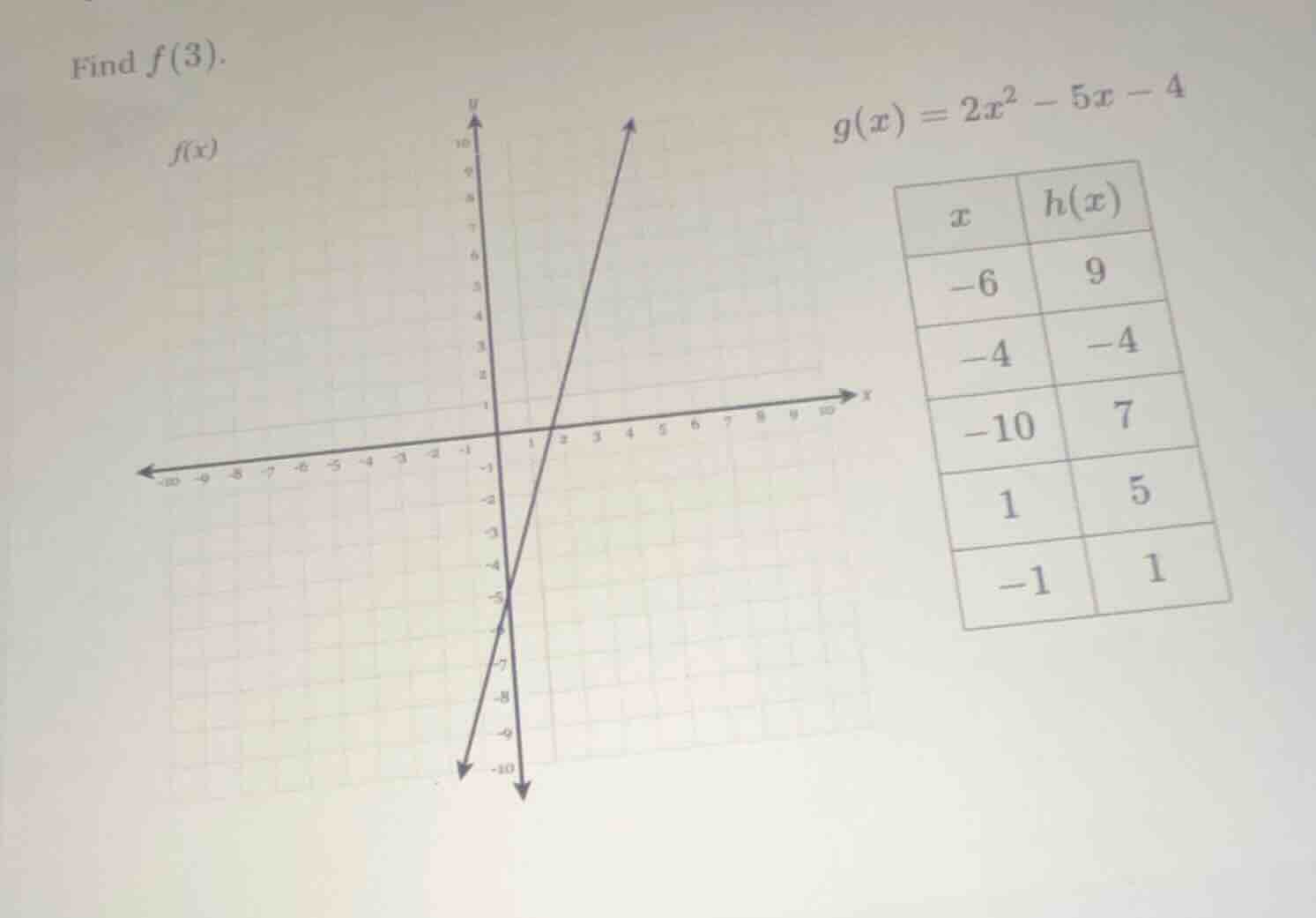
find $f(3)$.
$f(x)$
$g(x) = 2x^2 - 5x - 4$
$\
$
Step1: Identify the graph of \( f(x) \)
The graph of \( f(x) \) is the one with the negative slope (the one going downwards from left to right initially and then upwards? Wait, no, looking at the graph, the two lines: one with positive slope (going up) and one with negative slope (going down). Wait, the problem says "Find \( f(3) \)", so we need to look at the graph of \( f(x) \). Let's assume the graph of \( f(x) \) is the line that we can use to find \( f(3) \) by plugging \( x = 3 \) into its equation or by reading from the graph. Wait, maybe the graph of \( f(x) \) is the line with the equation? Wait, no, let's check the coordinates. Wait, maybe the two lines: let's see, when \( x = 3 \), we need to find the \( y \)-value of \( f(x) \) at \( x = 3 \). Wait, maybe the graph of \( f(x) \) is the line that passes through some points. Wait, alternatively, maybe the graph of \( f(x) \) is the line with the negative slope? Wait, no, let's think again. Wait, the problem is to find \( f(3) \), so we need to look at the graph of \( f(x) \) and find the \( y \)-coordinate when \( x = 3 \).
Wait, maybe the graph of \( f(x) \) is the line that we can see: let's check the grid. Each square is 1 unit. So when \( x = 3 \), we look at the graph of \( f(x) \). Wait, maybe the two lines: one is \( f(x) \) and one is another function. Wait, the graph of \( f(x) \) – let's see, when \( x = 0 \), \( f(0) = -5 \) (since it crosses the y-axis at -5). Then, let's find the slope. Wait, maybe the other line is \( g(x) \), but no, the problem is about \( f(x) \). Wait, maybe the graph of \( f(x) \) is the line with the negative slope? Wait, no, let's check the coordinates. Wait, when \( x = 3 \), let's see the graph. Wait, maybe the answer is obtained by looking at the graph: when \( x = 3 \), the \( y \)-value of \( f(x) \) is... Wait, maybe I made a mistake. Wait, alternatively, maybe the graph of \( f(x) \) is the line that we can use to find \( f(3) \). Wait, let's assume that the graph of \( f(x) \) is the line with the equation, but maybe it's a linear function. Let's check two points. For example, when \( x = 0 \), \( f(0) = -5 \). When \( x = 1 \), what's \( f(1) \)? Wait, maybe the other line is \( g(x) \), but no. Wait, maybe the graph of \( f(x) \) is the line that goes through (0, -5) and (2, -1)? Wait, no, maybe not. Wait, alternatively, maybe the answer is 1? No, wait, let's look at the graph again. Wait, the problem is to find \( f(3) \), so we need to look at the graph of \( f(x) \) and find the \( y \)-coordinate when \( x = 3 \). Let's check the grid: each x and y is 1 unit. So when \( x = 3 \), moving up or down on the graph of \( f(x) \). Wait, maybe the graph of \( f(x) \) is the line with the negative slope? Wait, no, maybe the positive slope? Wait, no, the two lines: one is \( f(x) \) (negative slope) and one is \( g(x) \) (positive slope). Wait, when \( x = 3 \), the \( y \)-value of \( f(x) \) – let's see, if we look at the graph, when \( x = 3 \), the point on \( f(x) \) is... Wait, maybe I'm overcomplicating. Wait, maybe the answer is 1? No, wait, let's check the graph again. Wait, the graph of \( f(x) \) – let's see, when \( x = 3 \), the \( y \)-coordinate is 1? No, wait, maybe not. Wait, alternatively, maybe the graph of \( f(x) \) is the line that we can use to find \( f(3) \) by plugging into its equation. Wait, let's assume that \( f(x) \) is a linear function. Let's find its equation. Let's take two points: when \( x = 0 \), \( f(0) = -5 \) (y-intercept). When \( x = 2 \), what's \( f(2) \)? Wait, maybe the other line…

Snap & solve any problem in the app
Get step-by-step solutions on Sovi AI
Photo-based solutions with guided steps
Explore more problems and detailed explanations
\( \boxed{1} \)